Question
Explain with suitable examples importance of anatomical evidences in evolution.
###
Explain the importance of Anatomical evidences with examples.

Answer

i. Anatomical evidences are the similarities in structures and anatomy between different organisms.
ii. The hand of human, foreleg of ox, flipper of whale and forelimbs of bat appear different superficially or morphologically.
iii. Also, the function of these structures is different in different animals.
iv. However, there is a similarity in the structure of bones and bony joints in the organs of these animals.
v. These similarities indicate that the animals evolved from a common ancestor thus providing proof of evolution.

Need a full question paper?

Generate a complete, print-ready paper with questions like this in minutes — across 16+ boards, with answer keys.
Start Generating Free

Similar questions

A ray of light travelling in air is incident on a rectangular glass block and emerges out into the air from the opposite face. Draw a labelled ray diagram to show the complete path of this ray of light. Mark the two points where the refraction of light takes place. What can you say about the final direction of ray of light?
An object of height 4.25mm is placed at a distance of 10cm from a convex lens of power +5D. Find:
  1. Focal length of the lens, and
  2. Size of the image.
What is Newlands’ law of octaves? Explain with an example.
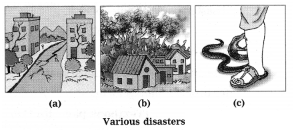
Following are some pictures of disasters. Which precautions would you take during those disasters?
Image
What is meant by dominant genes and recessive genes? Give one example of each.
Write the name of the atom having the smallest size.
The electronic configurations of three elements A, B and C are as follows:
A 2, 8, 1
B 2, 8, 7
C 2, 4
  1. Which of these elements is a metal?
  2. Which of these elements are non-metals?
  3. Which two elements will combine to form an ionic bond?
  4. Which two elements will combine to form a covalent bond?
  5. Which element will form an anion of valency 1?
Observe the following figure and answer the questions:
Image
i. Identify the process shown in the figure.
ii. Explain the process in short.
If a convex lens of focal length 20 cm and a concave lens of focal length 30 cm are kept in contact with each other, (i) What will be the focal length of the combination? (ii) What will be the power of the combination? (iii) What will be the behaviour of the combination?
Write the answer of the question with reference to laws of gravitation.
State the universal law of gravitation.