Explain with the help of a diagram, why the concave lens is also called a diverging lens.
Download our app for free and get started
A concave lens is known as diverging lens because it diverges the parallel rays of light passing through it.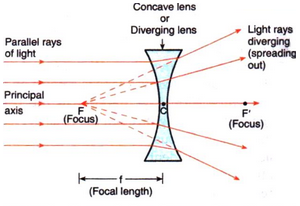

Download our appand get started for free
Experience the future of education. Simply download our apps or reach out to us for more information. Let's shape the future of learning together!No signup needed.*
Similar Questions
- 1View Solution“A ray of light incident on a rectangular glass slab immersed in any medium emerges parallel to itself.” Draw labeled ray diagram to justify this statement.
- 2View SolutionA doctor has prescribed a corrective lens of power +1.5 D. Find the focal length of the lens. Is the prescribed lens diverging or converging?
- 3View Solution
Explain how to read the following message which was found on some blotting paper:

- 4View SolutionExplain what is meant by a virtual, magnified image.
- 5View SolutionThe lens A produces a magnification of, -0.6 whereas lens B produces a magnification of +0.6:
- What is the nature of lens A?
- What is the nature of lens B?
- 6View SolutionThe optician’s prescription for a spectacle lens is marked +0.5D. What is the:
- Nature of spectacle lens?
- Focal length of spectacle lens?
- 7View SolutionList two possible ways in which a concave mirror can produce a magnified image of an object placed in front of it. State the difference, if any, between these two images.
- 8View SolutionWhat is the difference between a real image and a virtual image? Give one example of each type of image.
- 9View SolutionA student focuses the image of a well illuminated distant object on a screen using a convex lens. After that he gradually moves the object towards the lens and each time focuses its image on the screen by adjusting the lens.
- In which direction-towards the screen or away from the screen, does he move the lens?
- What happens to the size of the image-does it decrease or increase?
- What happens to the image on the screen when he moves the object very close to the lens?
- 10View SolutionAn object is placed at the following distance from a convex lens of focal length 15cm:
- 35cm
- 30cm
- 20cm
- 10cm
- A magnified real image?
- A magnified virtual image?
- A diminished real image?
- An image of same size as the object?