Question
Explain with the help of one example how genetically modified plants can:
  1. Reduce usage of chemical pesticides.
  2. Enhance nutritional value of food crops.

Answer

  1. Reduce usage of chemical pesticides: Bt toxin is produced by a bacterium called Bacillus thuringiensis (Bt for short). Bt toxin gene has been cloned from the bacteria and been expressed in plants to provide resistance to insects without the need for insecticides; in effect created a bio-pesticide. Examples are Bt cotton, Bt com, rice, tomato, potato and soyabean etc.
  2. Enhance nutritional value of food crops: Golden rice is the transgenic variety of basmati rice which gives high yield and rich in vitamin A, so it is used in the deficiency of vitamin-A causing night blindness and skin disorder.

Need a full question paper?

Generate a complete, print-ready paper with questions like this in minutes — across 16+ boards, with answer keys.
Start Generating Free

Similar questions

(a) IVF is a very powerful method these days that is helping childless couples to bear a child. Describe the different steps that are carried out in this technique.
(b) Would you consider Gamete Intrafallopian transfer (GIFT) as on IVF? Give a reason in support of your answer.
Answer the following questions:
When and where does spermatogenesis occur in a human male?
Answer the following questions:
Draw a Graafian follicle and label antrum and secondary oocyte.
Name three species of fungi that cause ringworm. Mention the symptoms of this disease?
Explain the Megasporogenesis in flowering plants with the help of diagram.
Study the following flow chart. Name the hormones involved at each stage. Explain their functions.
Hypothalamus → Pituitary → Testes → Sperms.
  1. State the law of independent assortment.
  2. Using Punnett Square demonstrate the law of independent assortment in a dihybrid cross involving two heterozygous parents.
Explain the various types of interactions between species.
A true breeding pea plant homozygous for axial violet flowers is crossed with another pea plant with terminal white flowers (aavv).
Give the phenotypic ratio of F2 generation.
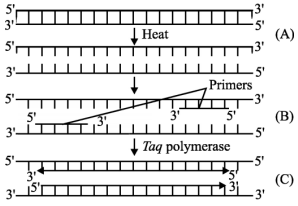
The melding of a technique for repeated rounds of DNA synthesis with the discovery of a thermostable DNA polymerase has given scientists the very powerful technique known as polymerase chain reaction (PCR). PCR is based on three simple steps required for any DNA synthesis reaction: (1) denaturation of the template into single strands; (2) annealing of primers to each original strand for new strand synthesis; and (3) extension of the new DNA strands from the primers.
In the given figure, one cycle of polymerase chain reaction (PCR) is shown:
Image
i. Name the steps A, B and C.
ii. Give the purpose of each of these steps.
iii. State the contribution of Thermus aquaticus in this process.