Electric Current Through Conductors — Physics STD 11 Science — Question
Maharashtra BoardEnglish MediumSTD 11 SciencePhysicsElectric Current Through Conductors4 Marks
Question
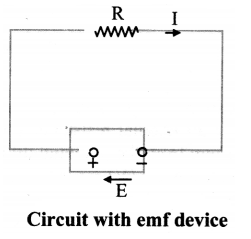
Explain working of a circuit when connected to emf device.
✓
Answer
i. A circuit is formed with connecting an emf device and a resistor R. Flere, the emf device keeps the positive terminal (+) at a higher electric potential than the negative terminal (-)
ii. The emf is represented by an arrow from the negative terminal to the positive terminal. iii. When the circuit is open, there is no net flow of charge carriers within the device. iv. When connected in a circuit, the positive charge carriers move towards the positive terminal which acts as cathode inside the emf device. v. Thus, the positive charge carriers move from the region of lower potential energy, to the region of higher potential energy. vi. Consider a charge dq flowing through the cross section of the circuit in time dt. vii. Since, same amount of charge dq flows throughout the circuit, including the emf device. Hence, the device must do work dW on the charge dq, so that the charge enters the negative terminal (low potential terminal) and leaves the positive terminal (higher potential terminal). viii. Therefore, e.m.f. of the emf device is, $E =\frac{d W}{d q}$ The SI unit of emf is joule/coulomb (J/C).
Need a full question paper?
Generate a complete, print-ready paper with questions like this in minutes — across 16+ boards, with answer keys.