Question
Explain Yukawa's Principle for the origin of nuclear forces.

Answer

Yukawa's Theory for the Origin of Nuclear Forces : In 1935, Japanese scientist Yukawa attributed the origin of these forces to a new particle called 'π-meson' which, later on, was discovered experimentally in cosmic rays. The rest mass of a π-meson is a little more than the rest mass of electron but less than the mass of proton or neutron. Mesons are of three types, positively charged, negatively charged and uncharged $\left(\pi^{+}, \pi^{-}, \pi^0\right)$. The magnitude of charge on a charged meson is equal to electronic charge. According to Yukawa, there is a cloud of π-mesons around every nucleon (proton and neutron). The difference between proton and neutron is only due to different structures of meson clouds around them. There is a continuous exchange of π-mesons between protons and neutrons due to which they continue to be converted into one another.
According to Yukawa, when a proton and a neutron interact, the proton emits a positively charged π-meson which is absorbed by the neutron. As a result, the proton is converted into neutron and the neutron is converted into proton:
$p - \pi^{+} \rightarrow n; n + \pi^{+} \rightarrow p$
Similarly, when a neutron emits a negatively charged π-meson which is absorbed by a proton, then the neutron is converted into proton and proton is converted into neutron:
$n-\pi^{+} \rightarrow p ; p+\pi^{-} \rightarrow n$
The exchange of $\pi^{-}$ and $\pi^{+}$ mesons between protons and neutrons is responsible for the origin of nuclear forces between them. Similarly, nuclear forces between two protons and between two neutrons are generated by a continuous exchange of $\pi^{0}$-mesons between them. Thus, the basis of nuclear forces is the exchange of mesons and hence these are also called 'exchange forces'.
Since mesons are continuously moving between the nucleons, so their mass is not added to the mass of the nucleus.

Need a full question paper?

Generate a complete, print-ready paper with questions like this in minutes — across 16+ boards, with answer keys.
Start Generating Free

Similar questions

A converging lens and a diverging mirror are placed at a separation of 15cm. The focal length of the lens is 25cm and that of the mirror is 40cm. Where should a point source be placed between the lens and the mirror so that the light, after getting reflected by the mirror and then getting transmitted by the lens, comes out parallel to the principal axis?
When a photon is emitted from an atom, the atom recoils. The kinetic energy of recoil and the energy of the photon come from the difference in energies between the states involved in the transition. Suppose, a hydrogen atom changes its state from n = 3 to n = 2. Calculate the fractional change in the wavelength of light emitted, due to the recoil.
A uniform magnetic field of magnitude 0.20T exists in space from east to west. With what speed should a particle of mass 0.010g and with charge 1.0 × 10⁻⁵C be projected from south to north so that it moves with uniform velocity?
The neutron separation energy is defined as the energy required to remove a neutron from the nucleus. Obtain the neutron separation energies of the nuclei ${ }_{20}^{41} Ca$ and ${ }_{13}^{27} Al$ from the following data:
$\begin{array}{l} m \left({ }_{20}^{40} C a\right)=39.962591 u \\ 
m \left({ }_{20}^{41} C a\right)=40.962278 u \\ 
m \left({ }_{13}^{26} A l\right)=25.986895 u \\ 
m \left({ }_{13}^{27} A l\right)=26.981541 u \end{array}$
A uniform rod of mass 300g and length 50cm rotates at a uniform angular speed of 2rad/s about an axis perpendicular to the rod through an end. Calculate:
  1. The angular momentum of the rod about the axis of rotation.
  2. The speed of the centre of the rod.
  3. Its kinetic energy.
Using Gauss's law obtain the expression for the electric field due to a uniformly charged thin spherical shell of radius R at a point outside the shell. Draw a graph showing the variation of electric field with r, for r > R and r < R.
A zener diode is fabricated by heavily doping both p- and n- sides of the junction. Explain, why? Briefly explain the use of zener diode as a de voltage regulator with the help of a circuit diagram.
A vessel contains 1.60g of oxygen and 2.80g of nitrogen. The temperature is maintained at 300K and the volume of the vessel is 0.166m3. Find the pressure of the mixture.
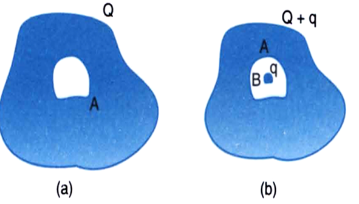
  1. A conductor A with a cavity as shown in Fig. 1.36(a) is given a charge Q. Show that the entire charge must appear on the outer surface of the conductor.
  2. Another conductor B with charge q is inserted into the cavity keeping B insulated from A. Show that the total charge on the outside surface of A is Q + q [Fig. 1.36(b)].
  3. A sensitive instrument is to be shielded from the strong electrostatic fields in its environment. Suggest a possible way.

Can we perform Young's double slit experiment with sound waves? To get a reasonable "fringe pattern", what should be the order of separation between the slits? How can the bright fringes and the dark fringes be detected in this case?