Question
Explain:
  1. Cyclic silicates
  2. Ino silicates

Answer

1. Cyclic silicates:
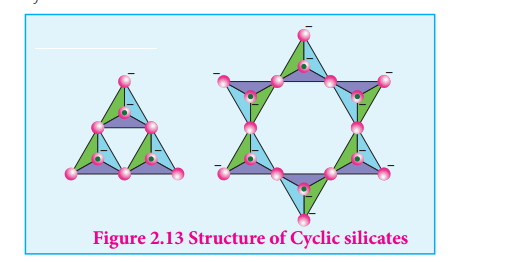
Silicates which contain $\left( SiO _3\right)_n^{2 n-}$ ions which are formed by linking three or more tetrahedral $\left( SiO _3\right)_n^{4-}$ units cyclically are called cyclic silicates. Each silicate unit shares two of its oxygen atoms with other units.
Example:
Beryl $\left[ Be _3 Al _2\left( SiO _3\right)_6\right]$ (an aluminosilicate with each aluminium is surrounded by 6 Structure of Cyclic silicates


Image
2. Ino silicones:
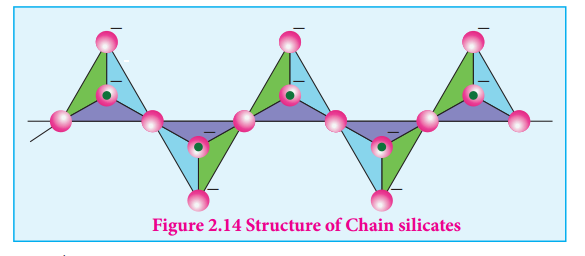
Silicates which contain $V$ number of silicate units liked by sharing two or more oxygen atoms are called inosilicates. They are further classified as chain silicates and double chain silicates. Chain silicates (or pyroxenes) - These silicates contain $\left( SiO _3\right)_n^{2 n-}$ ions formed by linking ' $n$ ' number of tetrahedral $\left( SiO _3\right)_n^{4-}$ units linearly. Each silicate unit shares two of its oxygen atoms with other Structure of Chain silicates units.


Image
Example:
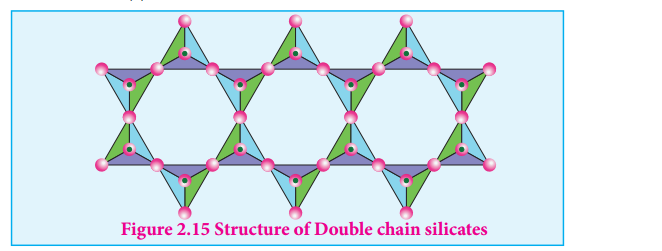
Spodumene - $LiAl \left( SiO _3\right)_2$ Double chain silicates (or amphiboles) - These silicates contains $\left[ Si _4 O _{11}\right]_n^{6 n-}$ ions. In these silicates there are two different types of
3. Tetrahedra:
1. Those sharing 3 vertices
2. Those sharing only 2 vertices.
Examples.
Asbestos - These are fibrous and noncombustible silicates. Therefore they are used for thermal insulation material, brake linings, construction material and filters. Asbestos being carcinogenic silicates, their applications are restricted.


Image

Need a full question paper?

Generate a complete, print-ready paper with questions like this in minutes — across 16+ boards, with answer keys.
Start Generating Free

Similar questions

Derive an expression for Ostwald’s dilution law.
An organic compound $(A)$ of molecular formula $C _4 H _{10} O$ gives no colouration in Victor Meyer's test. (A) on reaction with $P / I _2$ gives (B) of formula $C _4 H _9$ I. (B) on treatment with nitrous acid gives (C) of formula $C _3 H _9 NO _2$. (C) does not react with KOH . Identify $A , B , C$ and explain.
How are polymers classified on the basis of forces operating between their molecules? To which of these classes does nylon-6,6 belong?
What is corrosion? Explain about the electrochemical mechanism of corrosion.
  1. How is bleaching powder prepared?
  2. What happens when benzene reacts with chlorine?
An organic compound (A) of molecular formula $C _7 H _6 O _2$ reacts with $PCl _5$ to give (B) of formula $C _7 H _5 OCl ( B )$ on treatment with ammonia gives (C) of formula $C _7 H _7 NO ( C )$ on treatment with phosphorous pentoxide gives ( D ) of formula $C _7 H _5 N$. Identify $A , BC , D$ and explain the reactions involved.
Explain about the hydrolysis of salt of strong acid and a strong base with a suitable example.
An organic compound (A) of molecular formula $C _3 H _6 O$ reduces Tollen's reagent on reaction with methyl magnesium bromide followed by acid hydrolysis gives (B) of formula $C _4 H _{10} O$. (B) gives blue colour in victor meyer test. (B) on reaction with Cu at 573 K gives (C) of formula $C _4 H _8 O ( C )$ on reaction with hydrazine and sodium ethoxide gives (D) of molecular formula $C _4 H _{10}$. identify $A , B , C , D$ and explain the reactions involved.
 An organic compound (A) of molecular formula $C _3 H _6$ on hydration in the presence of $H _2 SO _4$ gives (B) $C _3 H _5 O$ which gives blue colour In victor meyer's test. (B) on treatment with Cu at 573 K gives $C _3 H _6 O$ a compound (C) on self condensation in the presence of magnesium amalgam and water gives (D) of formula $C _6 H _{14} O _2$. Identify $A , B , C , D$ and explain the reaction involved.
How does carbonmonoxide reacts with following reagents,
(i) $O _2$
(ii) $Cl _2$
(iii) $F _2 O _3$
(iv) $H _2$
(v) ethene