Question
Explanation hydrogen spectrum on the basis of Bohr's principle.

Answer

Explanation of Hydrogen spectrum on the basis of Bohr's principle:
In general the energy of electron in nth orbit of the hydrogen atom is given by: $E _n=-\left(13.6 / n^2\right) eV$.
$E_1=-\left(13.6 / 1^2\right) eV =-13.6 eV$
$E _2=-\left(13.6 / 2^2\right) eV =-1.51 eV$
$E_3=-\left(13.6 / 3^2\right) e V=-0.85 e V$
$E _4=-\left(13.6 / 4^2\right) eV =-0.54 eV$
$E _5=-\left(13.6 / 5^2\right) eV =-0.37 eV$
...................................................................
$E_{\infty}=-\left(13.6 / \infty^2\right) e V=0$
From these values it is obvious that the electron in hydrogen atom can have only certain discrete values of energy while revolving in different orbits. It is also obvious that the first orbit corresponds to the lowest energy and is called ground state. As $n$ increases, the energy becomes less negative i.e, goes on increasing. When $n$ becomes very large $(n \rightarrow \infty)$ the energy becomes zero. This zero level represents the state of maximum energy. The minimum energy required to remove an electron from n = 1 to n = ∞ is called ionisation energy of H2 atom and it is equal to difference of E1 and $E_{\infty}$ infty i.e., it is 13.6 eV. Zero energy state is called ionisation state of the atom. It is also obvious that with increasing value of $n$ the difference between the energy of different states goes on decreasing.
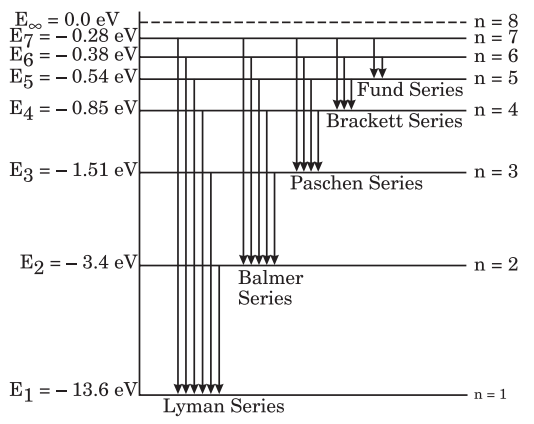
Image
Taking all the above points into account if a diagram is drawn in which the energies of the different orbits (energy states) of H2 atom are represented by parallel horizontal lines with some suitable energy scale, this diagram is called energy level diagram of H2 atom. In this diagram the transitions corresponding to different spectral series of hydrogen atom are also shown.
formula :
$\frac{1}{\lambda}= R \left(\frac{1}{n_1^2}-\frac{1}{n_2^2}\right)$ ...(1)
On the basis of this formula production of all the five spectral series can be explained as follows :
(1) Lymann Series : When the electron of hydrogen atom transits from some higher energy level to the first energy level (lowest energy level), (i.e., n1 = 1 and n2 = n = 2 ,3,4,....) then the emitted spectral lines are obtained in the ultraviolet region of the spectrum and make the Lymann series. Hence the wavelength of these lines can be found by the following form of the above equation (1),
$\frac{ 1 }{\lambda}= R \left(\frac{ 1 }{ 1 ^2}-\frac{ 1 }{ n ^2}\right), \quad$ where $n=2,3,4, \ldots$
Where R is Rydberg's constant and its value is 1.097$\times 10^7 m^{-1}$. Somewhere it is also denoted by RH.
The series lies in the ultra-violet. Lymann, in 1916, photographed the lines of this series of hydrogen spectrum. Hence this series is named 'Lymann series'. The longest wavelength of this series (for n = 2 ) is 1216 Å and the shortest wavelength (for n = ∞ ) is 912 Å. The wavelength (912 Å) corresponding to n = ∞ is called the 'series limit'.
(2) Balmer Series : Its wavelengths are given by
$\frac{1}{\lambda}= R \left(\frac{1}{2^2}-\frac{1}{n^2}\right),(n=3,4,5, \ldots)$ ...(2)
The lines of this series were seen and studied for the first time by Balmer in 1885. Hence this series is named as Balmer series. The longest wavelength of this series (for n = 3 ) is 6563 Å and the shortest wavelength (for n = ∞) is 3646 Å.
For n = 3 4, 5, 6, ...the spectral lines of Balmer series were termed as $H _\alpha, H _\beta, H _\gamma, H _\delta, \ldots$ and so on.
(3) Paschen Series : Its wavelengths are given by
$\frac{1}{\lambda}= R \left(\frac{1}{3^2}-\frac{1}{n^2}\right),(n=4,5,6, \ldots$ ...(3)
The series lies in the near infrared region.
This series was discovered by Paschen.
The greatest wavelength of this series is 18751 Å and the shortest is 8107 Å.
(4) Brackett Series : Its wavelengths are given by
$\frac{1}{\lambda}= R \left(\frac{1}{4^2}-\frac{1}{n^2}\right),(n=5,6,7, \ldots$ ...(4)
The series lies in the far infrared region.
This series was discovered by Brackett in 1922. The greatest wavelength of this series is 40500 Å and the shortest is 14516 Å.
(5) Pfund Series : Its wavelengths are given by
$\frac{1}{\lambda}= R \left(\frac{1}{3^2}-\frac{1}{n^2}\right),(n=6,7,8, \ldots)$ ...(5)
The series lies in far infrared region.
This series was discovered by Pfund is 1924. The largest wavelength of this series is 74000 Å and shortest is 23673 Å.

Need a full question paper?

Generate a complete, print-ready paper with questions like this in minutes — across 16+ boards, with answer keys.
Start Generating Free

Similar questions

The mixture a pure liquid and a solution in a long vertical column (i.e, horizontal dimensions < < vertical dimensions) produces diffusion of solute particles and hence a refractive index gradient along the vertical dimension. A ray of light entering the column at right angles to the vertical is deviated from its original path. Find the deviation in travelling a horizontal distance d < < h, the height of the column.
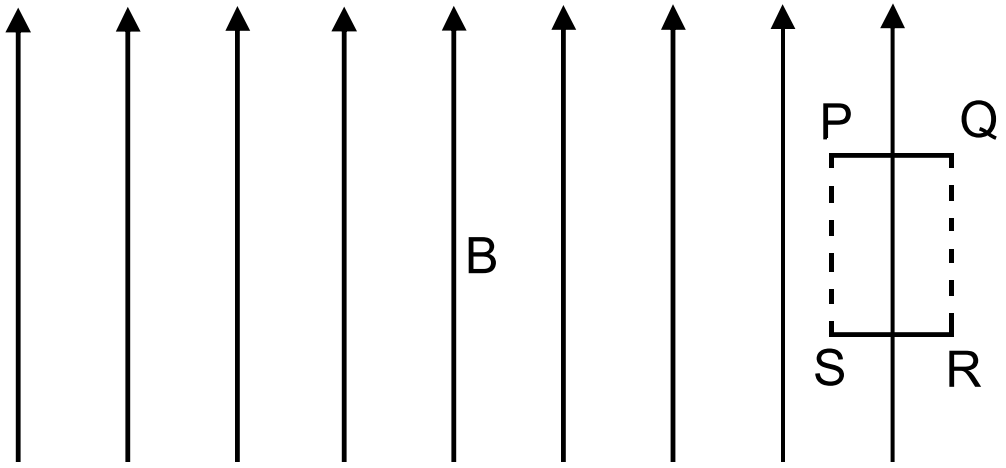
Sometimes we show an idealised magnetic field which is uniform in a given region and falls to zero abruptly. One such field is represented in figure. Using Ampere's law over the path PQRS, show that such a field is not possible.

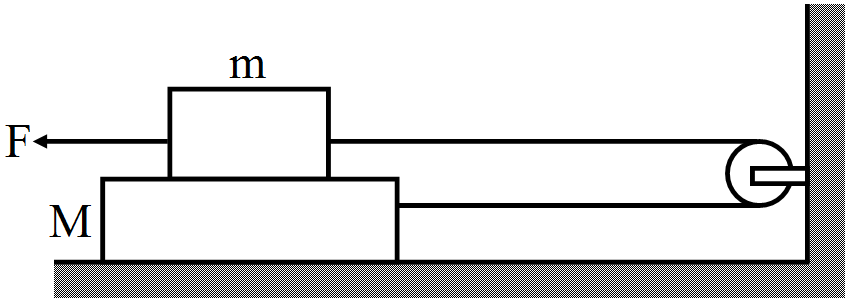
The friction coefficient between the two blocks shown in figure is $\mu$ but the floor is smooth.
  1. What maximum horizontal force F can be applied without disturbing the equilibrium of the system?
  2. Suppose the horizontal force applied is double of that found in part (a). Find the accelerations of the two masses.
​​​​​​​
Show that average value of radiant flux density ‘S’ over a single period ‘T’ is given by $\text{S}=\frac{1}{2\text{c}\mu_0}\text{E}_0^2$.
Explain Hertz experiment for communication of electromagnetic waves. Draw labelled diagram of apparatus used in the experiment.
$(or)$
Explain Hertz experiment related with electromagnetic waves and also explain experiments of Jagdish Chandra Basu and Marconi.
$(or)$
Critically evaluate Hertz experiment of production and communication of electromagnetic waves.
Two point charges $q$ and $-q$ are located at points $(0,0,-a)$ and $(0,0, a)$ respectively.
i. Find the electrostatic potential at $(0,0, z)$ and $(x, y, 0)$.
ii. How much work is done in moving a small test charge from the point $(5,0,0)$ to $(-7,0,0)$ along the $X$-axis?
iii. How would your answer change if the path of the test charge between the same points is not along the $x$-axis but along any other random path?
iv. If the above point charges are now placed in the same positions in a uniform external electric field $\vec{E}$, what would be the potential energy of the charge system in its orientation of unstable equilibrium? Justify your answer in each case.
What are coherent sources of light? Why are coherent sources required to produce interference of light? Give an example of interference in everyday life.
A convex lens of focal length 20cm and a concave lens of focal length 10cm are placed 10cm apart with their principal axes coinciding. A beam of light travelling parallel to the principal axis and having a beam diameter 5.0mm, is incident on the combination. Show that the emergent beam is parallel to the incident one. Find the beam diameter of the emergent beam.
Suppose a 'n' - type wafer is created by doping Si crystal having 5 × 1028 atoms/m3 with 1ppm concentration of As. On the surface 200 ppm Boron is added to create ‘P’ region in this wafer. Considering ni = 1.5 × 1016m-3.
  1. Calculate the densities of the charge carriers in the n & p regions.
  2. Comment which charge carriers would contribute largely for the reverse saturation current when diode is reverse biased.
State Biot-Savart law, giving the mathematical expression for it.
Use this law to derive the expression for the magnetic field due to a circular coil carrying current at a point along its axis.
How does a circular loop carrying current behave as a magnet?