Question
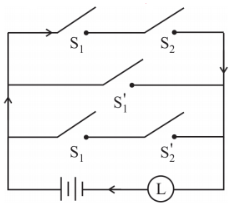
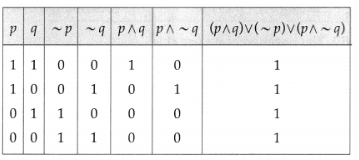
Express the following circuits in the symbolic form. Prepare the switching table :
Image

Answer

Let $p :$ the switch $\mathrm{S}_1$ is closed
$q$ : the switch $S_2$ is closed
$\sim \mathrm{p}$ : the switch $S_1^{\prime}$ is closed or the switch $S_1$ is open
$\sim \mathrm{q}$ : the switch $\mathrm{S}_2{ }^{\prime}$ is closed or the switch $\mathrm{S}_2$ is open.
Then the symbolic form of the given circuit is :
$(p \wedge q) \vee(\sim p) \vee(p \wedge \sim q)$

Image

Need a full question paper?

Generate a complete, print-ready paper with questions like this in minutes — across 16+ boards, with answer keys.
Start Generating Free

Similar questions

Evalute the following integrals:
$\int\frac{2\cos2\text{x}+\sec^2\text{x}}{\sin2\text{x}+\tan\text{x}-5}\text{dx}$
Tickets are numbered from 1 to 10. Two tickets are drawn one after the other at random. Find the probability that the number on one of the tickets is a multiple of 5 and on the other a multiple of 4.
A ladder 10 meter long is leaning against a vertical wall. If the bottom of the ladder is pulled horizontally away from the wall at the rate of 1.2 meters per seconds, find how fast the top of the ladder is sliding down the wall when the bottom is 6 meters away from the wall
Evaluate the following:

$\int e^{2 x} \cos 3 x d x$

Prove that $\sin \left[\tan ^{-1}\left(\frac{1-x^2}{2 x}\right)+\cos ^{-1}\left(\frac{1-x^2}{1+x^2}\right)\right]=1$
A bag contains 5 white, 7 red and 3 black balls. If three balls are drawn one by one without replacement, find the probability that none is red.
Differentiate the following w. r. t. x.$y=\log \left[\frac{x+\sqrt{x^2+a^2}}{\sqrt{x^2+a^2}-x}\right]$
Find the points o local maxima or local minima, if any, of the following functions, using the first derivatives test. Also, find the local maximum or local minimum values, as the case may be:
$\text{f}(\text{x})=\frac{1}{\text{x}^{2}+2}$
Determine the value of the constant k so that the function
$\text{f}\text{(x)}=\begin{cases}\frac{\sin2\text{x}}{5\text{x}}, &\text{if}\text{ x}\neq0\\\text{k}, &\text{if}\text{ x}=0\end{cases}$ is continuous at x = 0.
If $\text{y}=\log_\text{a}\text{x},$, find $\frac{\text{dy}}{\text{dx}}.$