Question
Express the following complex numbers in the form $\text{r}(\cos\theta+\text{i}\sin\theta):$
$1+\text{i}\tan\alpha$

Answer

 Let $\text{z}=1+\text{i}\tan\alpha$

$\tan\alpha$ is periodic function with period $\pi$

So, let us take $\alpha$ lying in the interval $\Big[0,\frac{\pi}{2}\Big)\cup\Big(\frac{\pi}{2},\pi\Big].$

Case - 1: when $\alpha\in\Big[0,\frac{\pi}{2}\Big)$

$|\text{z}|=\sqrt{1+\tan^2\alpha}=\sqrt{\sec^2\alpha}=|\sec\alpha|=\sec\alpha$

Let $\beta$ be acute angle given by $\tan\beta=\frac{|\text{Im(z)}|}{|\text{Re(z)|}}.$

$\tan\beta=|\tan\alpha|=\tan\alpha$

$\Rightarrow\beta=\alpha$

As z represented by a point in first quadrant.

$\therefore \ \text{arg(z)}=\beta=\alpha$

So polar form of z is $\sec\alpha\big(\cos\alpha+\text{i}\sin\alpha\big)$

Case - 2: when $\alpha\in\Big(\frac{\pi}{2},\pi\Big]$

$|\text{z}|=\sqrt{1+\tan^2\alpha}=\sqrt{\sec^2\alpha}=|\sec\alpha|=-\sec\alpha$

Let $\beta$ be acute angle given by $\tan\beta=\frac{|\text{Im(z)}|}{|\text{Re(z)|}}.$

$\tan\beta=|\tan\alpha|=-\tan\alpha=\tan(\pi-\alpha)$

$\Rightarrow\beta=\pi-\alpha$

As z represented by a point in fourth quadarnt.

$\therefore \ \text{arg(z)}=-\beta=\alpha-\pi$

So polar form of z is $-\sec\alpha\big(\cos(\alpha-\pi)+\text{i}\sin(\alpha-\pi)\big).$ 

Need a full question paper?

Generate a complete, print-ready paper with questions like this in minutes — across 16+ boards, with answer keys.
Start Generating Free

Similar questions

Prove the following by the principle of mathematical induction:
$1^2 + 2^2 + 3^2 +...+ \text{n}^2=\frac{\text{n}(\text{n}+1)(2\text{n}+1)}{6}$
Evaluate the following limit:
$\lim\limits_{\text{n}\rightarrow\infty}\frac{1^2+2^2+\ \cdots+\text{n}^2}{\text{n}^3}$
In a $\triangle\text{ABC,}$ if $\sin^2\text{A}+\sin^2\text{B}=\sin^2\text{C},$ show that the triangle is right angled.
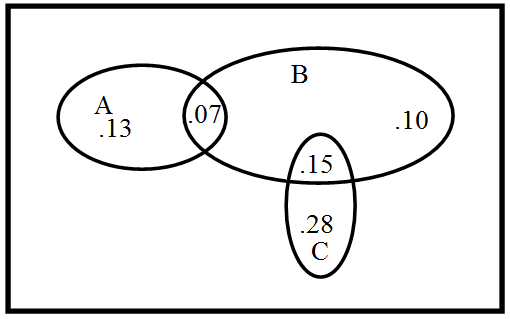
The accompanying Venn diagram shows three events, A, B, and C, and also the probabilities of the various intersections $($for instance, $\text{P}(\text{A}\cap\text{B})=.07)$ Determine:
  1. $\text{P(A)}$
  2. $\text{P}(\text{B}\cap\bar{\text{C}})$
  3. $\text{P(A}\cup\text{B})$
  4. $\text{P(A}\cap\bar{\text{B}})$
  5. $\text{P(B}\cap\text{C})$
  6. Probability of exactly one of the three occurs.
Evaluate the following limit:
$\lim\limits_{\text{x}\rightarrow{\frac{\pi}{6}}}\frac{\cot^2\text{x}-3}{\text{cosec x}-2}$
If $\frac{\text{b}+\text{c}}{\text{a}},\ \frac{\text{c}+\text{a}}{\text{b}},\ \frac{\text{a}+\text{b}}{b}$ are A.P., prove that:
$\frac{1}{\text{a}},\ \frac{1}{\text{b}},\ \frac{1}{\text{c}}$ are in A.P.
Evaluate the following limit:
$\lim\limits_{\text{x}\rightarrow0}\frac{\text{x}}{\sqrt{1+\text{x}}-\sqrt{1-\text{x}}}$
Find the area of the triangle formed by the lines:
 x + y - 6 = 0, x - 3y - 2 = 0 and 5x - 3y + 2 = 0
Express the following complex numbers in the form $\text{r}(\cos\theta+\text{i}\sin\theta):$
$1-\sin\alpha+\text{i}\cos\alpha$
Prove that:
$\cos\frac{\pi}{15}\cos\frac{2\pi}{15}\cos\frac{3\pi}{15}\cos\frac{4\pi}{15}\cos\frac{5\pi}{15}\cos\frac{6\pi}{15}\cos\frac{7\pi}{15}=\cos\frac{1}{128}$