Question
Express the following in exponential form: $512$

Answer

$512$
$2$ $512$
$2$ $256$
$2$ $128$
$2$ $64$
$2$ $32$
$2$ $16$
$2$ $8$
$2$ $4$
$2$ $2$
  $1$
$= 2 \times 2 \times 2 \times 2 \times 2 \times 2 \times 2 \times 2 \times 2 = 2^9 $

Need a full question paper?

Generate a complete, print-ready paper with questions like this in minutes — across 16+ boards, with answer keys.
Start Generating Free

Similar questions

Put the given fraction in ascending order by making denominator equal:
$\frac{1}{3}, \frac{2}{5}, \frac{3}{4} \text { and } \frac{1}{6}$
Evaluate: $\left(-6 \times \frac{5}{18}\right)-\left(-4 \frac{2}{9}\right)$
Saket wrote four different algebraic expressions in his notebook. These are $f(x)=2 x^3-\frac{1}{3} x$ $g(x)=x-\frac{1}{x}+2, h(x)=x^2-2 \sqrt{x}$ and $k(y)=2 y-1$.
Q.1. Which of these expressions is / are binomials ?
(a) $f(x), g(x), h(x)$ only
(b) $f(x), g(x), k(y)$ only
(c) $f(x), h(x), h(y)$ only
(d) $f(x), h(x)$ only
Q.2. Which of these expressions is / are not polynomials ?
(a) $f(x), g(x), h(x)$ only
(b) $f(x), h(x)$ only
(c) $g(x), h(x)$ only
(d) $h(x)$ only
Q.3. Which of these expressions is/are polynomials in two variables ?
(a) $f(x)$ only $\quad$$\quad$(b) $k(y)$ only $\quad$$\quad$$\quad$$\quad$(c) $f(x), k(y)$ only $\quad$$\quad$(d) None of these
Q.4. The degree of the polynomial $f(x)$ is :
(a) 0$\quad$$\quad$(b) 1 $\quad$$\quad$$\quad$$\quad$(c) 2 $\quad$$\quad$(d) 3
Simplify: 4(3x - 8) - 3(5x + 3) - 2(6x - 8)
Shyam bought a refrigerator for Rs. 5000 . He paid $\frac{1}{10}$ of the price in cash and the rest in 12 equal monthly instalments. How much had he to pay each month?
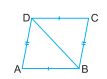
In the given figure, AB = CD and AD = CB.
Prove that :
(i) $\triangle ABD =\triangle CDB$
(ii) $\angle A =\angle C$
Image
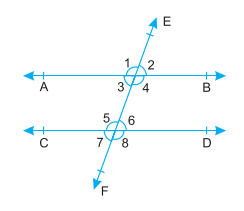
Two lines $A B$ and $C D$ are cut by a transversal $E F$, as shown in the figure. Identify the given pair of angles as adjacent angles, vertically opposite angles, alternate angles, corresponding angles or co-interior angles.
Image
(i) $\angle 6$ and $\angle 7$
(ii) $\angle 3$ and $\angle 4$
(iii) $\angle 4$ and $\angle 8$
(iv) $\angle 1$ and $\angle 5$
(v) $\angle 3$ and $\angle 5$
(vi) $\angle 2$ and $\angle 4$
(vii) $\angle 4$ and $\angle 5$
(viii) $\angle 2$ and $\angle 7$
(ix) $\angle 3$ and $\angle 6$
(x) $\angle 4$ and $\angle 6$
(xi) $\angle 2$ and $\angle 6$
(xii) $\angle 1$ and $\angle 4$
Evaluate: $\frac{-3}{8}+\frac{-5}{12}$
A shopkeeper buys an article for ₹ 300. He increases its price by 20% and then gives 10% discount on the new price. Find:
(i) the new price (marked price) of the article.
(ii) the discount is given by the shopkeeper.
(iii) the selling price.
(iv) profit percent made by the shopkeeper.
By selling an article for ₹825, a man loses equal to j of its selling price. Find:
(i) the cost price of the article,
(ii) the profit percent or the loss percent made, if the same article is sold for ₹ 1265.