MCQ
Extra pure $N_2$ can be obtained by heating :-
- A$NH_4NO_2$
- B$(NH_4)_2Cr_2O_7$
- ✓$Ba(N_3)_2$
- D$NH_3$ with $CuO$
$2 \mathrm{NaN}_{3} \stackrel{573 \mathrm{K}}{\longrightarrow} 2 \mathrm{Na}+3 \mathrm{N}_{2}$
Azide salt of barium can be obtained in the purest form as well as the decomposition product contains solid Ba as a by-product along with gaseous nitrogen, hence no additional step of
separation is required.
$\mathrm{Ba}\left(\mathrm{N}_{3}\right)_{2} \stackrel{\text { heat }}{\longrightarrow} \mathrm{Ba}+3 \mathrm{N}_{2}$
Hence, option $\mathrm{C}$ is correct.
Generate a complete, print-ready paper with questions like this in minutes — across 16+ boards, with answer keys.
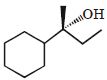
In addition of $HOBr$ to $(I)$ and $(II)$
(The atomic mass of $Na$ is $23\, g / mol$ ) :
${H_2}\left( g \right)\,1atm\,|\,{H^ + }\left( {1M} \right)\,||\,C{u^{2 + }}\left( {1M} \right)\,|\,Cu\left( s \right)$
which of the following statements is true
$K = \left( {4.5 \times {{10}^{11}}{S^{ - 1}}} \right){e^{ - \left( {28000\frac{{{K^2}mol}}{J}} \right)\frac{R}{T}}}$
The activation energy of reaction (in $J/mol$) is