Question
Factorise:
$8\text{x}^3-\frac{1}{27\text{y}^3}$

Answer

We know that:
Since a3 - b3 = (a - b)(a2 + a × b + b2)
Let us rewrite
$8\text{x}^3-\frac{1}{27\text{y}^3}$
$=(2\text{x})^3-\Big(\frac{1}{3\text{y}}\Big)^3$
$=\Big(2\text{x}-\frac{1}{3\text{y}}\Big)\bigg[(2\text{x})^2+2\text{x}\times\frac{1}{3\text{y}}+\Big(\frac{1}{3\text{y}}\Big)^2\bigg]$
$=\Big(2\text{x}-\frac{1}{3\text{y}}\Big)\Big(4\text{x}^2+\frac{2\text{x}}{3\text{y}}+\frac{1}{9\text{y}^2}\Big)$

Need a full question paper?

Generate a complete, print-ready paper with questions like this in minutes — across 16+ boards, with answer keys.
Start Generating Free

Similar questions

Factorise:
3x2 - 14x + 8
Simplify the following:
$\frac{3}{\sqrt{8}}+\frac{1}{\sqrt{2}}$
12 Packets of salt, each marked 2kg, actually contained the following weights (in kg) of salt:
1.950, 2.020, 2.060, 1.980, 2.030, 1.970, 2.040, 1.990, 1.985, 2.025, 2.000, 1.980.
Out of these packets, one packet is chosen at random.
What is the probability that the chosen packet contains more than 2kg of salt?
The angles of a quadrilateral are in the ratio 2 : 4 : 5 : 7. Find the angles.
Write the following in decimal form and say what kind of decimal expansion has.
$\frac{7}{25}$
Check the following are solutions of the equation 2x - y = 6 and which are not:
$\Big(\frac{1}{2},\ -5\Big)$
An angle is equal to 8 times its complement. Determine its measure.
Factorise:
6 - x - x2
Using suitable identity, evaluate the following:

101 × 102

Read the Source/ Text given below and answer these questions:

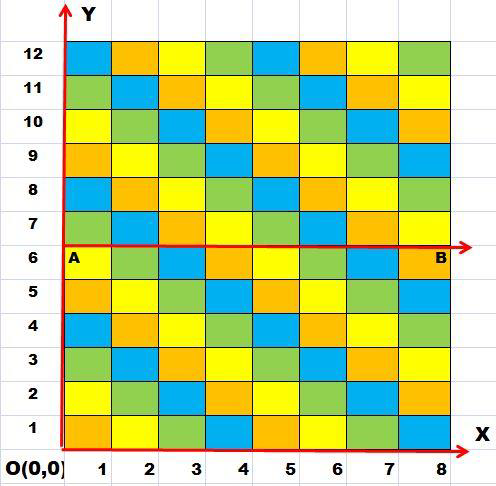
Roshan decorated one of his bathroom wall with tiles as shown in the picture. He was having tiles of four colours orange, yellow, green and blue. He fitted the tiles in 8 columns and 12 rows. The size of one tile was 1 foot × 1 foot and the area of each tile is 1 foot2. He arranged the tile in such a way that colour of tiles in each row and column were in the pattern: Orange → Yellow → green → Blue → Orange → ..... and so on.
questions:
1. Which colour tile was fitted at the point with coordinate (2, 5)?
2. What is the area of the tiles fitted in the rectangular part OABX?