Question
Factorise:$\text{a}^3-\frac{1}{\text{a}^3}-2\text{a}+\frac{2}{\text{a}}$

Answer

We know that, Since $a^3 - b^3 = (a - b)(a^2 + a \times b + b^2)$$\text{a}^3-\frac{1}{\text{a}^3}-2\text{a}+\frac{2}{\text{a}}$
$=\text{a}^3-\frac{1}{\text{a}^3}-2\Big(\text{a}-\frac{1}{\text{a}}\Big)$
$=\Big(\text{a}-\frac{1}{\text{a}}\Big)\Big(\text{a}^2+\text{a}\times\frac{1}{\text{a}}+\frac{1}{\text{a}^2}\Big)-2\Big(\text{a}-\frac{1}{\text{a}}\Big)$
$=\Big(\text{a}-\frac{1}{\text{a}}\Big)\Big(\text{a}^2+1+\frac{1}{\text{a}^2}-2\Big)$
$=\Big(\text{a}-\frac{1}{\text{a}}\Big)\Big(\text{a}^2+\frac{1}{\text{a}^2}-1\Big)$

Need a full question paper?

Generate a complete, print-ready paper with questions like this in minutes — across 16+ boards, with answer keys.
Start Generating Free

Similar questions

Express the following decimals in the form $\frac{\text{p}}{\text{q}},$ where p, q are integers and $\text{q}\neq0.$$0.\overline{53}$
Using the remainder theorem, find the remainder, when p(x) is divided by g(x), where,
p(x) = 2x^3 + 3x^2 - 11x - 3$, $\text{g}(\text{x})=\Big(\text{x}+\frac{1}{2}\Big).$
The diameter of the moon is approximately one-fourth of the diameter of the earth. What is the earth the volume of the moon?
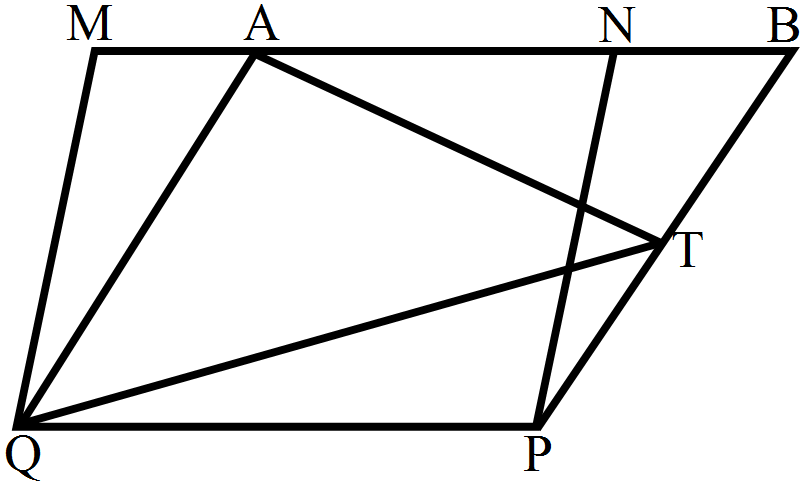
In the adjoining figure, MNPQ and ABPQ are parallelograms and T is any point on the side BP. Prove that
  1. $\text{ar}(\text{MNPQ})=\text{ar}(\text{ABPQ})$
  2. $\text{ar}(\triangle\text{ATQ})=\frac{1}{2}\text{ar}\text{(MNPQ}).$
Find the sum of the deviations of the variate values 3, 4, 6, 7, 8, 14 from their mean.
If $\frac{x}{3 x-y-z}=\frac{y}{3 y-z-x}=\frac{z}{3 z-x-y}$ and $x + y + z \neq 0$, then show that the value of each ratio is equal to 1.
A sphere, a cylinder, and a cone have the same diameter. The height of the cylinder and also the cone are equal to the diameter of the sphere. Find the ratio of their volumes.
In right angled triangle $\triangle \mathrm{PQR}, \angle \mathrm{Q}=90^{\circ}, \angle \mathrm{R}=\theta$ and if $\sin \theta=\frac{5}{13}$ then find $\cos \theta$ and $\tan \theta$
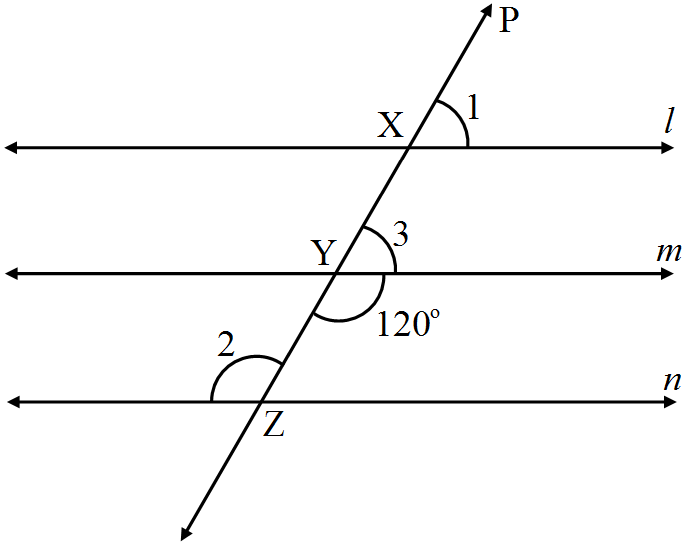
In figure, l, m and n are parallel lines intersected by transversal p at X. Y and Z respectively. Find $\angle\text{1},\angle\text{2}$ and $\angle\text{3}.$
If $\text{x}^2+\frac{1}{\text{x}^2}=66,$ find the value of $\text{x}-\frac{1}{\text{x}}.$