Question
Factorise the following by the difference of two squares:$a(a - 1) - b(b - 1)$

Answer

$a(a - 1) - b(b - 1)$
$a^2 - a - b^2 + b$
$= a^2 - b^2 - a + b$
$= (a^2 - b^2) - (a - b)$
$= (a - b)(a + b) - (a - b)$
$= (a - b)(a + b - 1).$

Need a full question paper?

Generate a complete, print-ready paper with questions like this in minutes — across 16+ boards, with answer keys.
Start Generating Free

Similar questions

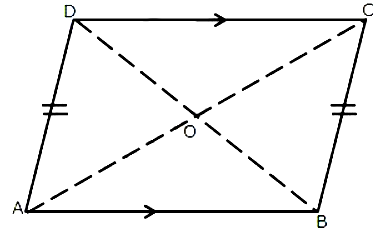
The following figure shows a trapezium $\text{ABCD}$ in which $A B$ is parallel to $DC$ and $AD =BC$.

Prove that$:(i) \angle DAB =\angle CBA;(ii)\angle ADC =\angle BCD;iii)AC = BD;(iv) OA = OB$ and $OC = OD$.
Use method of contradiction to show that $\sqrt{3}$ and $\sqrt{5}$ are irrational numbers.
Anant bought toffees at $5$ for a rupee. How many for a rupee must he sell to gain $25\%\ $?
A part of monthly expenses of a family is constants and the remainingvarywith the number of members in the family. For a family of $4$ person, the total monthly expenses are $Rs. 10,400$ whereas for a family of $7$ persons, the total monthly expenses are $Rs. 15,800$. Find the constant expenses per month and the monthly expenses of each member of a family.
The sum of the digits of a two-digit number is 12. If the digits are reversed, the new number is 12 less than twice the original number. Find the original number.
On which axis does the following point lie?
(i) (5, 0) (ii) (0, -2) (iii) (0, 3) (iv) (-3, 0)
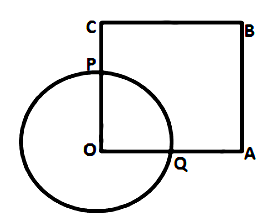
In the following figure, $\text{OABC}$ is a square. A circle is drawn with $O$ as centre which meets $OC$ at $P$ and $OA$ at $Q$.Prove that$:( i ) \triangle OPA \cong \triangle OQC;( ii ) \triangle BPC \cong \triangle BQA$
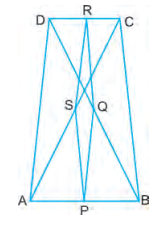
In the adjoining figure, ABCD is a quadrilateral in which $A D=B C$ and $P, Q, R, S$ are the mid-points of $A B, B D, C D$ and $A C$ respectively. Prove that $P Q R S$ is a rhombus.
Image
If the difference between an exterior angle of a regular polygon of $'n\ '$ sides and an exterior angle of another regular polygon of $'(n + 1)'$ sides is equal to $4^\circ$; find the value of $'n\ '.$
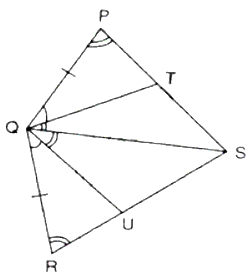
$\text{PQRS}$ is a quadrilateral and $T$ and $U$ are points on $PS$ and $RS$ respectively such that $PQ = RQ, ∠PQT = ∠RQU$and $∠TQS = ∠UQS$. Prove that $QT = QU.$