Question
Factorise the following:$(x + 4)^2 - 5xy - 20y - 6y^2$

Answer

$(x + 4)^2 - 5xy - 20y - 6y^2$
$= (x + 4)^2 - 5y(x + 4) - y^2$
$= (x + 4)^2 - 6y(x + 4) + y(x + 4) - 6y^2$
$= (x + 4)(x + 4 - 6y) + y(x + 4 - 6y)$
$= (x + 4 - 6y)(x + 4 + y)$
$= (x - 6y + 4)(x + y + 4).$

Need a full question paper?

Generate a complete, print-ready paper with questions like this in minutes — across 16+ boards, with answer keys.

Start Generating Free

Similar questions

Arrange the following rational numbers in descending order.$\frac{4}{3}, \frac{-14}{5}$ and $\frac{17}{15}$
Find
(i) the volume
(ii) the total surface area
(iii) the lateral surface area and
(iv) the length of the diagonal of a cube of side 10 cm.
Image
In the given figure, ABCD is a rectangle inscribed in a circle. If two adjacent sides of the rectangle be 8 cm and 6 cm, calculate :
(i) the radius of the circle; and
(ii) the area of the shaded region. (Take $\pi$ = 3.14 ).
$\left[\right.$ Hint. Radius $=\left(\frac{1}{2} \times\right.$ Diagonal $\left.)=5 cm\right]$
The daily wages in a factory are distributed as follows:
Daily wages $($in $Rs.)$ $125 - 175$ $175 - 225$ $225 - 275$ $275 - 325$ $325 - 375$
Number of workers $4$ $20$ $22$ $10$ $6$
Draw a frequency polygon for this distribution.
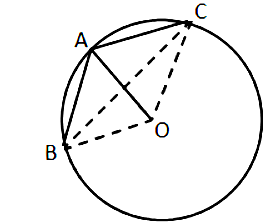
In the given figure, $AB$ is a side of a regular hexagon and $AC$ is a side of a regular eight$-$sided polygon.
Find$:(i) \angle AOB,(ii) \angle AOC,(iii) \angle BOC,(iv) \angle OBC$
Solve the following pair of linear $($simultaneous$)$ equation by the method of elimination by substitution:$0.2x + 0.1y = 25;2(x - 2) - 1.6y = 116$
Draw the graph for the linear equation given below:$2x - 7 = 0$
Two articles $A$ and $B$ are sold for $Rs. 1,167$ making $5\%$ profit on $A$ and$ 7\%$ profiton $A$ and $7\%$ profit on $B$. IF the two articles are sold for $Rs. 1,165,$ a profit of $7\%$ is made on $A$ and a profit of $5\%$ is made on $B$. Find the cost prices of each article.
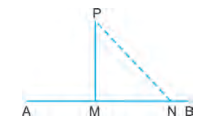
Of all the line segments that can be drawn to a given straight line from a given point outside it, the perpendicular is the shortest.
Given: $\quad A$ straight line $A B$ and a point $P$ outside it; $PM \perp AB$ and N is any other point on AB .
To prove : $PM < PN$.
Proof.
Image