Question
Factorize:
$21\text{x}^2-2\text{x}+\frac{1}{21}$

Answer

$21 x^2-2 x+\frac{1}{21}$
$=(\sqrt{21 x})^2-2 \sqrt{21} x \times \frac{1}{\sqrt{21}}+\left(\frac{1}{\sqrt{21}}\right)^2$
Using the identity $(x-y)^2=x^2+y^2-2 x y$
$\left(\sqrt{21} x-\frac{1}{\sqrt{21}}\right)^2$
$\therefore 21 x^2-2 x+\frac{1}{21}=\left(\sqrt{21} x-\frac{1}{\sqrt{21}}\right)^2$

Need a full question paper?

Generate a complete, print-ready paper with questions like this in minutes — across 16+ boards, with answer keys.

Start Generating Free

Similar questions

Find the median of the following observations: $46, 64, 87, 41, 58, 77, 35, 90, 55, 92, 33$. If $92$ is replaced by $99$ and $41$ by $43$ in the above data, find the new median?
Plot the points $P(1, 0), Q(4, 0)$ and $S(1, 3)$. Find the coordinates of the point $R$ such that $PQRS$ is a square.
If $V$ is the volume of a cuboid of dimensions $a, b, c $and S is its surface area then prove that $\frac{1}{\text{V}}=\frac{2}{\text{S}}\Big(\frac{1}{\text{a}}+\frac{1}{\text{b}}+\frac{1}{\text{c}}\Big).$
Verify whether the indicated numbers are zeros of the polynomials corresponding to them in the following case: $\text{f(x)}=5\text{x}-\pi,\text{x}=\frac{4}{5}$
On one page of a telephone directory, there are $200$ phone numbers. The frequency distribution of their unit's digits is given below:
Unit's digit $0$ $1$ $2$ $3$ $4$ $5$ $6$ $7$ $8$ $9$
Frequency $19$ $22$ $23$ $19$ $21$ $24$ $23$ $18$ $16$ $15$
One of the numbers is chosen at random from the page. What is the probability that the unit's digit of the chosen number is:
$i. 5?$
$ii. 8?$
A coin is tossed $500$ times and we get: heads: $285$ times and tails:$ 215$ times. When a coin is tossed at random, what is the probability of getting
$i.$ A head?
$ii.$ A tail?
Factorise:
$x^3+x^2-4 x-4$
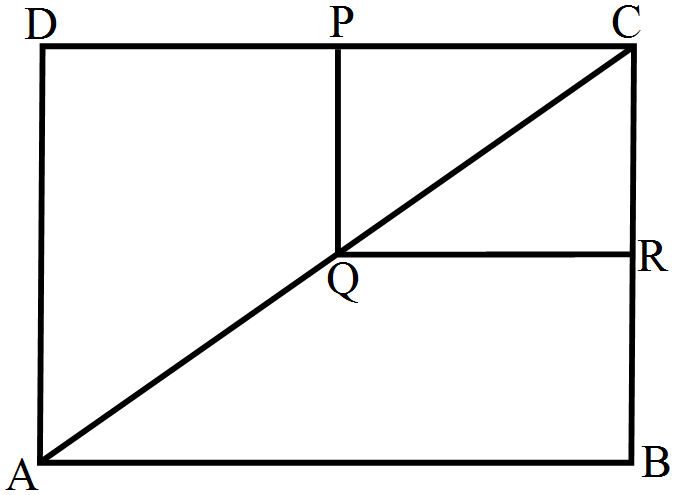
In figure, $\text{ABCD}$ and $\text{PQRC}$ are rectangles and $Q$ is the mid$-$point of $AC$. Prove that
$i. DP = PC$
$ii. \text{PR}=\Big(\frac{1}{2}\Big)\text{AC}$
A cylindrical bucket with base radius $15\ cm$ is filled with water up to a height of $20\ cm$. A heavy iron spherical ball of radius $9\ cm$ is dropped into the bucket to submerge completely in the water. Find the increase in the level of water.
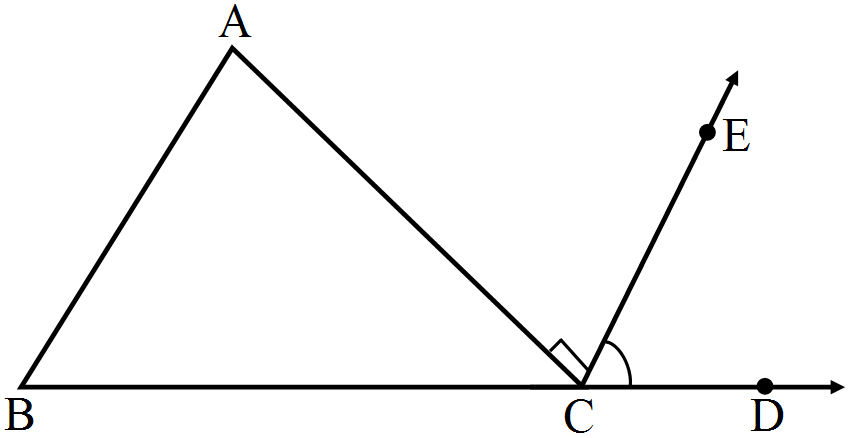
In Fig. $\text{AC}\perp\text{CE}$ and $\angle\text{A}:\angle\text{B}:\angle\text{C}=3:2:1,$ find the value of $\angle\text{ECD}.$