Question
Factorize:
$(a - b + c)^2 + (b - c + a)^2 + 2(a - b + c)(b - c + a)$

Answer

$(a - b + c)^2 + (b - c + a)^2 + 2(a - b + c)(b - c + a)$
Let $(a - b + c) = x$ and $(b - c + a) = y$
$= x^2 + y^2 + 2xy$
Using the identity $(a + b)^2 = a^2 + b^2 + 2ab$
$= (x + y)^2$
Now, substituting $x$ and $y$
$(a - b + c + b - c + a)^2$
Cancelling $-b, +b + c, -c$
$= (2a)^2$
$= 4a^2$
$\therefore (a - b + c)^2 + (b - c + a)^2 + 2(a - b + c)(b - c + a)$
$ = 4a^2$​​​​​​​

Need a full question paper?

Generate a complete, print-ready paper with questions like this in minutes — across 16+ boards, with answer keys.

Start Generating Free

Similar questions

If the temperature of a liquid can be measured in kelvin units as x°K or in fahrenheit units as y°F, the relation between the two systems of measurement of temperature is given by the linear equation.
$\text{y}=\frac{9}{5}(\text{x}-273)+32$
  1. find the temperature of the liquid in fahrenheit, if the temperature of the liquid is 313K.
  2. If the temperature is 158°F, then find the temperature in kelvin.
A cylindrical container with diameter of base 56cm contains sufficient water to submerge a rectangular solid of iron with dimensions (32cm × 22cm × 14cm). Find the rise in the level of water when the solid is completely submerged.
Rationalise the denominator of the following:
$\frac{16}{\sqrt{41}-5}$
Find the mean of the following frequency distribution:
Variables $(x_i)$ $10$ $30$ $50$ $70$ $89$
Frequency $(f_i)$ $7$ $8$ $10$ $15$ $10$
Draw the graph of the following equation.
y + 5 = 0
The diameter of the moon is approximately one-fourth the diameter of the earth. What fraction is the volume of the moon of the volume of the earth?
In a $\triangle\text{ABC},$ if $\angle\text{A}=55^\circ,\angle\text{B}=40^\circ,$ find $\angle\text{C}.$
Factorize: $x^3 + x - 3x^2 - 3$
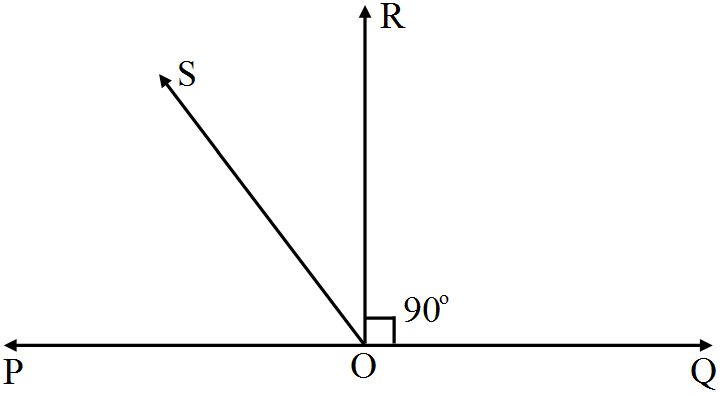
In figure POQ is a line. Ray OR is perpendicular to line PQ. OS is another ray lying between rays OP and OR. Prove that $\angle\text{ROS}=\frac{1}{2}(\angle\text{QOS}-\angle\text{POS}).$
In figure ABC and BDE are two equilateral triangles such that D is the midpoint of BC. AE intersects BC in F. Prove that:

$\text{ar}(\triangle\text{ABC})=2\text{ar}(\triangle\text{BEC})$