Question
Factorize: $\Big(\text{x}^2+\frac{1}{\text{x}^2}\Big)-4\Big(\text{x}+\frac{1}{\text{x}}\Big)+6$

Answer

$\Big(\text{x}^2+\frac{1}{\text{x}^2}\Big)-4\Big(\text{x}+\frac{1}{\text{x}}\Big)+6$
$=\text{x}^2+\frac{1}{\text{x}^2}-4\text{x}-\frac{4}{\text{x}}+4+2$
$=\text{x}^2+\frac{1}{\text{x}^2}+4+2-4\text{x}-4\text{x}$
$=\big(\text{x}^2\big)+\Big(\frac{1}{\text{x}}\Big)^2+(-2)^2+2\times\text{x}\times\frac{1}{\text{x}}+2\times\frac{1}{\text{x}}\times(-2)+2(-2)\text{x}$
Using identity $x^2 + y^2 + z^2 + 2xy + 2yz + 2zx = (x + y + z)^2$
We get, $=\Big[\text{x}+\frac{1}{\text{x}}+(-2)\Big]^2$
$=\Big[\text{x}+\frac{1}{\text{x}}-2\Big]^2$
$=\Big[\text{x}+\frac{1}{\text{x}}-2\Big]\Big[\text{x}+\frac{1}{\text{x}}-2\Big]$
$\therefore\Big[\text{x}^2+\frac{1}{\text{x}^2}\Big]-4\Big[\text{x}+\frac{1}{\text{x}}\Big]+6$
$=\Big[\text{x}+\frac{1}{\text{x}}-2\Big]\Big[\text{x}+\frac{1}{\text{x}}-2\Big]$

Need a full question paper?

Generate a complete, print-ready paper with questions like this in minutes — across 16+ boards, with answer keys.

Start Generating Free

Similar questions

The production of oil (in lakh tonnes) in some of the refineries in India during $1982$ was given below:
Refinery
Barauni
Koyali
Mathura
Mumbai
Florida
Production of oil (in lakh tonnes)
$30$
$70$
$40$
$45$
$25$
Construct a bar graph to represent the above data so that the bars are drawn horizontally.
In a $\triangle\text{ABC},$ BM and CN are perpendiculars from B and C respectively on any line passing through A. If L is the mid-point of BC, prove that ML = NL.
In a $\triangle\text{ABC},$ $BM$ and $CN$ are perpendiculars from $B$ and $C$ respectively on any line passing through $A$. If $L$ is the mid-point of $BC$, prove that $ML = NL$.
What must be added to $x^3 - 3x^2 - 12x + 19$ so that the result is exactly divisibly by $x^2 + x - 6?$
If the bisectors of two adjacent angles $A$ and $B$ of a quadrilateral $ABCD$ intersect at a point $O$ such that $\angle\text{C}+\angle\text{D}=\text{k}\angle\text{AOB},$ then find the value of $k.$
A triangle and a parallelogram have the same base and the same area. If the sides of the triangle are $13\ cm, 14\ cm$ and $15\ cm$ and the parallelogram stands on the base $14\ cm$, find the height of a parallelogram.
Plot the following points on the graph paper:$(-4, 0)$
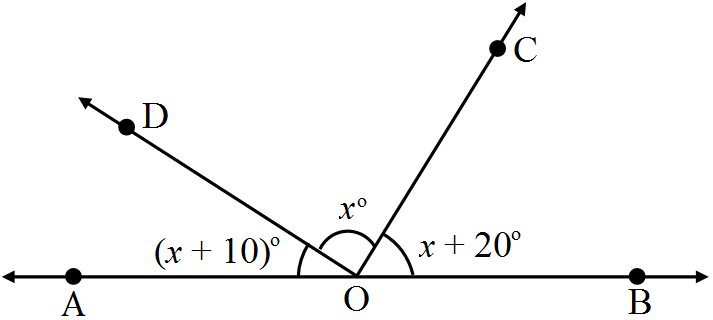
In figure, find $x.$ Further find $\angle\text{BOC},\angle\text{COD}$ and $\angle\text{AOD}.$