MCQ
$[Fe(NO_2)_3Cl_3]$ and $[Fe(ONO)_3Cl_3]$ shows
  • linkage isomerism
  • B
    geometrical isomerism
  • C
    optical isomerism
  • D
    none of the above

Answer

Correct option: A.
linkage isomerism
a
The given compound contains $-NO_2$ group which can donate electrons either from $O\,-$ or from $-\,N$. Thus , it shows linkage isomerism. Thus, the two given compounds are linkage isomers, one is nitrite $-\,O-N=O$ form and the other is nitro, (Figure) form.

Need a full question paper?

Generate a complete, print-ready paper with questions like this in minutes — across 16+ boards, with answer keys.

Start Generating Free

Similar questions

What is the nature of the bond between $B$ and $O$ in ${({C_2}{H_5})_2}OB{H_3}$
A process that has $\Delta H = 200\,J\,mo{l^{ - 1}}$ and $\Delta S = 40\,J{K^{ - 1}}\,mo{l^{ - 1}}$. Out of the values given below, choose the minimum temperature above which the process will be spontaneous......$K$
Consider the following reactions 

$M{e_3}SiCl\xrightarrow{{{H_2}O}}A$

$M{e_3}SiCl_2\xrightarrow{{{H_2}O}}B$

$MeSiCl_3\xrightarrow{{{H_2}O}}C$

$(A), (B)$ and $(C)$ are known as ____,____, and ____ respectively in silicones formation

The melting point of $RbBr$ is $682\,^oC$ while that of $NaF$ is $988\,^oC$. The  principal reason for this fact is
The number of non-ionisable hydrogen atoms present in the final product obtained from the hydrolysis of $\mathrm{PCl}_{5}$ is :
An invert sugar is
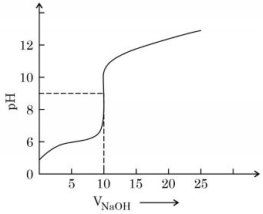
The titration curve of weak acid vs. strong base with phenolphthalein as indictor) is shown below. The $K _{\text {phenolphthalein }}=4 \times 10^{-10}$. Given: $\log 2=0.3$

The number of following statements which is/are correct about phenolphthalein is $.....$.

$A$. It can be used as an indicator for the titration of weak acid with weak base.

$B$. It begins to change colour at $pH =8.4$

$C$. It is a weak organic base

$D$. It is colourless in acidic medium
According to Bronsted principle, an aqueous solution of $HN{O_3}$ will contain
An aqueous solution containing $28\%$ by mass of a liquid (mol. mass $= 140$) has a vapour pressure of $160\ mm$ at $37\,^oC$. Find the vapour pressure of the pure liquid $A$ approximately .......... $mm$ . (The vapour pressure of water at $37\,^oC$ is $150\ mm$)
$CH \equiv CH\mathop {\xrightarrow{{{H_2}O/H{g^{2 + }}}}}\limits_{{H_2}S{O_4}} X\xrightarrow{{LiAl{H_4}}}Y\xrightarrow{{{P_4}/B{r_2}}}Z$ Here $Z$ is