Question
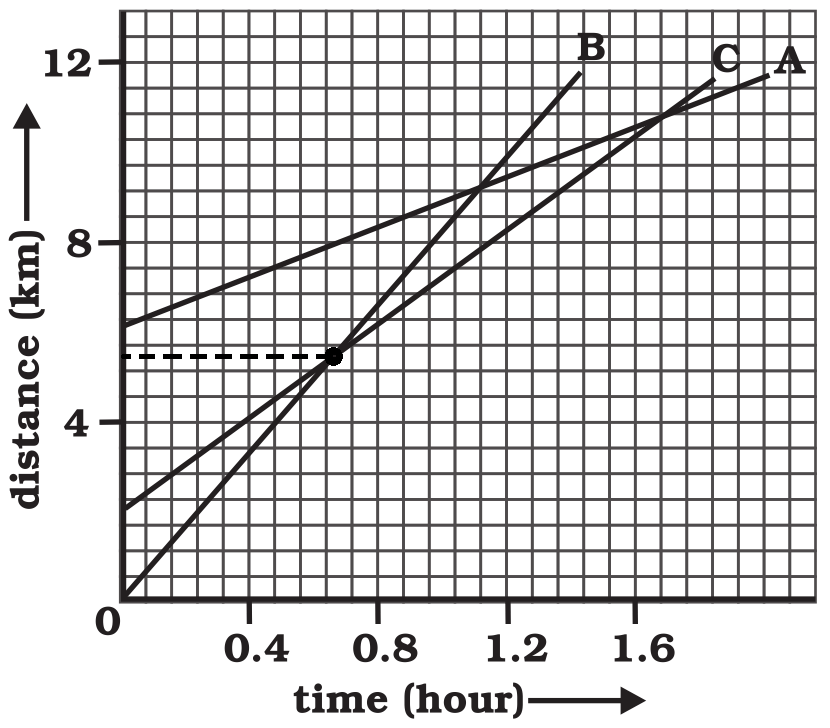
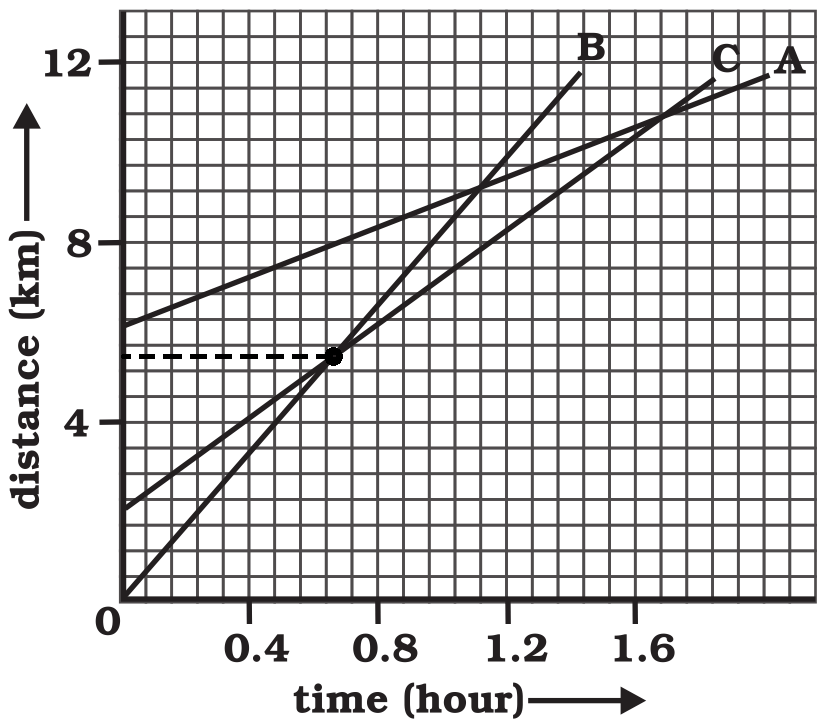
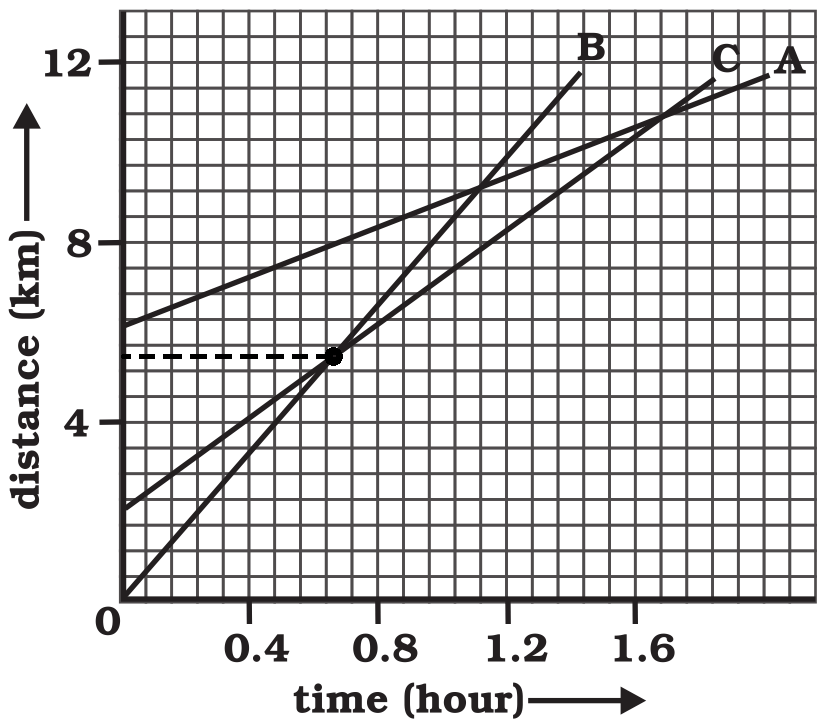
Fig shows the distance-time graph of three objects $A, B$ and $C$. Study the graph and answer the following questions:
  1. Which of the three is travelling the fastest?
  2. Are all three ever at the same point on the road?
  3. How far has $C$ travelled when $B$ passes $A?$
  4. How far has $B$ travelled by the time it passes $C?$
Answer

  1. Object $B$
  2. No
  3. $5.714km$
  4. $5.143km$
  1. Speed $=\frac{\text{Distance}}{\text{Time}}$
Slope of graph $=\frac{\text{y-axis}}{\text{x-axis}}=\frac{\text{Distance}}{\text{Time}}$
Therefore, Speed = slope of the graph.
Since slope of object B is greater than objects $A$ and $C$, it is travelling the fastest.
  1. All three objects $A, B$ and $C$ never meet at a single point. Thus, they were never at the same point on road.
$7$ square box $= 4km$
$\therefore$ $1$ square box $=\frac{4}{7}\text{km}$
$C$ is $4$ blocks away from origin therefore initial distance of $C$ from origin
Distance of $C$ from origin when $B$ passes $A = 8km$
Thus, Distance travelled by $C$ when $B$ passes $A$
$= 8 - \frac{16}{7 }$
$=\frac{(56 - 16)}{7 }$
$=\frac{40}{7}= 5.714\text{km}$
  1. Distance travelled by B by the time it passes $C = 9$ square boxes
$9×\frac{4}{7} =\frac{36}{7}= 5.143\text{km}$

Need a full question paper?

Generate a complete, print-ready paper with questions like this in minutes — across 16+ boards, with answer keys.

Start Generating Free