MCQ
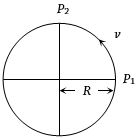
Figure below shows a body of mass $M$ moving with the uniform speed on a circular path of radius, $R$. What is the change in acceleration in going from ${P_1}$ to ${P_2}$
  • A
    Zero
  • B
    ${v^2}/2R$
  • C
    $2{v^2}/R$
  • $\frac{{{v^2}}}{R} \times \sqrt 2 $

Answer

Correct option: D.
$\frac{{{v^2}}}{R} \times \sqrt 2 $
d
(d) $\Delta a = 2a\sin \left( {\frac{\theta }{2}} \right)$= $2a \times \sin 45^\circ $$ = \sqrt 2 a = \sqrt 2 \frac{{{v^2}}}{R}$

Need a full question paper?

Generate a complete, print-ready paper with questions like this in minutes — across 16+ boards, with answer keys.
Start Generating Free

Similar questions

What is the number of significant figures in $ 0.310\times 10^3$
$A$ cylinder and a ring of same mass $M$ and radius $R$ are placed on the top of a rough inclined plane of inclination $\theta$ . Both are released simultaneously from the same height $h$. Identify the correct statement $(s)$
If $\rho$ is the density and $\eta$ is coefficient of viscosity of fluid which flows with a speed $v$ in the pipe of diameter $d$, the correct formula for Reynolds number $R _{ e }$ is ..............
Streamline flow is more likely for liquids with:
$Assertion :$ In simple harmonic motion, the motion is to and fro and periodic
$Reason :$ Velocity of the particle $(v) = \omega \sqrt {k^2 - x^2}$ (where $x$ is the displacement).
A healthy adult of height $1.7 \,m$ has an average blood pressure $( BP )$ of $100 \,mm$ of $Hg$. The heart is typically at a height of $1.3 \,m$ from the foot. Take, the density of blood to be $10^3 \,kg / m ^3$ and note that $100 \,mm$ of $Hg$ is equivalent to $13.3 \,kPa$ (kilo pascals). The ratio of $BP$ in the foot region to that in the head region is close to
Two pendulums differ in lengths by $22\,cm$ . They oscillate at the same place such that one of them makes $15\,oscillations$ and the other makes $18\,oscillations$ during the same time. The lengths (in $cm$ ) of the pendulums are 
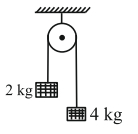
Two blocks of mass $2 \mathrm{~kg}$ and $4 \mathrm{~kg}$ are connected by a metal wire going over a smooth pulley as shown in figure. The radius of wire is $4.0 \times 10^{-5}$ $\mathrm{m}$ and Young's modulus of the metal is $2.0 \times 10^{11} \mathrm{~N} / \mathrm{m}^2$. The longitudinal strain developed in the wire is $\frac{1}{\alpha \pi}$. The value of $\alpha$ is [Use $\mathrm{g}=10 \mathrm{~m} / \mathrm{s}^2$ )
If $I = 50\,kg-m^2$ , then ......... $N-m$ torque will be applied to stop it in $10\,sec$ . Its initial angular speed is $20\,rad/sec$ 
A satellite is moving with a constant speed $v$ in circular orbit around the earth. An object of mass $‘m’$ is ejected from the satellite such that it just escapes from the gravitational pull of the earth. At the time of ejection, the kinetic energy of the object is