Question
Figure represents two simple harmonic motions. The parameter which has different values in the two motions is:
  1. Amplitude.
  2. Frequency.
  3. Phase.
  4. Maximum velocity.

Answer

  1. Phase.
Explanation:
Because the direction of motion of particles A and B is just opposite to each other.

Need a full question paper?

Generate a complete, print-ready paper with questions like this in minutes — across 16+ boards, with answer keys.
Start Generating Free

Similar questions

A person A can clearly see objects between 25cm and 200cm. Which of the following may represent the range of clear vision for a person B having muscles stronger than A, but all other parameters of eye identical to that of A?
The power of two convex lenses A and B are 8 diopters and 4 diopters respectively. If they are to be used as a simple microscope, the magnification of(a) B will be greater than A  (b) A will be greater than B (c) The information is incomplete (d) None of the above 
   
   
Plane polarised light is passed through a polaroid. On viewing through the polaroid we find that when the polariod is given one complete rotation about the direction of the light, one of the following is observed (a) The intensity of light gradually decreases to zero and remains at zero (b) The intensity of light gradually increases to a maximum and remains at maximum(c) There is no change in intensity (d) The intensity of light is twice maximum and twice zero


A piece of wire of resistance 4 ohms is bent through 180°  at its mid point and the two halves are twisted together, then the resistance is(a) 8 ohms(b) 1 ohm(c) 2 ohms(d) 5 ohms
       
When an electric field is applied across a semiconductor:
The minimum wavelength of X-rays emitted by coolidge tube depends upon :
Whenever a stream of electrons collides with a stream of photons, in this collision, which of the following is not conserved?
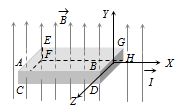
A metallic block carrying current $I$ is subjected to a uniform magnetic induction $\overrightarrow{B}$ as shown in the figure. The moving charges experience a force $\overrightarrow{F}$ given by $.........$ which results in the lowering of the potential of the face $........$ Assume the speed of the carriers to be $v$
In Thomson's experiment if the value of q/m is the same for all positive ions striking the photographic plate, then the trace would be(a) Straight line(b) Parabolic(c) Circular(d) Elliptical
       
The time period of a freely suspended magnet is 4 seconds. If it is broken in length into two equal parts and one part is suspended in the same way, then its time period will be(a) 4 sec (b) 2 sec(c) 0.5 sec(d) 0.25 sec