Question

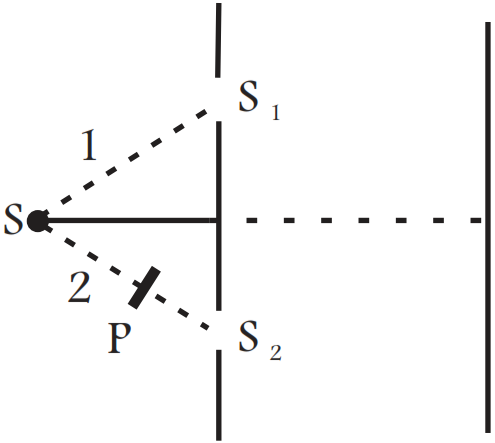
Figure shown a two slit arrangement with a source which emits unpolarised light. P is a polariser with axis whose direction is not given. If I0 is the intensity of the principal maxima when no polariser is present, calculate in the present case, the intensity of the principal maxima as well as of the first minima.
Answer

The resultant amplitude of wave reaching on screen will be the sum of amplitude of either wave in perpendicular and parallel polarisation.
Amplitude of the wave in perpendicular polarisation
$\text{A}_\bot=\text{A}_\bot^1+\text{A}_\bot^2=\text{A}_\bot^0\sin(\text{kx}-\omega\text{t})+\text{A}_\bot^2\sin(\text{kx}-\omega\text{t}+\phi)$
$\Rightarrow\ \text{A}_\bot=\text{A}_\bot^0(\sin(\text{kx}-\omega\text{t})+\sin(\text{kx}-\omega\text{t}+\phi))$
Amplitude of the wave in parallel polarisation
$\text{A}_{||}=\text{A}_{||}^{(1)}+\text{A}_{||}^{(2)}$
$\Rightarrow\ \text{A}_\bot=\text{A}_\bot^0[\sin(\text{kx}-\omega\text{t})+\sin(\text{kx}-\omega\text{t}+\phi)]$
$\therefore$ Average Intensity on the screen
$\text{I}=\begin{Bmatrix} \Big|\text{A}_\bot^0\Big|^2+\Big|\text{A}_\bot^0\Big|^2\end{Bmatrix}\big[\sin(\text{kx}-\omega\text{t})(1+\cos^2\phi+2\sin\phi)+\sin^2(\text{kx}-\omega\text{t})\sin^2\phi\big]_\text{average}$
$=\begin{Bmatrix} \Big|\text{A}_\bot^0\Big|^2+\Big|\text{A}_\bot^0\Big|^2\end{Bmatrix}\Big(\frac{1}{2}\Big)2(1+\cos\phi)$
$\Rightarrow\ \text{I}=2\Big|\text{A}_{||}^0\Big|^2(1+\cos\phi)\text{ since},\Big|\text{A}_\bot^0\Big|_\text{av}+\Big|\text{A}_\bot^0\Big|_\text{av}$
With polariser P,
Assume $\text{A}_\bot^2$ is blocked
Intensity $=(\text{A}_{||}^1+\text{A}_{||}^2)^2+({\text{A}_{||}^2})^2$
$=\Big|\text{A}_{\bot}^0\Big|(1+\cos\phi)+\Big|\text{A}_{\bot}^0\Big|.\frac{1}{2}$
Given, $\text{I}_0=4\Big|\text{A}_{\bot}^0\Big|=$ Intensity without polariser at principal maxima.
Intensity at first minima with polariser
$=\Big|\text{A}_{\bot}^0\Big|(1-1)+\frac{\Big|\text{A}_{\bot}^0\Big|}{2}=\frac{\text{I}_0}{8}.$

Need a full question paper?

Generate a complete, print-ready paper with questions like this in minutes — across 16+ boards, with answer keys.

Start Generating Free

Similar questions

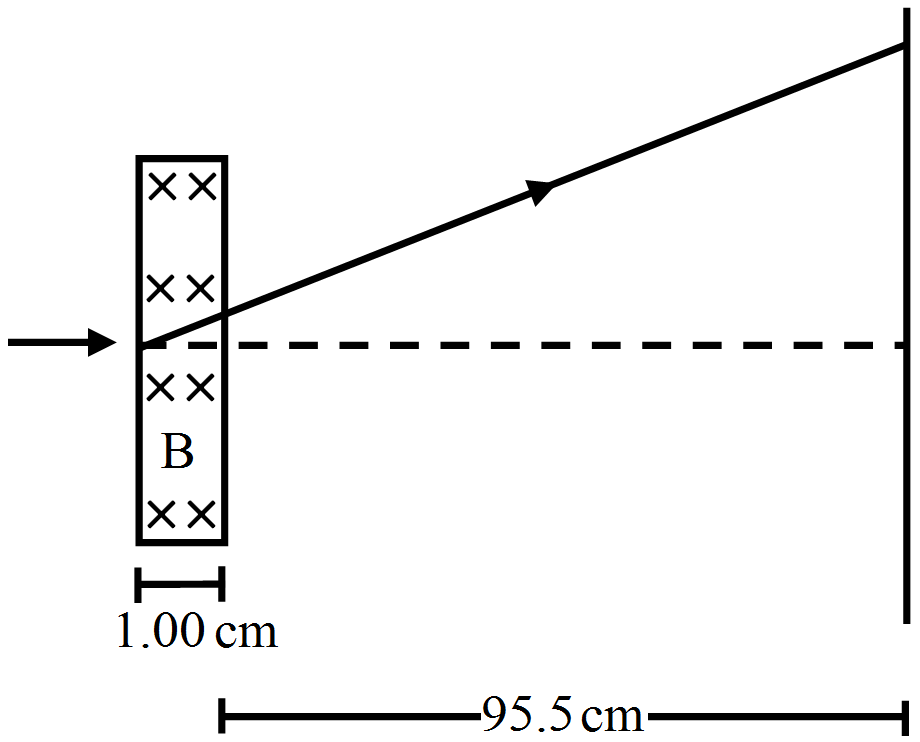
A narrow beam of singly charged potassium ions of kinetic energy 32keV is injected into a region of width 1.00cm with a magnetic field of strength 0.500T, as shown in the figure. The ions are collected at a screen 95.5cm away from the field region. If the beam contains isotopes of atomic weights 39 and 41, find the separation between the points where these isotopes strike the screen. Take the mass of a potassium ion = A (1.6 × 10⁻²⁷)kg, where A is the mass number.

A lady uses +1.5D glasses to have normal vision from 25cm onwards. She uses a 20D lens as a simple microscope to see an object. Find the maximum magnifying power if she uses then microscope
  1. Together with her glass
  2. Without the glass. Do the answers suggest that an object can be more clearly seen through a microscope without using the correcting glasses?
A motorcycle has to move with a constant speed on an overbridge which is in the form of a circular arc of radius R and has a total length L. Suppose the motorcycle starts from the highest point.
  1. What can its maximum velocity be for which the contact with the road is not broken at the highest point?
  2. If the motorcycle goes at speed $\frac{1}{\sqrt2}$ times the maximum found in part (a), where will it lose the contact with the road?
  3. What maximum uniform speed can it maintain on the bridge if it does not lose contact anywhere on the bridge?
A sound source, fixed at the origin, is continuously emitting sound at a frequency of 660Hz. The sound travels in air at a speed of 330m/s. A listener is moving along the line x = 336m at a constant speed of 26m/s. Find the frequency of the sound as observed by the listener when he is:
  1. At y = - 140m.
  2. At y = 0.
  3. At y = 140m.
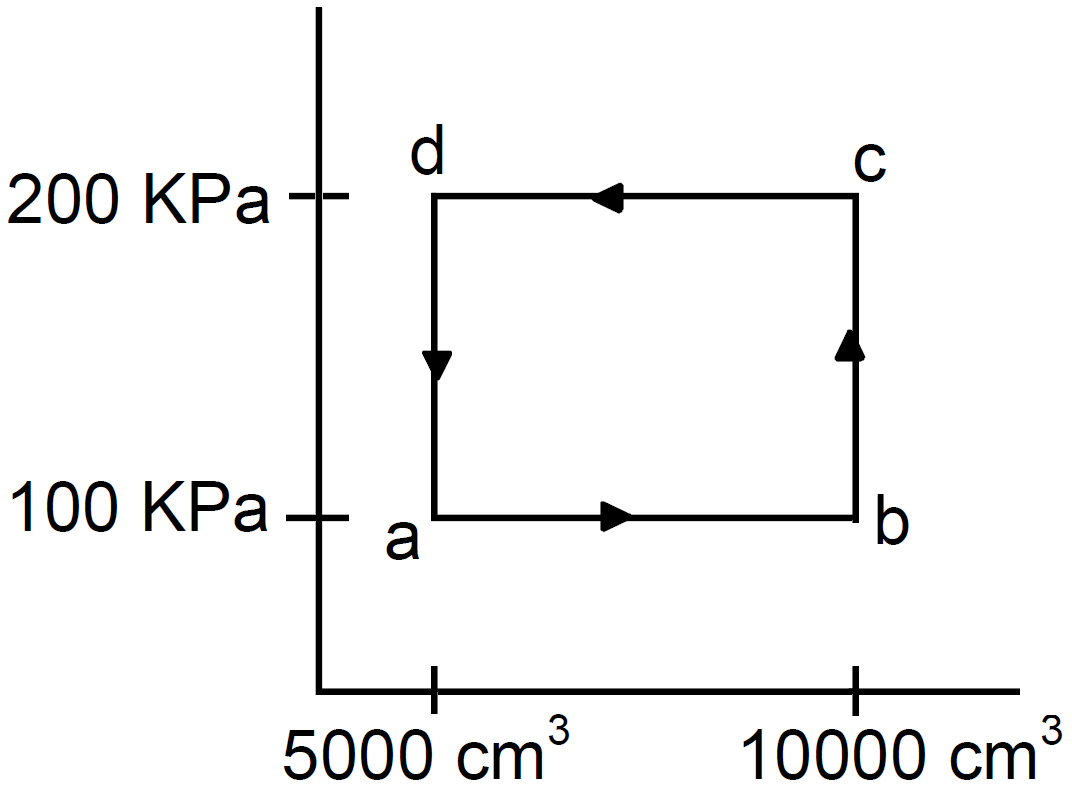
Half mole of an ideal gas $\Big(\gamma=\frac{5}{3}\Big)$ is taken through the cycle abcda, as shown in the figure. Take $\text{R}=\frac{25}{3}\text{JK}^{-1}\text{mol}^{-1}.$
  1. Find the temperature of the gas in the states a, b, c and d.
  2. Find the amount of heat supplied in the processes ab and bc.
  3. Find the amount of heat liberated in the processes cd and da.

A uniform chain of length L and mass M overhangs a horizontal table with its two third part on the table. The friction coefficient between the table and the chain is $\mu.$ Find the work done by the friction during the period the chain slips off the table.
A charge of $1\mu\text{C}$ is given to one plate of a parallel-plate capacitor of capacitance $0.1\mu\text{F}$ and a charge of $2\mu\text{C}$ is given to the other plate. Find the potential difference developed between the plates.
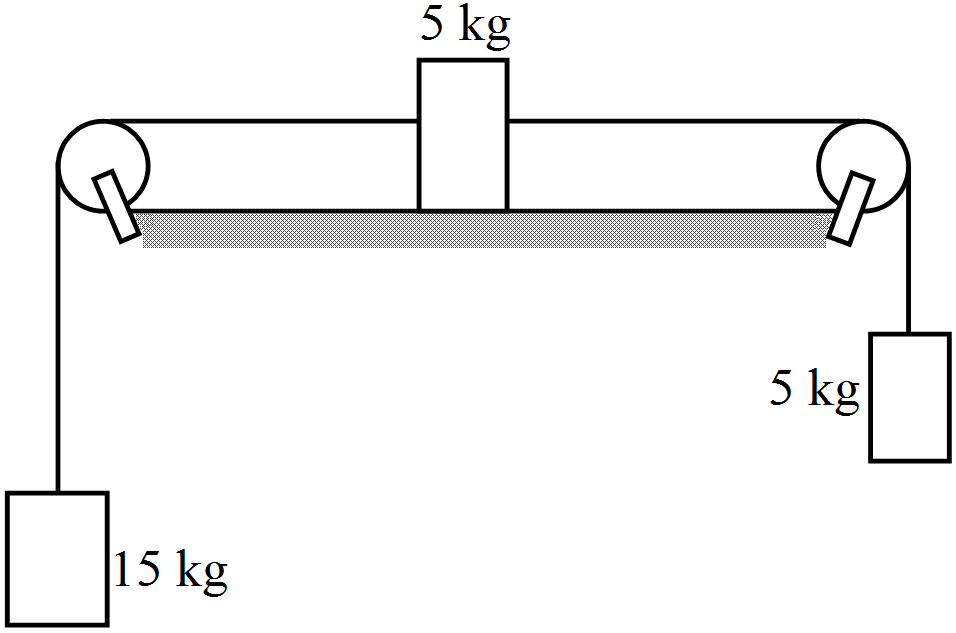
The friction coefficient between the table and the block shown in figure is 0.2. Find the tensions in the two strings.

k transparent slabs are arranged one over another. The refractive indices of the slabs are $\mu_1,\mu_2,\mu_3, \ ...\mu_{\text{k}}$ and the thicknesses are t1, t2, t3, ... tk . An object is seen through this combination with nearly perpendicular light. Find the equivalent refractive index of the system which will allow the image to be formed at the same place.
An electrical device draws 2kW power from AC mains $(\text{voltage }223\text{V}\text{(rms)}=\sqrt{50.000}\text{V})$. The current differs (lags) in phase by $\phi\Big(\tan\phi=\frac{-3}{4}\Big)$ as compared to voltage. Find,
  1. R,
  2. XC - XL,
  3. IM. Another device has twice the values for R, XC and XL. How are the answers affected?