Question
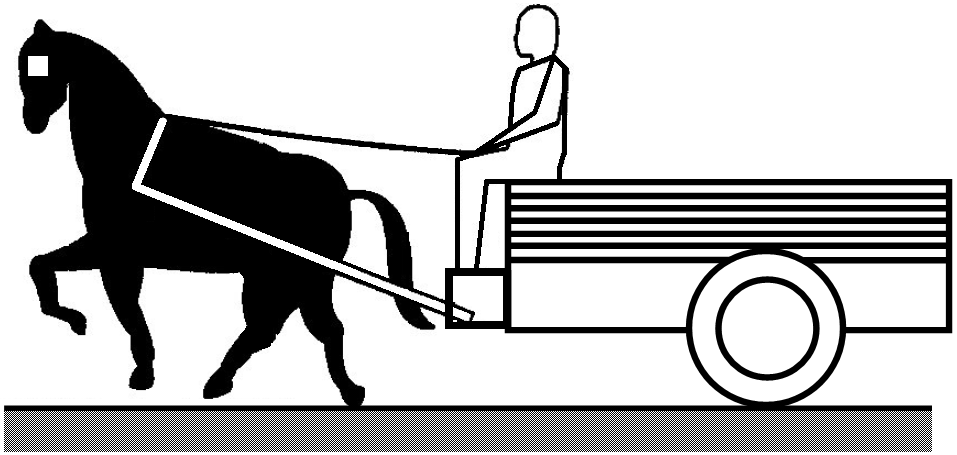
Figure shows a cart. Complete the table shown.
Answer

Force on Force by Nature Direction
cart gravity(weight) gravitational downward
friction(road) mechanical backward
pull (horse) mechanical forward
horse cart(weight) gravitational downward
pull(cart) mechanical backward
driver pull (cart) mechanical forward

Need a full question paper?

Generate a complete, print-ready paper with questions like this in minutes — across 16+ boards, with answer keys.

Start Generating Free

Similar questions

A wheel of moment of inertia $0.10kg-m^2$ is rotating about a shaft at an angular speed of 160rev/ minute. A second wheel is set into rotation at 300rev/ minute and is coupled to the same shaft so that both the wheels finally rotate with a common angular speed of 200rev/ minute. Find the moment of inertia of the second wheel.
If the acceleration due to gravity on moon is one sixth that on the earth what will be the length and time period of a second's pendulum there? (g = 9.8 ms?)
If the radius of the earth were increased by a factor of 3, by what factor would its density have to be changed to keep 'g' the same?
An ice box is built of wood $1.75cm$ thick, lined inside with cork $2cm$ thick. If the temperature of the inner surface of the cork is $0°C$ and that of the outer surface of the wood is $12°C$, what is the temperature of the interface? The thermal conductivity of wood is $0.0006$ and that of cork is $0.00012$ CGS units.
Establish a relation between angular momentum and moment of inertia of a rigid body. Define moment of inertia in terms of it.
Considering the pressure p to be proportional to the density, find the pressure p at a height h if the pressure on the surface of the earth is $p_0$.
Calculate the ratio of the angular momentum of the earth about its axis due to its spinning motion to that about the sun due to its orbital motion. Radius of the earth = $6400km$ and radius of the orbit of the earth about the sun = $1.5 \times 10^8km$.
The centre of mass is defined as $\overrightarrow{\text{R}}=\frac{1}{\text{M}}\sum\limits_\text{i}\text{m}_\text{i}\overrightarrow{\text{r}_{\text{i}}}.$ Suppose we define "centre of charge" as $\overrightarrow{\text{R}}_\text{c}=\frac{1}{\text{Q}}\sum\limits_\text{i}\text{q}_\text{i}\overrightarrow{\text{r}_{\text{i}}}$ where $q_i$ represents the $i^{th}$ charge placed at $\overrightarrow{\text{r}_\text{i}}$ and Q is the total charge of the system.
  1. Can the centre of charge of a two-charge system be outside the line segment joining the charges?
  2. If all the charges of a system are in X-Y plane, is it necessary that the centre of charge be in X-Y plane?
  3. If all the charges of a system lie in a cube, is it necessary that the centre of charge be in the cube?
Calculate the number of states per cubic metre of sodium in $3s$ band. The density of sodium is $1013\ kg/ m^3$. How many of them are empty?
Find the radius and energy of a $He^+$ ion in the states $(a) n = 1, (b) n = 4$ and $(c) n = 10.$