Question
Figure shows a charge array known as an electric quadrupole. For a point on the axis of the quadrupole, obtain the dependence of potential on r for r/a >> 1, and contrast your results with thatdue to an electric dipole, and an electric monopole (i.e., a single charge).


Answer

Four charges of same magnitude are placed at points X, Y, Y, and Z respectively, as shown in the following figure. A point is located at P, which is r distance away from point Y. The system of charges forms an electric quadrupole. It can be considered that the system of the electric quadrupole has three charges. Charge +q placed at point X
Charge -2q placed at point Y
Charge +q placed at point Z XY = YZ = a
YP = r
PX = r + a
PZ = r - a Electrostatic potential caused by the system of three charges at point P is given by, $\text{V}=\frac{1}{{4}\pi\in_{0}}\bigg[\frac{\text{q}}{\text{XP}}-\frac{{2}\text{q}}{\text{YP}}+\frac{\text{q}}{\text{ZP}}\bigg]$ $=\frac{1}{{4}\pi\in_{0}}\bigg[\frac{\text{q}}{\text{r}+\text{a}}-\frac{{2}\text{q}}{\text{r}}+\frac{\text{q}}{\text{r}-\text{a}}\bigg]$ $=\frac{\text{q}}{{4}\pi\in_{0}}\bigg[\frac{\text{r}(\text{r}-\text{a})-{2}(\text{r}+\text{a})(\text{r}-\text{a})+\text{r}(\text{r}+\text{a})}{\text{r}(\text{r}+\text{a})(\text{r}-\text{a})}\bigg]$ $=\frac{\text{q}}{{4}\pi\in_{0}}\bigg[\frac{\text{r}^2-\text{ra}-{2}\text{r}^2+{2}\text{a}^2+\text{r}^2+\text{ra}}{\text{r}(\text{r}^2-\text{a}^2)}\bigg]$ $=\frac{\text{q}}{{4}\pi\in_{0}}\bigg[\frac{2\text{a}^2}{\text{r}(\text{r}^2-\text{a}^2)}\bigg]$ $=\frac{{2}\text{qa}^2}{{4}\pi\in_{0}\text{r}^3\bigg({1}-\frac{\text{a}^2}{\text{r}^2}\bigg)}$ since $\frac{\text{r}}{\text{a}}>>{1}$ $\therefore\ \frac{\text{r}}{\text{a}}>>{1}$$\frac{\text{r}^2}{\text{a}^2}$ is taken as negligible.
$\therefore\ \text{V}=\frac{{2}\text{qa}^2}{{4}\pi\in_{0}\text{r}^3}$ It can be inferred that potential, $\text{V}\propto\frac{1}{\text{r}^3}$ However, it is known that for a dipole, $\text{V}\propto\frac{1}{\text{r}^2}$ And, for a monopole, $\text{V}\propto\frac{1}{\text{r}}$

Need a full question paper?

Generate a complete, print-ready paper with questions like this in minutes — across 16+ boards, with answer keys.

Start Generating Free

Similar questions

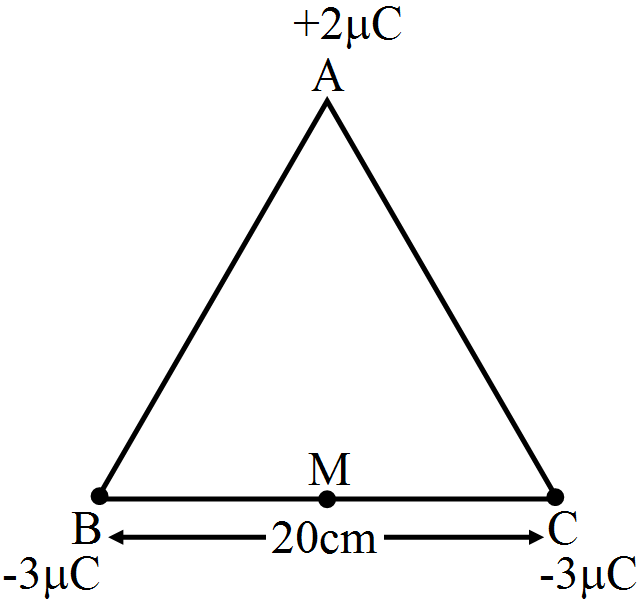
Three point charges of $+2\mu\text{C}, -3\mu\text{C}$ and $-3\mu\text{C}$ are kept at the vertices A, B and C respectively of an equilateral triangle of side 20cm as shown in figure. What should be the sign and magnitude of charge to be placed at the midpoint M of side BC so that charge at A remains in equilibrium?
Positive charge Q is distributed uniformly over a circular ring of radius R. A particle having a mass m and a negative charge q, is placed on its axis at a distance x from the centre. Find the force on the particle. Assuming x << R, find the time period of oscillation of the particle if it is released from there.
A sound source, fixed at the origin, is continuously emitting sound at a frequency of 660Hz. The sound travels in air at a speed of 330m/s. A listener is moving along the line x = 336m at a constant speed of 26m/s. Find the frequency of the sound as observed by the listener when he is:
  1. At y = - 140m.
  2. At y = 0.
  3. At y = 140m.
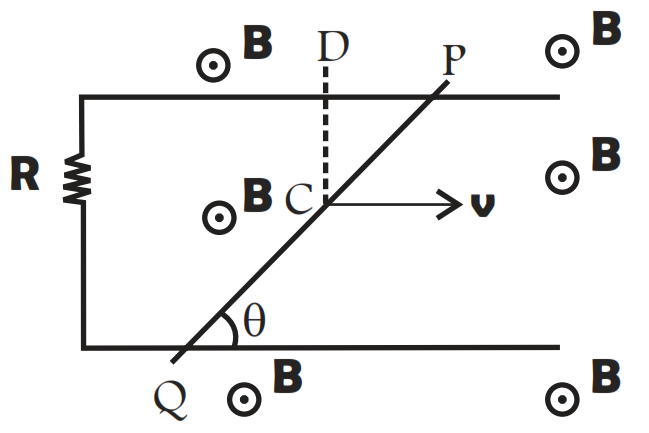
Find the current in the wire for the configuration shown in Fig. Wire PQ has negligible resistance. B, the magnetic field is coming out of the paper. θ is a fixed angle made by PQ travelling smoothly over two conducting parallel wires seperated by a distance d.
Consider an electron in front of metallic surface at a distance d (treated as an infinite plane surface). Assume the force of attraction by the plate is given as $\frac{1}{2}\frac{\text{q}^2}{4\pi\in_0\text{d}^2}$
Calculate work in taking the charge to an infinite distance from the plate. Taking d = 0.1nm, find the work done in electron volts. [Such a force law is not valid for d < 0.1nm].
A circular coil of 200 turns has a radius of 10cm and carries a current of 2.0A.
  1. Find the magnitude of the magnetic field. B at the centre of the coil.
  2. At what distance from the centre along the axis of the coil will the field B drop to half its value at the centre? $\big(\sqrt[3]{4}=1.5874\ ...\big)$
Obtain an expression for the frequency of radiation emitted when a hydrogen atom de-excites from level n to level (n – ncy of revolution of the electron in the orbit.
Two metre scales, one of steel and the other of aluminium, agree at $20^\circ C$. Calculate the ratio aluminium-centimetre/ steel-centimetre at:
  1. $0^\circ C,$
  2. $40^\circ C$
  3. 100C. $\alpha$ for steel $=1.1 \times 10^{-5}{ }^{\circ} \mathrm{C}^{-1}$ and for aluminium $=2.3 \times 10^{-5}{ }^{\circ} \mathrm{C}^{-1}$.
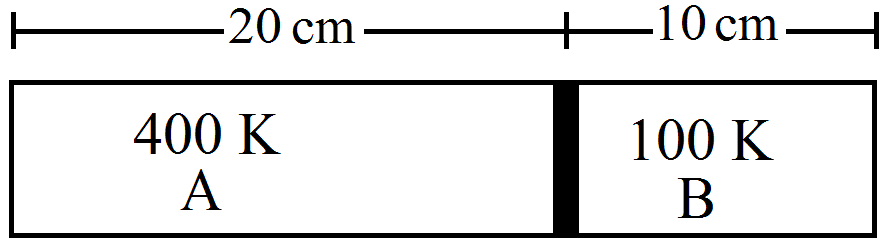
Figure. shows a cylindrical tube of length 30cm which is partitioned by a tight-fitting separator. The separator is very weakly conducting and can freely slide along the tube. Ideal gases are filled in the two parts of the vessel. In the beginning, the temperatures in the parts A and B are 400K and 100K respectively. The separator slides to a momentary equilibrium position shown in the figure. Find the final equilibrium position of the separator, reached after a long time.
Write the upper and lower limits of interference in terms of path difference.