Question
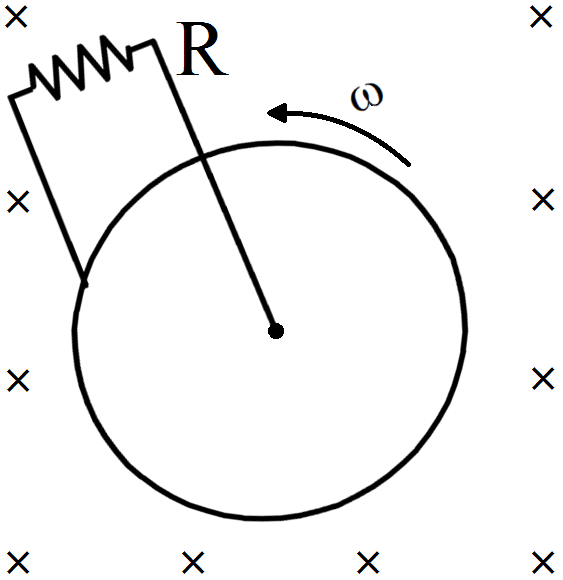
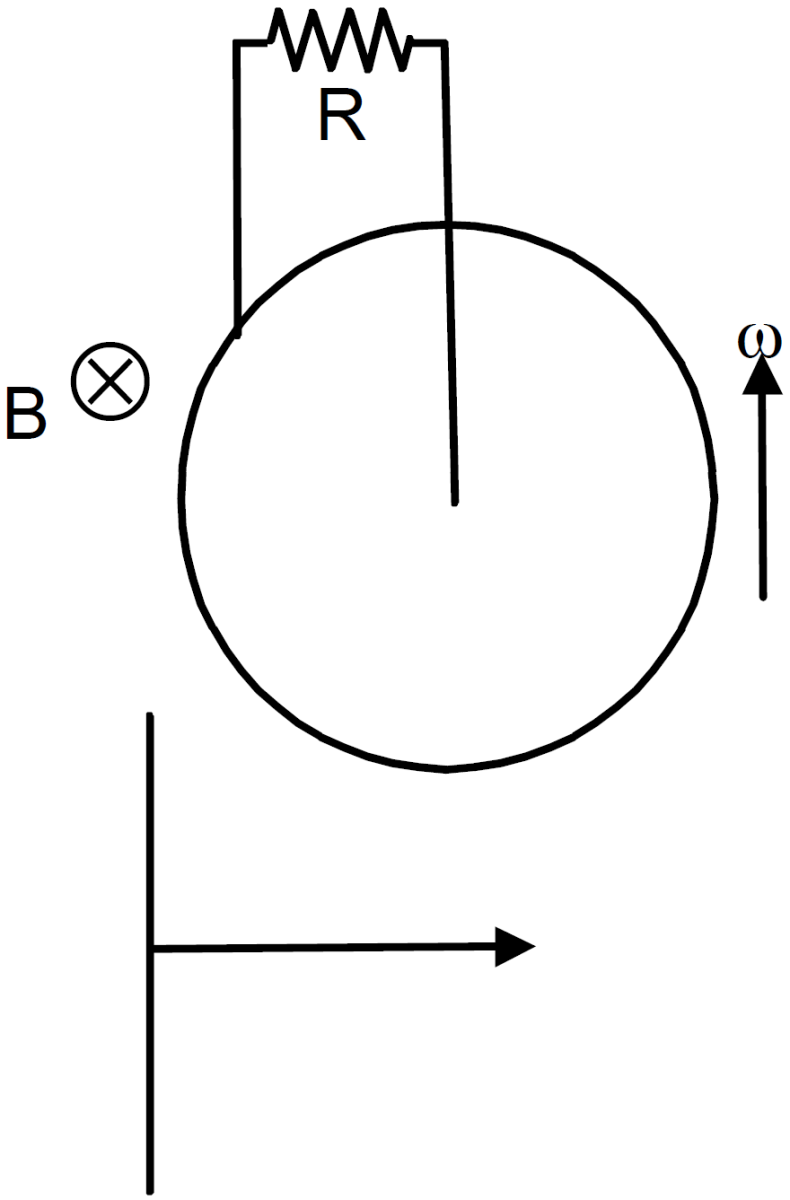
Figure shows a conducting disc rotating about its axis in a perpendicular magnetic field B. A resistor of resistance R is connected between the centre and the rim. Calculate the current in the resistor. Does it enter the disc or leave it at the centre? The radius of the disc is 5.0cm, angular speed $\omega=10 \ \text{rad/s}, \ \text{B}=0.40\text{T}$ and $\text{R}=10\Omega.$
Answer


$\text{B}=0.40\text{T},\omega=10 \ \text{rad}/',\text{r}=10\Omega$
$\text{r}=5\text{cm}=0.05\text{m}$
Considering a rod of length 0.05m affixed at the centre and rotating with the same $\omega$.
$\text{V}=\frac{\text{L}}{2}\times\omega=\frac{0.05}{2}\times10$
$\text{e}=\text{BLV}=0.40\times\frac{0.05}{2}\times10\times0.05=5\times10^{-3}\text{V}$
$\text{L}=\frac{\text{e}}{\text{R}}=\frac{5\times10^{-3}}{10}=0.5 \ \text{mA}$
It leaves from the centre.

Need a full question paper?

Generate a complete, print-ready paper with questions like this in minutes — across 16+ boards, with answer keys.

Start Generating Free

Similar questions

  1. Explain with the help of a diagram formation of depletion region and barrier potential in a pn junction.
  2. Draw the circuit diagram of a half wave rectifier and explain its working.
A wheel rotating at a speed of 600rpm (revolutions per minute) about its axis is brought to rest by applying a constant torque for 10 seconds. Find the angular deceleration and the angular velocity 5 seconds after the application of the torque.
The magnifying power of a simple microscope is given by $1+\frac{\text{D}}{\text{f}},$ where D is the least distance for clear vision. For farsighted persons, D is greater than the usual. Does it mean that the magnifying power of a simple microscope is greater for a farsighted person as compared to a normal person? Does it mean that a farsighted person can see an insect more clearly under a microscope than a normal person?
A traffic policeman standing on a road sounds a whistle emitting the main frequency of 2.00kHz. What could be the appparent frequency heard by a scooter-driver approaching the policeman at a speed of 36.0km/h? Speed of sound in air = 340m/s.
The thickness of a glass plate is measured to be 2.17mm, 2.17mm and 2.18mm at three different places. Find the average thickness of the plate from this data.
Write the mathematical relation for the resistivity of a material in terms of relaxation time, number density and mass and charge of charge carriers in it. Explain, using this relation, why the resistivity of a metal increases and that of a semi-conductor decreases with rise in temperature.
In a series LCR circuit connected to an ac source of variable frequency and voltage v $v_m= \sin, $ draw a plot showing the variation of current (I) with angular frequency ($\omega$) for two different values of resistance R1 and R2(R1 > R2 ). Write the condition under which the phenomenon of resonance occurs. For which value of the resistance out of the two curves, a sharper resonance is produced? Define Q-factor of the circuit and give its significance.
Write Biot-Savart law. Write the path of the motion of an electron when it enters magnetic field (a) perpendicularly (b) at $\theta$ angle.
An electric bulb is designed to operate at 12 volts DC. If this bulb is connected to an AC source and gives normal brightness, what would be the peak voltage of the source?
The number density of free electrons in a copper conductor estimated in Example 3.1 is $8.5 \times 10^{28}m^{-3}.$ How long does an electron take to drift from one end of a wire 3.0 m long to its other end? The area of cross-section of the wire is $2.0 \times 10^{-6} m^2$ and it is carrying a current of 3.0 A.