Question
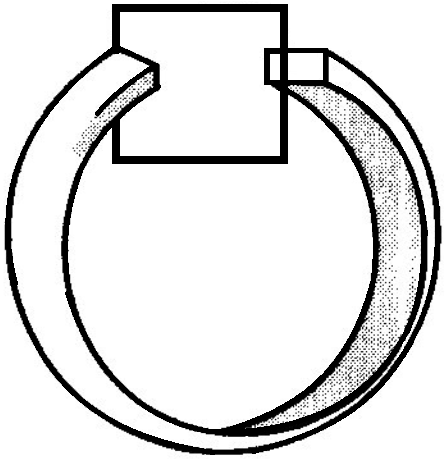
Figure shows a conducting square loop placed parallel to the pole faces of a ring magnet. The Pole-faces have an area of 1cm2 each and the field between the poles is 0.10T. The wires making the loop are all outside the magnetic field. If the magnet is removed in 1.0s, what is the average emf induced in the loop?
Answer

$\text{B}=0.10\text{T}$

$\text{A}=1\text{cm}^2=10^{-4}\text{m}^2$

$\text{T}=1\text{s}$

$\phi=\text{B}.\text{A=}10^{-1}\times10^{-4}=10^{-5}$

$\text{e}=\frac{\text{d}\phi}{\text{dt}}=\frac{10^{-5}}{1}=10^{-5}=10\mu\text{V}$

Need a full question paper?

Generate a complete, print-ready paper with questions like this in minutes — across 16+ boards, with answer keys.

Start Generating Free

Similar questions

Find the dimensions of:

  1. Electric field E,
  2. Magnetic field B and
  3. Magnetic permeability $\mu_0.$
The relevant equations are

$\text{F = qE, F = qvB,}$ and $\text{B}=\frac{\mu_0\text{I}}{2\pi\alpha};$

where F is force, q is charge, v is speed, I is current, and a is distance.

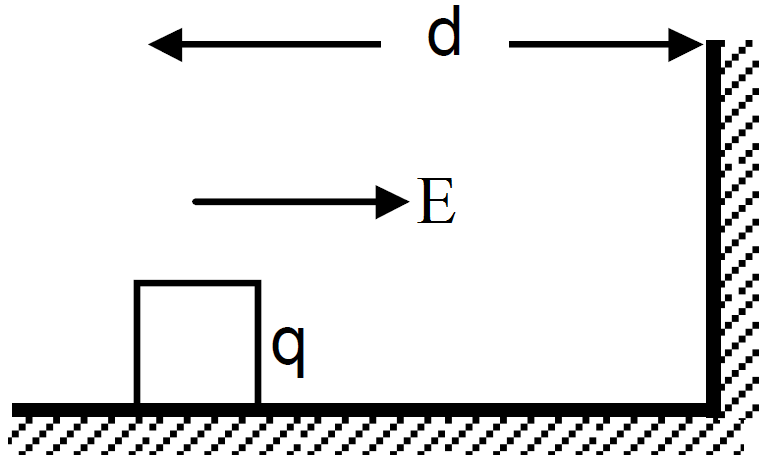
A block of mass m containing a net positive charge q is placed on a smooth horizontal table which terminates in a vertical wall as shown in figure. The distance of the block from the wall is d. A horizontal electric field E towards right is switched on. Assuming elastic collisions (if any) find the time period of the resulting oscillatory motion. Is it a simple harmonic motion?

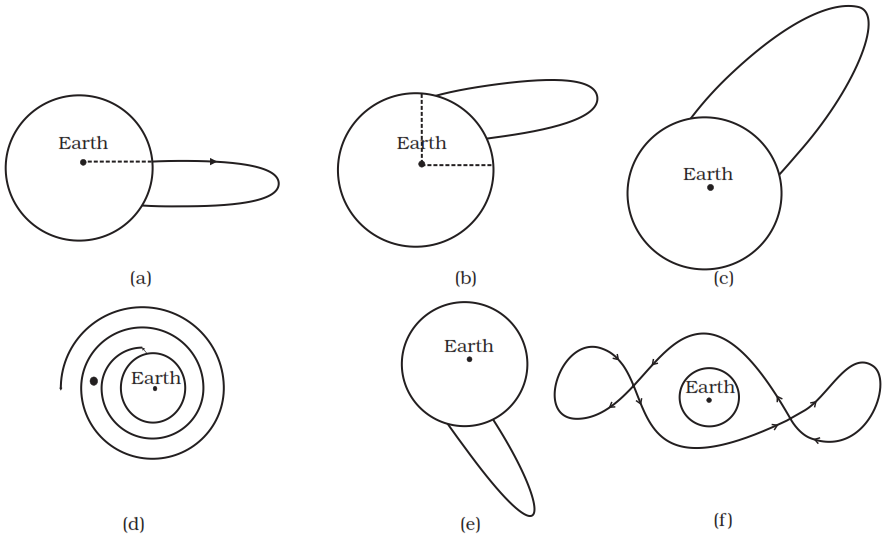
Shown are several curves. Explain with reason, which ones amongst them can be possible trajectories traced by a projectile (neglect air friction).

List any two characteristics of simple harmonic motion.
A particle starting from rest moves with constant acceleration. If it takes 5.0s to reach the speed 18.0km/h find:
  1. The average velocity during this period.
  2. The distance travelled by the particle during this period.
The stress-strain curves of two different types of rubbers are shown in the following figure. How are these stress-strain curves of rubber different from those of metals?
In what ways are the gas thermometers superior to mercury thermometers?
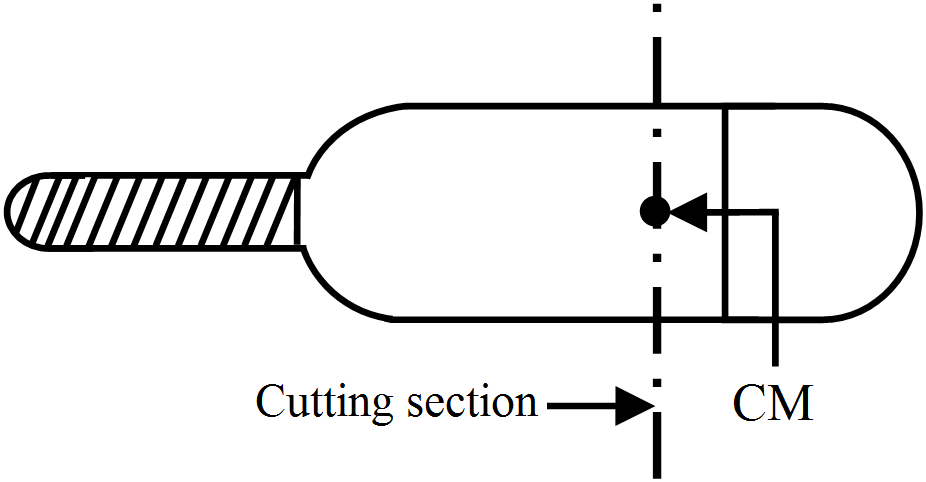
A cricket bat is cut through its centre of mass into two parts as shown

Then, state whether both parts are of same mass or not. Also, give reason.
Is the bulb of a thermometer made of diathermic or adiabatic wall?
A block of wood is floating on water at 0°C with a certain volume x above the level of water. The temperature of water is gradually increased from 0°C to 8°C. How does the volume x change with change in temperature?