Question
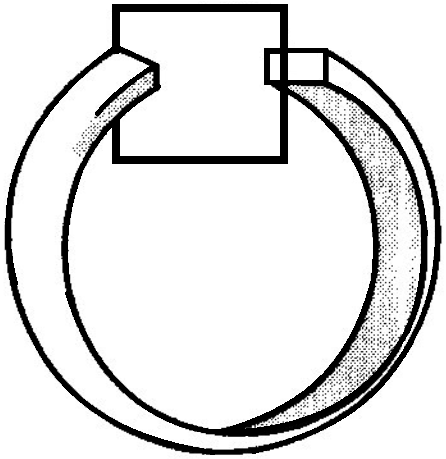
Figure shows a conducting square loop placed parallel to the pole faces of a ring magnet. The Pole-faces have an area of 1cm2 each and the field between the poles is 0.10T. The wires making the loop are all outside the magnetic field. If the magnet is removed in 1.0s, what is the average emf induced in the loop?
Answer

$\text{B}=0.10\text{T}$
$\text{A}=1\text{cm}^2=10^{-4}\text{m}^2$
$\text{T}=1\text{s}$
$\phi=\text{B}.\text{A=}10^{-1}\times10^{-4}=10^{-5}$
$\text{e}=\frac{\text{d}\phi}{\text{dt}}=\frac{10^{-5}}{1}=10^{-5}=10\mu\text{V}$

Need a full question paper?

Generate a complete, print-ready paper with questions like this in minutes — across 16+ boards, with answer keys.

Start Generating Free

Similar questions

An equilateral glass prism has a refractive index 1.6 in air. Calculate the angle of minimum deviation of the prism, when kept in a medium of refractive index $\frac{4\sqrt2}{5}.$
A particle executes simple harmonic motion. If you are told that its velocity at this instant is zero, can you say what is its displacement? If you are told that its velocity at this instant is maximum, can you say what is its displacement?
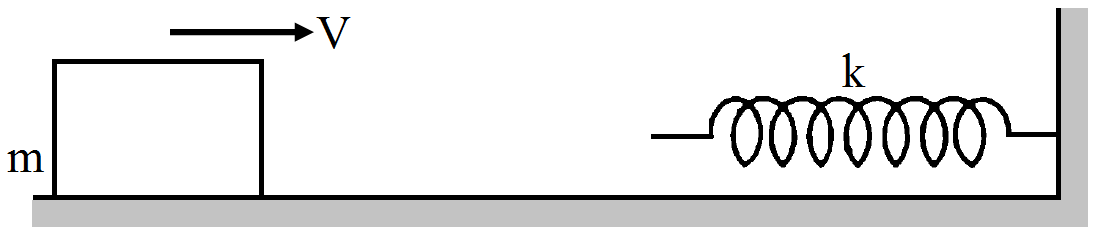
A block of massip, sliding on a smooth horizontal surface with a velocity $\vec{\text{v}}$ meets a long horizontal spring fixed at one end and having spring constant k as shown in figure. Find the maximum compression of tin spring. Will the velocity of the block be the same $\vec{\text{v}}$ when it comes back to the original position shown?

Can the dispersive power $\omega=\frac{\mu_\text{v}-\mu\text{r}}{\mu-1}$ be negative? What is the sign of co if a hollow prism is immersed into water?
How the radii of different stable orbits are related to principal quantum number?
What is the radius of the path of an electron (mass $9 \times 10^{-31} kg$ and charge $1.6 \times 10^{-19} C$ ) moving at a speed of $3 \times 10^7 m / s$ in a magnetic field of $6 \times 10^{-4} T$ perpendicular to it? What is its frequency? Calculate its energy in $keV .\left(1 eV =1.6 \times 10^{-19} J \right)$.
Briefly explain Rutherford's nuclear model.
Define electric flux. Write its S.I. units. A spherical rubber balloon carries a charge that is uniformly distributed over its surface. As the balloon is blown up and increases in size, how does the total electric flux coming out of the surface change? Give reason.
The susceptibility of magnesium at 300K is 1.2 × 10-5. At what temperature will the susceptibility increase to 1.8 × 10-5?
What are eddy currents? Write any two applications of eddy currents.