MCQ
Figure shows a hemispherical shell. The direction of gravitational field intensity at point $p$ will be along
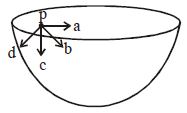
  • A
    $a$
  • B
    $b$
  • $c$
  • D
    $d$

Answer

Correct option: C.
$c$
c

Need a full question paper?

Generate a complete, print-ready paper with questions like this in minutes — across 16+ boards, with answer keys.
Start Generating Free

Similar questions

A container has $3$ gases whose mass ratio is $1:3:5.$ What is the ratio of mean square speed of the molecules of two gases? Their atomic masses are $20u, 30u\ \&\ 40u$ corresponding to the order in which the ratios are given.
A flywheel is making $\frac{3000}{\pi}$ revolutions per minute about its axis. If the  moment of inertia of the flywheel about that axis is $400\, kgm^2$, its rotational kinetic  energy is 
The figure shows a velocity-time graph of a particle moving along a straight line  The correct acceleration-time graph of the particle is shown as
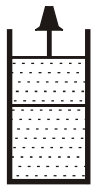
In the figure a container is shown to have a movable (without friction) piston on top. The container and the piston are all made of perfectly insulating material allowing no heat transfer between outside and inside the container. The container is divided into two compartments by a rigid partition made of a thermally conducting material that allows slow transfer of heat. The lower compartment of the container is filled with $2$ moles of an ideal monatomic gas at $700 \ K$ and the upper compartment is filled with $2$ moles of an ideal diatomic gas at $400$

K. The heat capacities per mole of an ideal monatomic gas are $C_v=\frac{3}{2} \ R, C_p=\frac{5}{2} R$, and those for an ideal diatomic gas are $C _{ v }=\frac{5}{2} \ R , C _{ P }=\frac{7}{2} R$.

$1.$ Consider the partition to be rigidly fixed so that it does not move. When equilibrium is achieved, the final temperature of the gases will be :

$(A)$ $550 \ K$ $(B)$ $525 \ K$ $(C)$ $513 \ K$ $(D)$ $490 \ K$

$2.$ Now consider the partition to be free to move without friction so that the pressure of gases in both compartments is the same. Then total work done by the gases till the time they achieve equilibrium will be:

$(A)$ $250 \ R$ $(B)$ $200 \ R$ $(C)$ $100 \ R$ $(D)$ $-100 \ R$

Give the answer question $1$ and $2.$
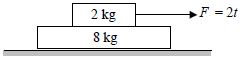
A force $F = Kt$ (where $t$ is the time in seconds and $K = 2\, N/s$) is applied on $2 \,kg$ block at $t = 0$ as shown in the figure. The displacement of $8\ kg$ block till the time when $2\, kg$ block start slipping on $8\,kg$ block will be (coefficient of friction between $2\,kg$ block and $8\, kg$ block is $0.2$ and between $8\, kg$ block and surface is zero,
$g = 10m/s^2)$
A horizontal circular loop carries a current that looks clockwise when viewed from above. It is replaced by an equivalent magnetic dipole consisting of a south pole $S$ and a north pole $N:$
  1. The line $SN$ should be along a diameter of the loop.
  2. The line $SN$ should be perpendicular to the plane of the loop.
  3. The south pole should be slow the loop.
  4. The north pole should be below the loop.
It is possible to hear beats from the two vibrating sources of frequency
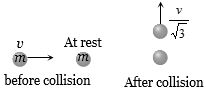
A mass $'m'$ moves with a velocity $'v'$ and collides inelastically with another identical mass. After collision the $1^{st}$ mass moves with velocity $\frac{v}{{\sqrt 3 }}$ in a direction perpendicular to the initial direction of motion. Find the speed of the $ 2^{nd}$ mass after collision
Two springs have their force constant as $k_1$ and $k_2 (k_1 > k_2)$. when they are  stretched by the same force
Moment of inertia of a circular wire of mass $M$ and radius $R$ about its diameter is