Question
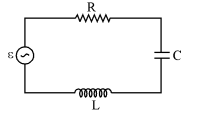
✓
Answer
Given : $L =5.0 H , C =80 \mu F=80 \times 10^{-6} F$$R =40 \Omega, E _{ rms }=230 V$
(a) Frequency f of the source which will cause reso-nance in the circuit
$f=f_r=\frac{1}{2 \pi \sqrt{ LC }}$
$f=f_r=\frac{1 \times 7}{2 \times 22 \sqrt{5.0 \times 80 \times 10^{-6}}}$
$=\frac{7}{2 \times 22 \times 20 \times 10^{-3}}$
$=\frac{7000}{880}=\frac{175}{22} Hz$
Hence, $\quad \omega_r=2 \pi f_r$
$=2 \times \frac{22}{7} \times \frac{175}{22}=50 rad s ^{-1}$
(b) Let the impedance at resonance be $Z$.
$Z=\sqrt{R^2+\left(\omega L-\frac{1}{\omega C}\right)^2}$
At resonance, $\omega=\omega_r$
and$\omega L=\frac{1}{\omega C}$
$\therefore \quad Z=R=40 \Omega$
$I_{ rms }=\frac{E_{ rms }}{Z}=\frac{E_{ rms }}{R}=\frac{230}{40}=5.75 A$
Amplitude of current at resonant frequency
$I_{rms}=\frac{I_0}{\sqrt{2}}$
$\therefore \quad I _0= I _{ rms } \sqrt{2}$
$=5.75 \times \sqrt{2} A$
$=8.13 A=8.1 A$.
(c) Potential drop across the ends of resistor
$V_R=I_{r m s} R$
$=5.75 \times 40=230 V$
Potential drop across the ends of L
$V_{r m s}=I_{r m s} X_L$
$= I _{ rms } \times \omega_{,} L$
$=5.75 \times 50 \times 5.0$
$V _{ rms }=1437.5 V$
In the same way, potential drop across the ends of capacitor
$= I _{ rms } \times X _{ C }$
$= I _{ rms } \times \frac{1}{\omega_r C }$"
$=5.75 \times \frac{1}{50 \times 80 \times 10^{-6}}$
$V _{ rms }=1437.5 V$
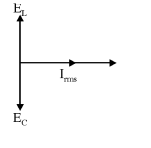
Potential drop across the ends of C = Potential difference across the endsL. $E _{ L }$ of and $E _{ C }$ are equal and opposite.
Hence magnitude of potential drop across the combination of LC combination is zero at resonant frequency.
(a) Frequency f of the source which will cause reso-nance in the circuit
$f=f_r=\frac{1}{2 \pi \sqrt{ LC }}$
$f=f_r=\frac{1 \times 7}{2 \times 22 \sqrt{5.0 \times 80 \times 10^{-6}}}$
$=\frac{7}{2 \times 22 \times 20 \times 10^{-3}}$
$=\frac{7000}{880}=\frac{175}{22} Hz$
Hence, $\quad \omega_r=2 \pi f_r$
$=2 \times \frac{22}{7} \times \frac{175}{22}=50 rad s ^{-1}$
(b) Let the impedance at resonance be $Z$.
$Z=\sqrt{R^2+\left(\omega L-\frac{1}{\omega C}\right)^2}$
At resonance, $\omega=\omega_r$
and$\omega L=\frac{1}{\omega C}$
$\therefore \quad Z=R=40 \Omega$
$I_{ rms }=\frac{E_{ rms }}{Z}=\frac{E_{ rms }}{R}=\frac{230}{40}=5.75 A$
Amplitude of current at resonant frequency
$I_{rms}=\frac{I_0}{\sqrt{2}}$
$\therefore \quad I _0= I _{ rms } \sqrt{2}$
$=5.75 \times \sqrt{2} A$
$=8.13 A=8.1 A$.
(c) Potential drop across the ends of resistor
$V_R=I_{r m s} R$
$=5.75 \times 40=230 V$
Potential drop across the ends of L
$V_{r m s}=I_{r m s} X_L$
$= I _{ rms } \times \omega_{,} L$
$=5.75 \times 50 \times 5.0$
$V _{ rms }=1437.5 V$
In the same way, potential drop across the ends of capacitor
$= I _{ rms } \times X _{ C }$
$= I _{ rms } \times \frac{1}{\omega_r C }$"
$=5.75 \times \frac{1}{50 \times 80 \times 10^{-6}}$
$V _{ rms }=1437.5 V$
Potential drop across the ends of C = Potential difference across the endsL. $E _{ L }$ of and $E _{ C }$ are equal and opposite.
Hence magnitude of potential drop across the combination of LC combination is zero at resonant frequency.
Need a full question paper?
Generate a complete, print-ready paper with questions like this in minutes — across 16+ boards, with answer keys.
Explore more
Similar questions
A charge Q is placed at the centre of an uncharged, hollow metallic sphere of radius a:
- Find the surface charge density on the inner surface and on the outer surface.
- If a charge q is put on the sphere, what would be the surface charge densities on the inner and the outer surfaces?
- Find the electric field inside the sphere at a distance x from the centre in the situations (a) and (b).
Clear the difference between interference and diffraction.
The switch S shown in figure. is kept closed for a long time and is then opened at t = 0. Find the current in the middle $1.0\Omega$ resistor at t = 1ms.
→
A uniform wheel of radius R is set into rotation about its axis at an angular speed $\omega.$ This rotating wheel is now placed on a rough horizontal surface with its axis horizontal. Because of friction at the contact, the wheel accelerates forward and its rotation decelerates till the wheel starts pure rolling on the surface. Find the linear speed of the wheel after it starts pure rolling.
→A multirange current meter can be constructed by using a galvanometer circuit as shown in Fig. We want a current meter that can measure 10mA, 100mA and 1A using a galvanometer of resistance 10Ω and that prduces maximum deflection for current of 1mA. Find S1, S2 and S3 that have to be used.
Figure shows a plane mirror M placed at a distance of 10cm from a concave lens L. A point object is placed at a distance of 60cm from the lens. The image formed due to refraction by the lens and reflection by the mirror is 30cm behind the mirror. What is the focal length of this lens?
Suppose a 'n' - type wafer is created by doping Si crystal having 5 × 1028 atoms/m3 with 1ppm concentration of As. On the surface 200 ppm Boron is added to create ‘P’ region in this wafer. Considering ni = 1.5 × 10¹⁶m-3.
- Calculate the densities of the charge carriers in the n & p regions.
- Comment which charge carriers would contribute largely for the reverse saturation current when diode is reverse biased.
Calculate the smallest wavelength of radiation that may be emitted by (a) hydrogen, (b) He+ and (c) Li++
An empty plastic box of mass m is found to accelerate up at the rate of $\frac{\text{g}}{6}$ when placed deep inside water. How much sand should be put inside the box so that it may accelerate down at the rate of $\frac{\text{g}}{6}?$
→Consider a circular current-carrying loop of radius R in the x-y plane with centre at origin. Consider the line intergral $\Im(\text{L})=\begin{vmatrix}\int\limits_{-\text{L}}^{\text{L}}\text{B.dl} \end{vmatrix}$ taken along z-axis.
→- Show that $\Im(\text{L})$ monotonically increases with L.
- Use an appropriate Amperian loop to show that $\Im(\infty)=\mu_0\text{I}$, where I is the current in the wire.
- Verify directly the above result.
- Suppose we replace the circular coil by a square coil of sides R carrying the same current I. What can you say about $\Im(\text{L})$ and $\Im(\infty)$?