MCQ
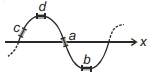
Figure shows a snapshot for a travelling sine wave along a string. Four elemental portions $a, b, c$ and $d$ are indicated on the string. The elemental portion which has maximum potential energy is/are
  • $a$
  • B
    $b$
  • C
    $c$
  • D
    $b$ and $d$

Answer

Correct option: A.
$a$
a
(a)

Maximum potential energy is stored where kinetic energy, i.e., velocity is zero as the total energy of an element of a wave is constant in its oscillating direction.

Need a full question paper?

Generate a complete, print-ready paper with questions like this in minutes — across 16+ boards, with answer keys.
Start Generating Free

Similar questions

Three forces are acting simultaneously at one point. Two forces $\overrightarrow{ P }, \overrightarrow{ Q }$ are $(2 \hat{i}-3 \hat{j})$ and $(\hat{i}-\hat{j})$ respectively. If the object is in equilibrium then which will be the third:
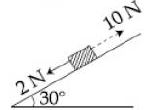
A block kept on a rough inclined plane, as shown in the figure, remains at rest upto a maximum force $2\,N$ down the inclined plane. The maximum external force up the inclined plane that does not move the block is $10\,N.$ The coefficient of static friction between the block and the plane is : [Take $g = 10\,m/s^2$ ]
$5.6$ liter of helium gas at $STP$ is adiabatically compressed to $0.7$ liter. Taking the initial temperature to be $T _1$, the work done in the process is
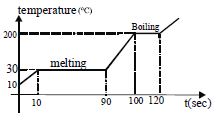
A given mass $m$ of a hypothetical solid is supplied with heat continuously at a constant rate and the graph shown in the adjacent figure is plotted. If $L_f$ and $L_v$ are latent heats of fusion and latent heats of vaporization and $S_l$ and $S_s$ are specific heats of liquid and solid respectively. It can be concluded that 
A body of mass $1\, kg$ is under a force, which causes a displacement in it is given by $x = \frac{{{t^3}}}{3}$ (in $m$). Find the work done by the force in first second ............ $\mathrm{J}$
A solid sphere and a solid cylinder of same mass and radius are rolling on a horizontal surface without slipping. The ratio of their radius of gyrations respectively $\left( k _{\text {sph }}: k _{ cyl }\right)$ is $2: \sqrt{ x }$, then value of $x$ is .............
Find the gravitational field at a distance of $2000\, km$ from centre of earth. (in $m / s ^{2}$)

(Given $\left.R_{\text {earth }}=6400 km , r =2000 km , M _{\text {earth }}=6 \times 10^{24} kg \right)$
You lift a suitcase from the floor and keep it on the table. The work done by you on the suitcase depends on:
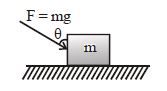
The force acting on the block pushes it, then pushing of the block will be possible along the surface if
The path difference between the two waves ${y_1} = {a_1}\sin \,\left( {\omega t - \frac{{2\pi x}}{\lambda }} \right)$ and ${y_2} = {a_2}\cos \,\left( {\omega t - \frac{{2\pi x}}{\lambda } + \phi } \right)$ is