Question
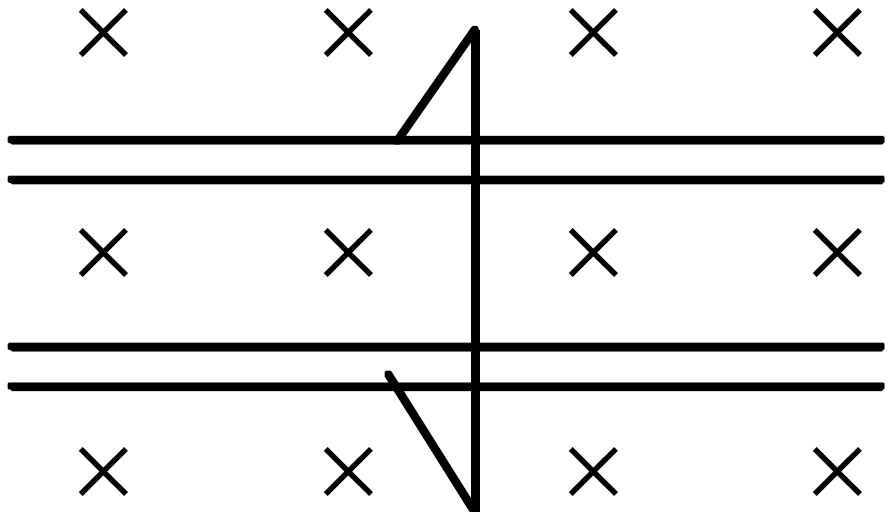
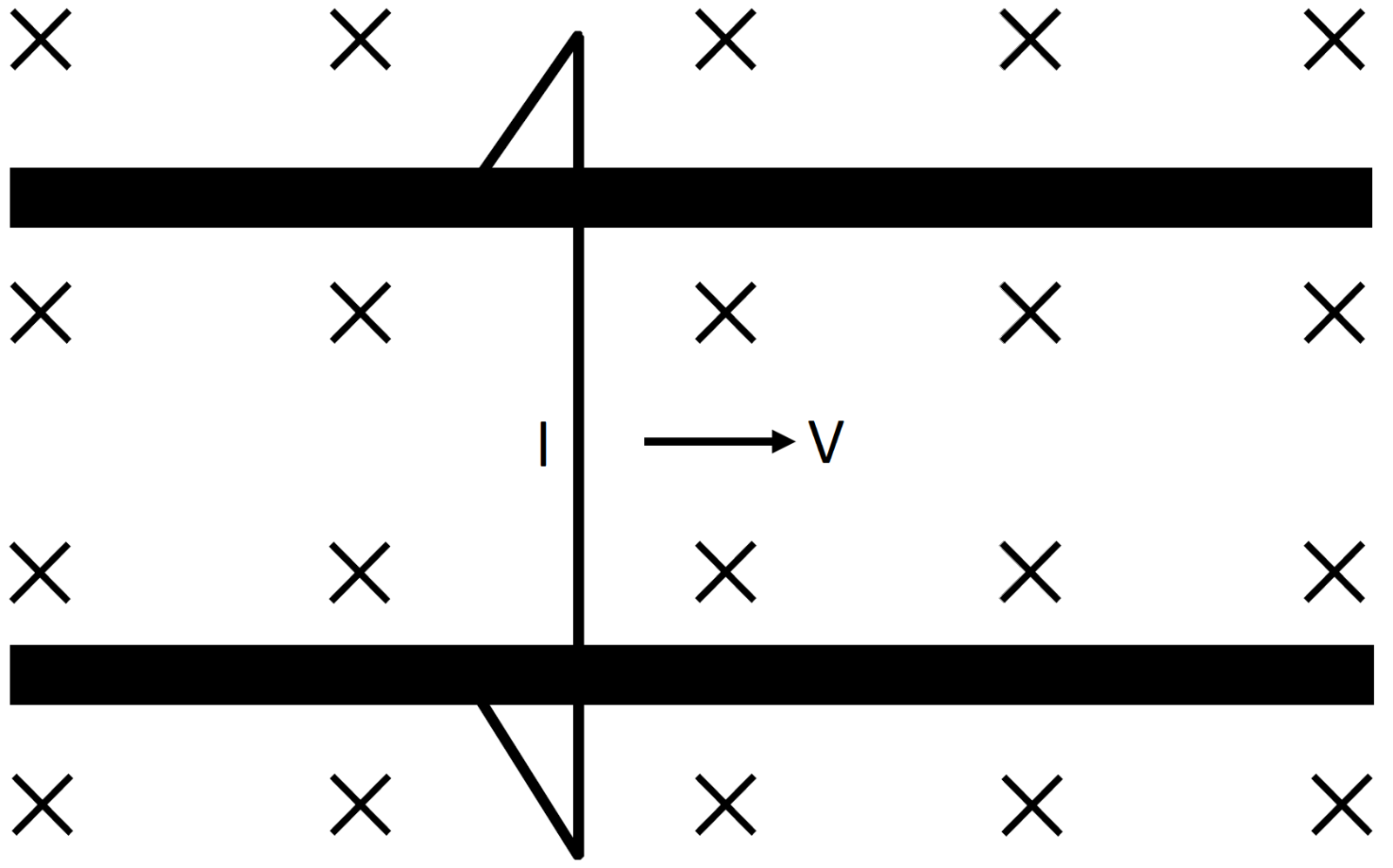
Figure shows a wire sliding on two parallel, conducting rails placed at a separation l. A magnetic field B exists in a direction perpendicular to the plane of the rails. What force is necessary to keep the wire moving at a constant velocity v?
Answer


Fmagnetic = ilB
This force produces an acceleration of the wire.
But since the velocity is given to be constant.
Hence net force acting on the wire must be zero.

Need a full question paper?

Generate a complete, print-ready paper with questions like this in minutes — across 16+ boards, with answer keys.

Start Generating Free

Similar questions

While gas from a cooking gas cylinder is used, the pressure does not fall appreciably till the last few minutes. Why?
A closed and an open pipe are sounded for same frequency. What is the ratio of their lengths?
A sphere of mass m rolls on a plane surface. Find its kinetic energy at an instant when its centre moves with speed v.
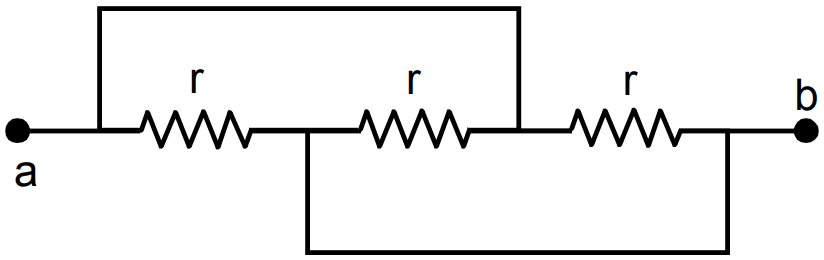
Find the equivalent resistance of the network shown in figure. between the points a and b.

A free neutron beta-decays to a proton with a half-life of 14 minutes.
  1. What is the decay constant?
  2. Find the energy liberated in the process.
Explain why
The size of the needle of a syringe controls flow rate better than the thumb pressure exerted by a doctor while administering an injection.
Two forces of 3 N each are acting simultaneously on a 6 kg wooden bundle.
(i) If these forces makes an angle of $90^{\circ}$ with each other then find the magnitude and direction of the acceleration produced in cart.
(ii) If the force in one direction what will be the acceleration?
(iii) What will be acceleration if the forces are acting in opposite directions?
The acceleration due to gravity at the moon's surface is $1.67 ms^{-2}$. If the radius of the moon is $1.74 \times 10^6 m$, then calculate the mass of the moon.
The length, breadth and thickness of a rectangular sheet of metal are 4.234 m, 1.005, and 2.01 cm respectively. Give the area and volume of the sheet to correct significant figures.
A boy is seated in a revolving chair revolving at an angular speed of 120 revolutions per minute. Two heavy balls form part of the revolving system and the boy can pull the balls closer to himself or may push them apart. If by pulling the balls closer, the boy decreases the moment of inertia of the system from 6kg-m2 to 2kg-m2, what will be the new angular speed?