Question
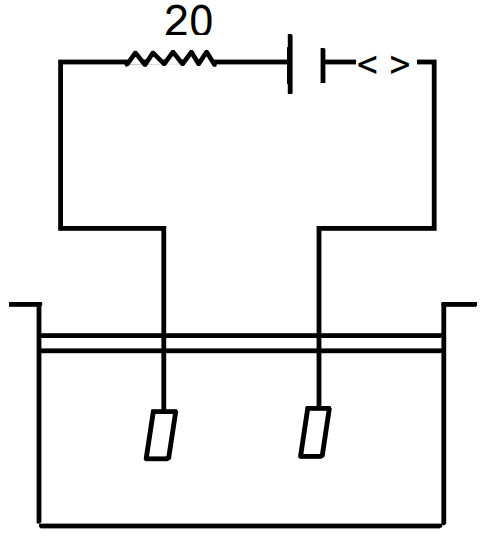
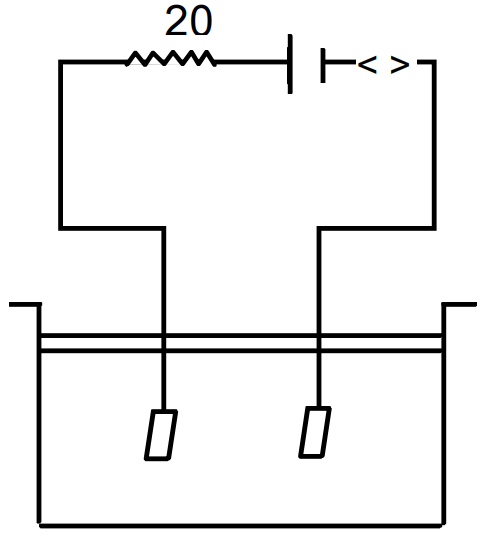
Figure shows an electrolyte of AgCl through which a current is passed. It is observed that 2.68g of silver is deposited in 10 minutes on the cathode. Find the heat developed in the $20\Omega$ resistor during this period. Atomic weight of silver is 107.9g/mole.
Answer


$\text{W}=\text{Zit}$
$2.68=\frac{107.9}{96500}\times\text{i}\times10\times60$
$\Rightarrow\text{l}=\frac{2.68\times965}{107.9\times6}=3.99\approx4\text{Amp}$
Heat developed in the $20\Omega$ resister$=(4)^2\times20\times10\times60=192000\text{J}=192\text{KJ}$

Need a full question paper?

Generate a complete, print-ready paper with questions like this in minutes — across 16+ boards, with answer keys.

Start Generating Free

Similar questions

If the radius of a copper wire is doubled, will its specific resistance increase, decrease or remain same?
Find the wavelength of electromagnetic waves of frequency 5 × 10¹⁹Hz in free space. Give its two applications.
The net charge in a current-carrying wire is zero. Then, why does a magnetic field exert a force on it?
A uranium-238 nucleus, initially at rest, emits an alpha particle with a speed of $1.4 x 10^7 \ m/s$. Calculate the recoil speed of the residual nucleus thorium-234. Assume that the mass of a nucleus is proportional to the mass number.
Using the formula $\overrightarrow{\text{F}}=\text{q}\overrightarrow{\text{v}}\times\overrightarrow{\text{B}}$ and $\text{B}=\frac{\mu_0\text{i}}{2\pi\text{r}},$ show that the SI units of the magnetic field B and the permeability constant $\mu_0$ may be written as N/A-m and $NA^2$ respectively.
At what rate should the earth rotate so that the apparent g at the equator becomes zero? What will be the length of the day in this situation?
How does the power of a convex lens vary, if the incident red light is replaced by violet light?
What information would you wish to know about the galvanometer before converting it into an ammeter or voltmeter?
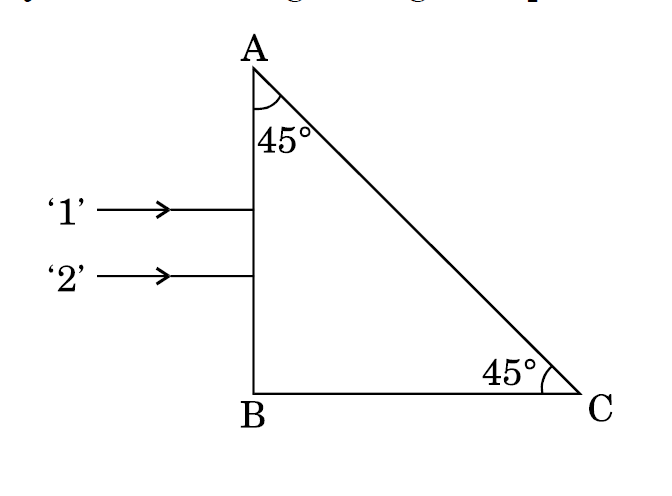
Two monochromatic rays of light are incident normally on the face AB of an isosceles right-angled prism ABC. The refractive indices of the glass prism for the two rays ‘1’ and ‘2’ are respectively 1.35 and 1.45. Trace the path of these rays after entering through the prism.
An α-particle and a proton are accelerated from rest by the same potential. Find the ratio of their de Broglie wavelengths.