Question
Figure shows three equidistant slits being illuminated by a monochromatic parallel beam of light. Let $\text{BP}_0-\text{AP}=\frac{\lambda}{3}$ and $\text{D}>\lambda.$
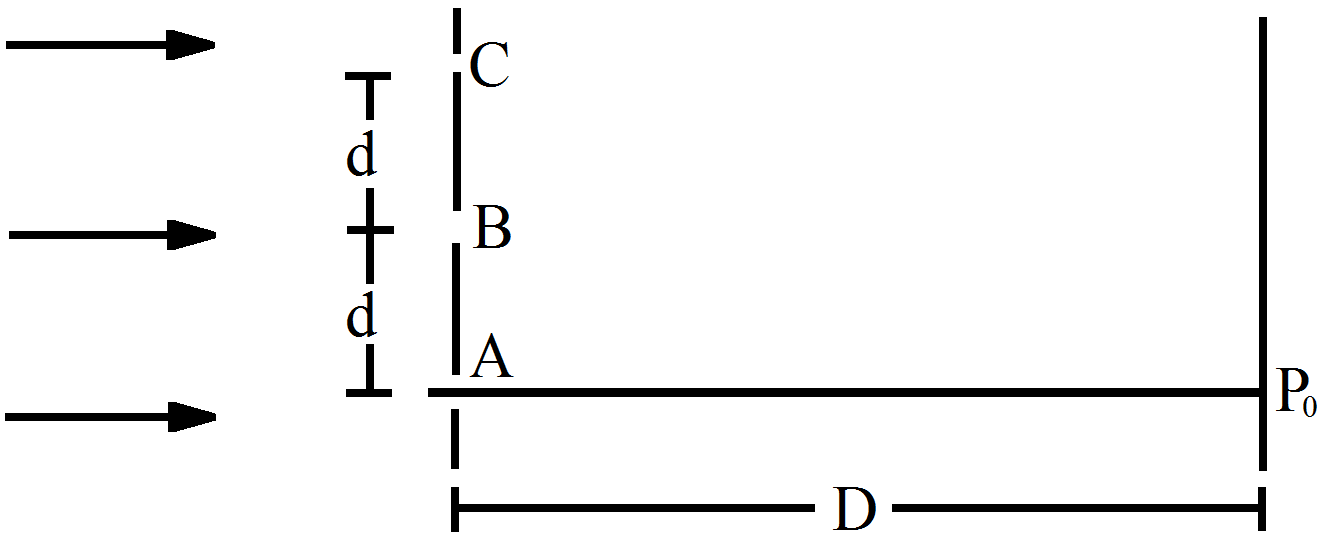
  1. Show that in this case $\text{d}=\sqrt{\frac{2\lambda\text{D}}{3}}.$
  2. Show that the intensity at P, is three times the intensity due to any of the three slits individually.
Answer

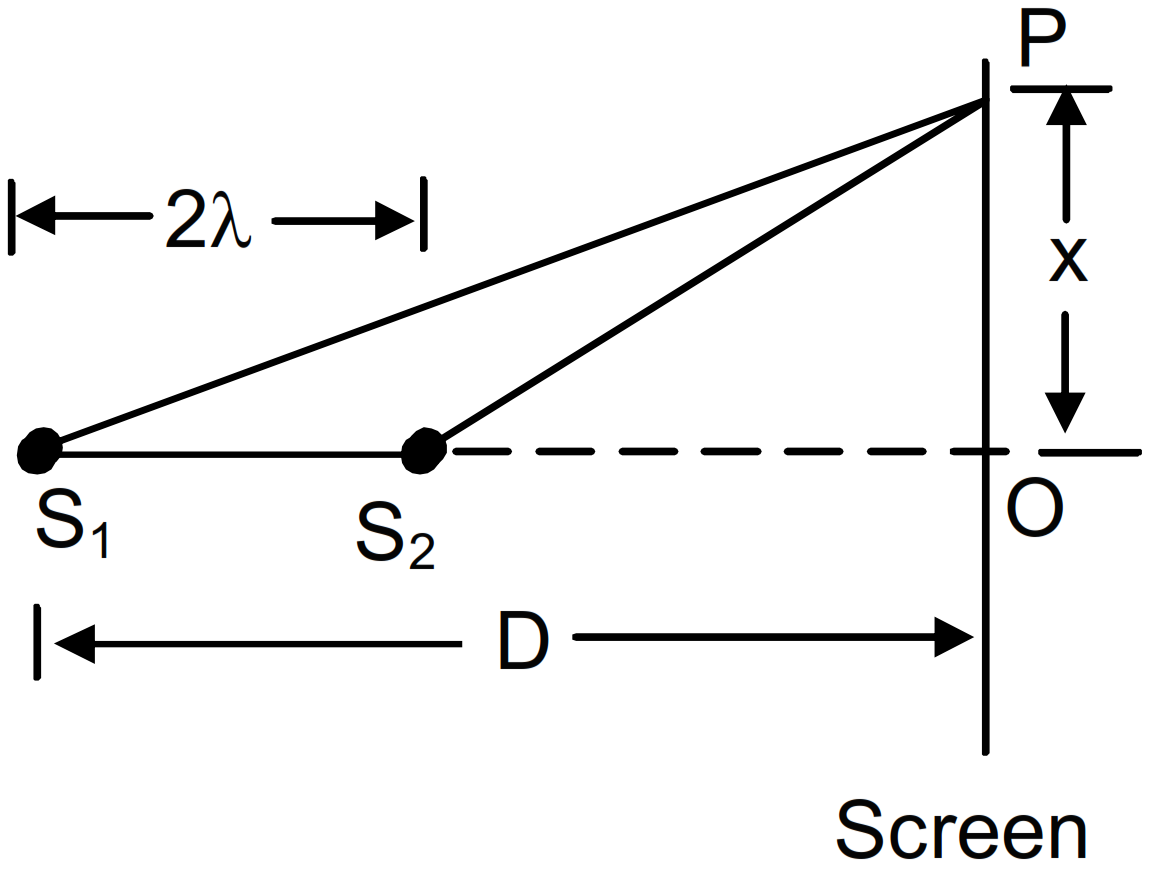
Since $S_1, S_2$ are in same phase, at O there will be maximum intensity. Given that, there will be a maximum intensity at P.
⇒ path difference $=\Delta\text{x}=\text{n}\lambda$ From the figure,$(\text{S}_1\text{P})^2-(\text{S}_2\text{P})^2=\Big(\sqrt{\text{D}^2+\text{X}^2}\Big)^2-\Big(\sqrt{(\text{D}-2\lambda)^2+\text{X}^2}\Big)^2$
$=4\lambda\text{D}-4\lambda^2=4\lambda\text{D}$ ($\lambda^2$ is so small and can be neglected)
$\Rightarrow\text{S}_1\text{P}-\text{S}_2\text{P}=\frac{4\lambda\text{D}}{2\sqrt{\text{x}^2+\text{D}^2}}=\text{n}\lambda$
$\Rightarrow\frac{2\text{D}}{\sqrt{\text{x}^2+\text{D}^2}}=\text{v}$
$\Rightarrow\text{n}^2(\text{X}^2+\text{D}^2)=4\text{D}^2=\Delta\text{X}=\frac{\text{D}}{\text{n}}\sqrt{4-\text{n}^2}$
when $\text{n}=1,\text{x}=\sqrt{3}\text{D}$$ (1^{st}$ order)$\text{n}=2,\text{x}=0$ $(2^{nd}$ order$)$
$\therefore$ When $\text{X}=\sqrt{3}\text{D},$ at P there will be maximum intensity.

Need a full question paper?

Generate a complete, print-ready paper with questions like this in minutes — across 16+ boards, with answer keys.

Start Generating Free

Similar questions

A capacitor is made of a flat plate of area A and a second plate having a stair-like structure as shown in figure. The width of each stair is a and the height is b. Find the capacitance of the assembly.
Consider the de Broglie wavelength of an electron and a proton. Which wavelength is smaller if the two particles have.
  1. The same speed.
  2. The same momentum.
  3. The same energy?.
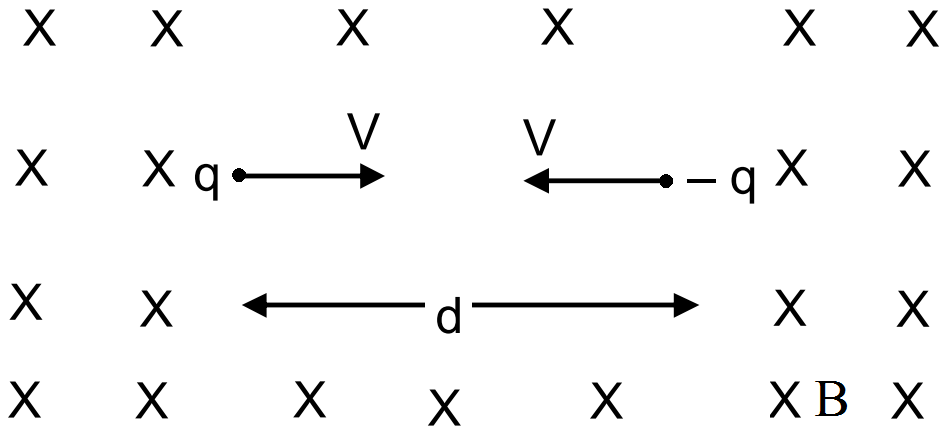
Two particles, each with mass m are placed at a separation d in a uniform magnetic field B, as shown in the figure. They have opposite charges of equal magnitude q. At time t = 0, the particles are projected towards each other, each with a speed v. Suppose the Coulomb force between the charges is switched off.
  1. Find the maximum value $v_m$ of the projection speed, so that the two particles do not collide.
  2. What would be the minimum and maximum separation between the particles if $\text{v}=\text{v}_{\text{m}}\sqrt{2}?$
  3. At what instant will a collision occur between the particles if $v = 2v_m?$
  4. Suppose $v = 2v_m$ and the collision between the particles is completely inelastic. Describe the motion after the collision.
State ampere's law. Obtain expression for magnetic field at a point located (i) externally (ii) internally due to a long cylindrical solid current carrying conductor.###Calculate the value of magnetic field at points $(r>a)$ and $(r
A person travelling in a fast spaceship measures the distance between the earth and the moon. Is it the same, smaller or larger than the value quoted in this book?
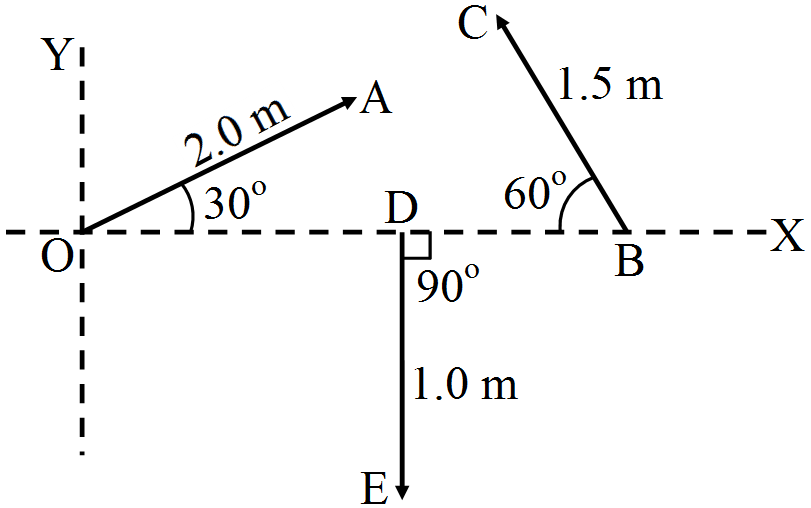
Refer to figure. Find
  1. The magnitude.
  2. x and y components
  3. The angle with the X-axis of the resultant of $\overrightarrow{\text{OA}},\overrightarrow{\text{BC}}$ and $\overrightarrow{\text{DE}}.$
Answer the following questions:
(a) Are the equations of nuclear reactions (such as those given in Section 13.7) 'balanced' in the sense a chemical equation (e.g., $2 H _2+ O _2 \rightarrow 2 H _2 O$ ) is? If not, in what sense are they balanced on both sides?
(b) If both the number of protons and the number of neutrons are conserved in each nuclear reaction, in what way is mass converted into energy (or vice-versa) in a nuclear reaction?
(c) A general impression exists that mass-energy interconversion takes place only in nuclear reaction and never in chemical reaction. This is strictly speaking, incorrect. Explain.
A coil of resistance $40\Omega$ is connected across a 4.0V battery 0.10s after the battery is connected, the current in the coil is 63mA. Find the inductance of the coil.
A circular loop of string rotates about its axis on a frictionless horizontal plane at a uniform rate so that the tangential speed of any particle of the string is v. If a small transverse disturbance is produced at. a point of the loop, with what speed (relative to the string) will this disturbance travel on the string?
A spherical ball of mass m and radius r rolls without slipping on a rough concave surface of large radius R. It makes small oscillations about the lowest point, Find the time period.