Question
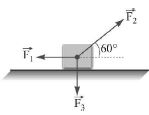
Figure shows three forces applied to a trunk that moves leftward by $3\, m$ over a smooth floor. The force magnitudes are $F_1 = 5\,N, F_2 = 9\,N$, and $F_3 = 3\,N$. The net work done on the trunk by the three forces $......... \mathrm{J}$
Answer

$\overrightarrow F = - 5\hat i + 9\cos {60^ \circ }\hat i + 9\sin {60^ \circ }\hat j - 3\hat j$
$= - 5\hat i + \frac{9}{2}\hat i + \frac{{9\sqrt 3 }}{2}\hat j - 3\hat j$
$= - \frac{{\hat i}}{2} + \left( {\frac{{9\sqrt 3 }}{2} - 3} \right)\hat j$
$\overrightarrow s = - 3\hat i.$
$W = \overrightarrow F \overrightarrow s = \left[ { - \frac{{\hat i}}{2} + \left( {\frac{{9\sqrt 3 }}{2} - 3} \right)\hat j} \right].\left( { - 3\hat i} \right)$
$= 1.5\,J.$

Need a full question paper?

Generate a complete, print-ready paper with questions like this in minutes — across 16+ boards, with answer keys.
Start Generating Free

Similar questions

The charge on a capacitor of capacitance $10\,\mu F$ connected as shown in the figure is.......$\mu C$
Which of the following statements is correct ?
Concentric metallic hollow spheres of radii $R$ and $4 R$ hold charges $Q _{1}$ and $Q _{2}$ respectively. Given that surface charge densities of the concentric spheres are equal, the potential difference $V ( R )- V (4 R )$ is
The major product formed in the reaction is
When the wavelength of light coming from a distant star is measured it is found shifted towards red. Then the conclusion is
A $2\,\mu F$ capacitor is charged to $100\,V$. After disconnecting the battery, a $20\, mH$ coil is then connected across the charged capacitor.The capacitor discharges through the inductor and the current in the circuit is oscillatory. Maximum current in the circuit, assuming zero resistance of the coil, is.....$A$
In a series $RLC$ circuit, the $r.m.s.$ voltage across the resistor and the inductor are respectively $400 \,V$ and $700 \,V$. If the equation for the applied voltage is $\varepsilon=500 \sqrt{2} \sin \omega t$, then the peak voltage across the capacitor is ........... $V$
A body is moving with velocity $30\; m/s$ towards east. After $10$ seconds its velocity becomes $40\; m/s$ towards north. The average acceleration of the body is ...... $m/s^2$
Four light waves are represented by

(i) $y = a_1\, sin\omega\, t$ 

(ii) $y = {a_2}\sin (\omega \,t + \phi )$

(iii) $y = {a_1}\sin 2\omega \,t$         

(iv) $y = {a_2}\sin 2(\,\omega \,t + \phi )$

Interference fringes may be observed due to superposition of

A thin bar of length $L$ has a mass per unit length $\lambda $, that increases linearly with distance from one end. If its total mass is $M$ and its mass per unit length at the lighter end is $\lambda_0$, then the distance of the centre of mass from the lighter end is