Question
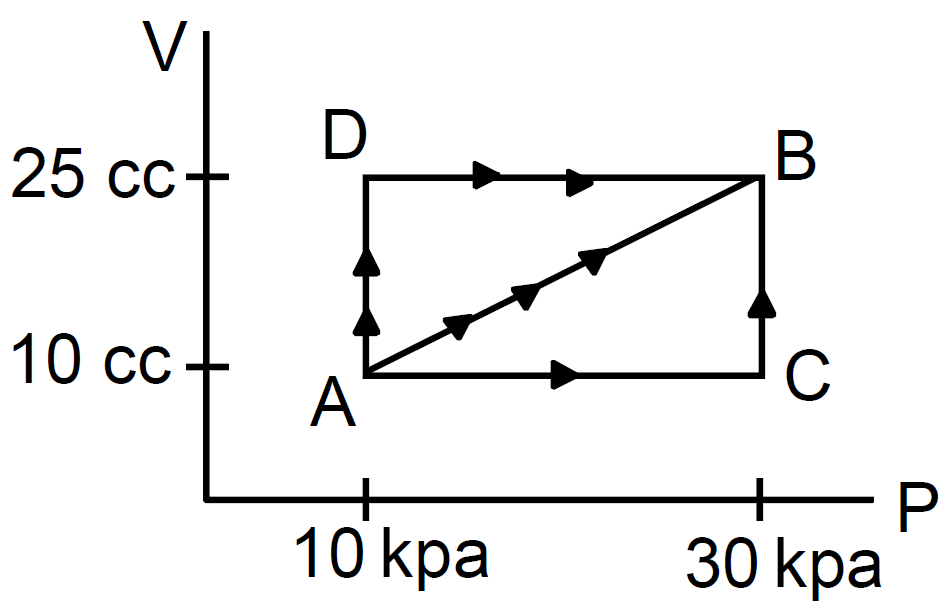
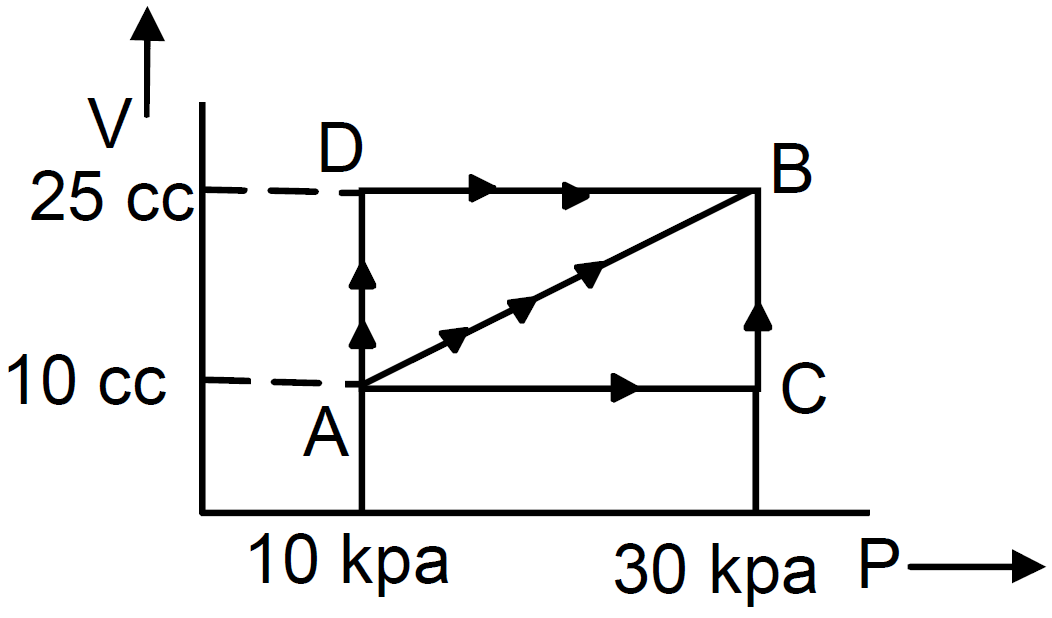
Figure. shows three paths through which a gas can be taken from the state A to the state B. Calculate the work done by the gas in each of the three paths.
Answer

In path ACB,

$W_{A C}+W_{B C}=0+p d v=30 \times 10^3(25-10) \times 10^{-6}=0.45 \mathrm{~J}$
In path $A B, W_{A B}=\frac{1}{2} \times(10+30) \times 10^3 \times 15 \times 10^{-6}=0.30 \mathrm{~J}$
In path $ A D B, W=W_{A D}+W_{D B}=10 \times 10^3(25-10) \times 10^{-6}+0=0.15 \mathrm{~J}$

Need a full question paper?

Generate a complete, print-ready paper with questions like this in minutes — across 16+ boards, with answer keys.

Start Generating Free

Similar questions

The current in a long solenoid of radius $R$ and having $n$ turns per unit length is given by $\text{i}=\text{i}_0\sin\omega\text{t}.$ A coil having $N$ turns is wound around it near the centre. Find
  1. The induced $\text{emf}$ in the coil.
  2. The mutual inductance between the solenoid and the coil.
Figure, shows an aluminium wire of length $60 cm$ joined to a steel wire of length $80 cm$ and stretched between two fixed supports. The tension produced is $40 N$ . The cross-sectional area of the steel wire is $1.0 \mathrm{~mm}^2$ and that of the aluminium wire is $3.0 \mathrm{~mm}^2$. What could be the minimum frequency of a tuning fork which can produce standing waves in the system with the joint as a node? The density of aluminium is $2.6 \mathrm{~g} / \mathrm{cm}^3$ and that of steel is $7.8 \mathrm{~g} / \mathrm{cm}^3$.
The force experienced by a mass moving with a uniform speed v in a circular path of radius r experiences a force which depends on its mass, speed and radius. Prove that the relation is $\text{f} = \frac{\text{mv}^2} {\text{r}} $
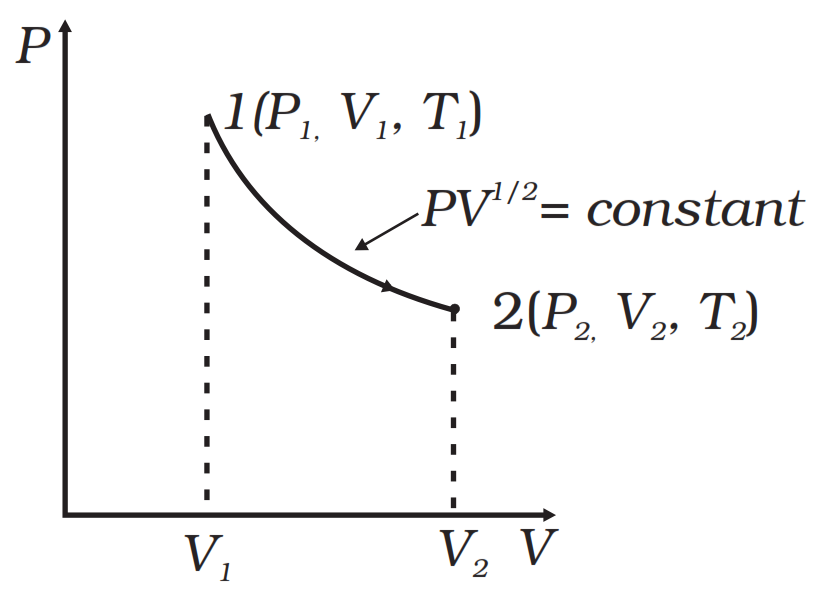
Consider a P-V diagram in which the path followed by one mole of perfect gas in a cylindrical container is shown in Fig.

Given the internal energy for one mole of gas at temperature T is (3/2) RT, find the heat supplied to the gas when it is taken from state (1) to (2) with $V_2 = 2V_{1.}$​​​​​​​
No physicist has ever “seen” an electron. Yet, all physicists believe in the existence of electrons. An intelligent but superstitious man advances this analogy to argue that ‘ghosts’ exist even though no one has ‘seen’ one. How will you refute his argument?
What is the temperature of the steel-copper junction in the steady state of the system shown in the figure. Length of steel rod = $15.0cm$, length of copper rod = $10.0cm$, temperature of the furnace = $300°C$, temperature of the other end = $0°C$. The area of cross-section of steel rod is twice that of copper rod. (Thermal conductivity of steel = $50.2Js^{-1}m^{-1}K^{-1}$ and of copper = $385Js^{-1}m^{-1}K^{-1}$).
The length, breadth and thickness of a rectangular sheet of metal are $4.234m, 1.005m$, and $2.01cm$ respectively. Give the area and volume of the sheet to correct significant figures.
A particle of mass $0.2kg$ attached to a massless string is moving in a vertical circle of radius $1.2m$. It is imparted a speed of $8ms^{-1}$ at the lowest point of its circular path. Does the particle complete the vertical circle? What is the change is tension in the string when the particle moves from the position where the string is vertical to the position where the string is horizontal?
Figure, shows an aluminium rod joined to a copper rod. Each of the rods has a length of 20 cm and area of cross section $0.20 \mathrm{~cm}^2$. The junction is maintained at a constant temperature $40^{\circ} \mathrm{C}$ and the two ends are maintained at $80^{\circ} \mathrm{C}$. Calculate the amount of heat taken out from the cold junction in one minute after the steady state is reached. The conductivities are $\mathrm{KAI}=200 \mathrm{wm}^{-1{ }^{\circ}} \mathrm{C}^{-1}$ and $\mathrm{K}_{\mathrm{Cu}}=400 \mathrm{wm}^{-1^{\circ}} \mathrm{C}^{-1}$.
In long jump, does it matter how high you jump? What factors determine the span of the jump?