MCQ
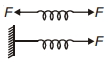
Figure shows two cases. In first case a spring (spring constant $K$ ) is pulled by two equal and opposite forces $F$ at both ends and in second case is pulled by a force $F$ at one end. Extensions $(x)$ in the springs will be
  • A
    In both cases $x=\frac{2 F}{K}$
  • In both cases $x=\frac{F}{K}$
  • C
    In first case $x=\frac{2 F}{K}$, in second case $x=\frac{F}{K}$
  • D
    In first case $x=\frac{F}{K}$, in second case $x=\frac{2 F}{K}$
Answer

Correct option: B.
In both cases $x=\frac{F}{K}$
b
(b)

Figure $(2)$ is $F.B.D.$ of figure $(1)$ at equilibrium $F=K x$

$x=F / K$

Need a full question paper?

Generate a complete, print-ready paper with questions like this in minutes — across 16+ boards, with answer keys.

Start Generating Free

Similar questions

A bullet moving with a uniform velocity v, stops suddenly after hitting the target and the whole mass melts be $m$, specific heat $S,$ initial temperature $25°C$ melting point $ 475°C$ and the latent heat $L.$ Then $v$ is given by
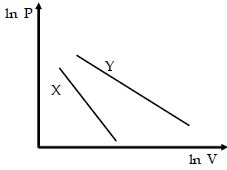
For two different gases $X$ and $Y,$ having degrees of freedom $f_1$ and $f_2$ and molar heat capacities at constant volume $C_{v_1}$ and $C_{v_2}$ respectively, for adiabatic process , the $\ln P$ versus $\ln V$ graph is plotted as shown :-
The displacement of a particle from a point having position vector $2 \hat{i}+4 \hat{j}$ to another point having position vector $5 \hat{i}+1 \hat{j}$ is ........ units
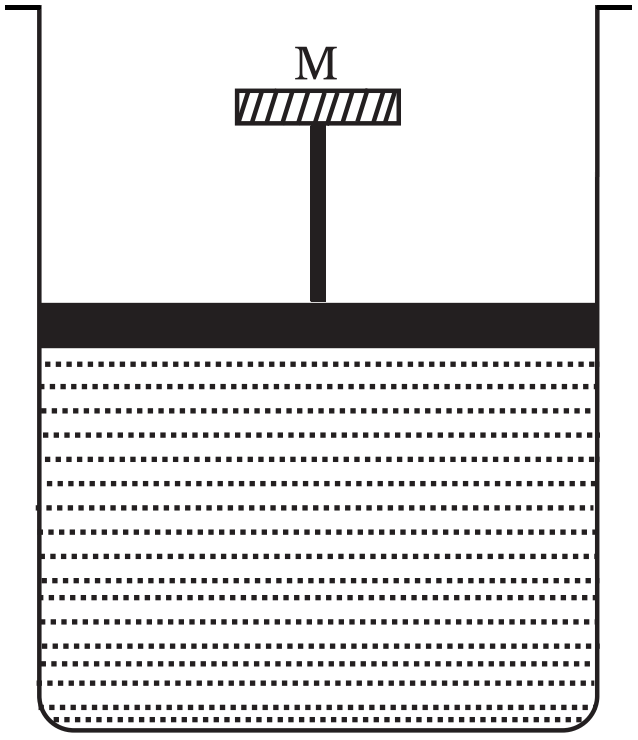
A cylinder containing an ideal gas is in vertical position and has a piston of mass $M$ that is able to move up or down without friction $($ figure$)$. If the temperature is increased.
Ametal wire is clamped between two vertical walls.At $20 ^o C$ the unstrained length of the wire is exactly equal to the separation between walls. If the temperature of the wire is decreased the graph between elastic energy density $(u)$ and temperature $(T)$ of the wire is
If there were no gravity. which of the following will not be there for a fluid?
A ball is moving to and fro about the lowest point $A$ of a smooth hemispherical bowl. If it is able to rise up to a height of $20 \,cm$ on either side of $A$, its speed at $A$ must be  .......... $m/s$ (Take = $10 m/s^2$, mass of the body $5 \,g$)
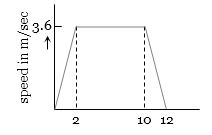
A lift is going up. The total mass of the lift and the passenger is $1500\, kg$. The variation in the speed of the lift is as given in the graph. the height to which the lift takes the passenger is ............ $m$
The $K.E.$ and $P.E.$ of a particle executing $SHM$ with amplitude $A$ will be equal when its displacement is
Which of the following statements is/ are true for a simple harmonic oscillator?