MCQ
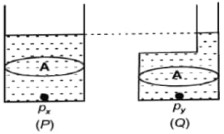
Figure shows two containers $P$ and $Q$ with same base area $A$ and each filled upto same height with same liquid. Select the correct alternative .............
  • $p_x=p_y$
  • B
    $p_x > p_y$
  • C
    $p_y > p_x$
  • D
    Cannot say

Answer

Correct option: A.
$p_x=p_y$
a
(a)

The level of water above both points is same so by hydrostatic paradox.

$p_x=p_y$

Need a full question paper?

Generate a complete, print-ready paper with questions like this in minutes — across 16+ boards, with answer keys.
Start Generating Free

Similar questions

A sphere can roll on a surface inclined at an angle $\theta$ if the friction coefficient is more than $\frac{2}{7}\text{g}\tan \theta.$ Suppose the friction coefficient is $\frac{1}{7}\text{g}\tan \theta.$ If a sphere is released from rest on the incline:
A sample of gas expands from $V_1$ to $V _2$. In which of the following, the work done will be greatest ?
A body is executing simple harmonic motion with frequency $'n',$ the frequency of its potential energy is :
If $T$ is the reverberation time of an auditorium of volume $V$ then
Which of the following is a unit that of force?
The displacement of an object at any instant is given by x = 30 + 20t2 , where x is in metres and t in seconds.
The acceleration of the object will be:
A tuning fork vibrating with a sonometer having $20\,cm$ wire produces $5$ beats per sec. The beat frequency does not change if the length of the wire is changed to $21\,cm$. The frequency of the tuning fork must be ..... $Hz$
Two particles are projected in air with speed vo at angles $\theta_1$ and $\theta_2$ (both acute) to the horizontal, respectively. If the height reached by the first particle is greater than that of the second, then tick the right choices
  1. angle of projection: q1 > q2
  2. time of flight: T1 > T2
  3. horizontal range: R1 > R2
  4. total energy: U1 > U2
The second's hand of a watch has $6\, cm$ length. The speed of its tip and magnitude of difference in velocities of its at any two perpendicular positions will be respectively
The spectral emissive power $E_\lambda $ for a body at temperature $T_1$ is plotted against the wavelength and area under the curve is found to be $A$. At a different temperature $T_2$ the area is found to be $9A$. Then $\lambda _1/\lambda _2 =$