Question
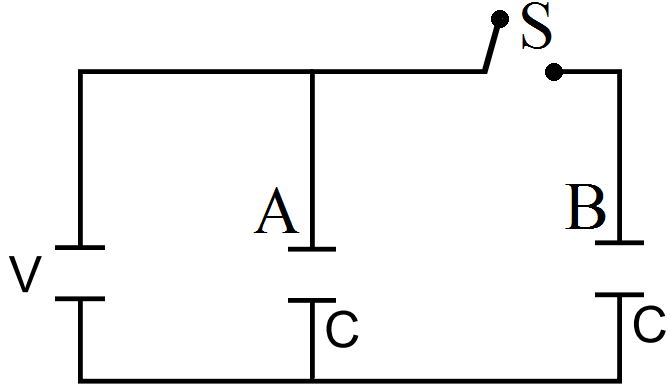
Figure shows two identical parallel plate capacitors connected to a battery through a switch S. Initially, the switch is closed so that the capacitors are completely charged. The switch is now opened and the free space between the plates of the capacitors is filled with a dielectric of dielectric constant 3. Find the ratio of the initial total energy stored in the capacitors to the final total energy stored.
Answer


Initially when switch ‘s’ is closed

Total Initial Energy $=\Big(\frac{1}{2}\Big)\text{CV}^2+\Big(\frac{1}{2}\Big)\text{CV}^2=\text{CV}^2\ \dots(1)$

When switch is open the capacitance in each of capacitors varies, hence the energy also varies.

i.e. in case of ‘B’, the charge remains.

Same i.e. cv

$\text{C}_{\text{eff}}=3\text{C}$

$\text{E}=\frac{1}{2}\times\frac{\text{q}^2}{\text{c}}$

$=\frac{1}{2}\times\frac{\text{c}^2\text{v}^2}{3\text{c}}=\frac{\text{cv}^2}{6}$

In case of 'A'

$\text{C}_{\text{eff}}=3\text{c}$

$\text{E}=\frac{1}{2}\times\text{C}_{\text{eff}}\text{v}^2$

$=\frac{1}{2}\times\text{3c}\times\text{v}^2=\frac{3}{2}\text{cv}^2$

Total final energy $=\frac{\text{cv}^2}{6}+\frac{3\text{cv}^2}{2}=\frac{10\text{cv}^2}{6}$

Now, $\frac{\text{Initial Energy}}{\text{Final Energy}}=\frac{\text{cv}^2}{\frac{10\text{cv}^2}{6}}=3$

Need a full question paper?

Generate a complete, print-ready paper with questions like this in minutes — across 16+ boards, with answer keys.

Start Generating Free

Similar questions

The wavelengths of $\text{K}_\alpha$ and $\text{L}_\alpha$ X-rays of a material are 21.3pm and 141pm respectively. Find the wavelength of $\text{K}_\beta$ X-ray of the material.
The air columns (of resonance tubes) 100cm and 101cm long give 17 beats in 20 seconds, when each is sounding its fundamental note. Calculate velocity of sound.
Find the maximum magnitude of the linear momentum of a photoelectron emitted when light of wavelength 400 run falls on a metal having work function 2.5eV.
It is required to construct a $10\mu\text{F}$ capacitor which can be connected across a 200V battery. Capacitors of capacitance $10\mu\text{F}$ are available but they can withstand only 50V. Design a combination which can yield the desired result.
A body of mass m makes an elastic collision with another identical body at rest. Show that if the collision is not head-on, the bodies go at right angle to each other after the collision.
A metre scale made of steel reads accurately at 20°C. In a sensitive experiment, distances accurate up to 0.055mm in 1m are required. Find the range of temperature in which the experiment can be performed with this metre scale. Coefficient of linear expansion of steel = 11 × 10-6 °C-1.
The track shown in figure is frictionless. The block B of mass 2m is lying at rest and the block A of mass m is pushed along the track with some speed. The collision between A and B is perfectly elastic. With what velocity should the block A be started to get the sleeping man awakened?

Two waves, each having a frequency of 100Hz and a wavelength of 2.0cm, are travelling in the same direction on a string. What is the phase difference between the waves,
  1. If the second wave was produced 0.015s later than the first one at the same place.
  2. If the two waves were produced at the same instant but the first one was produced a distance 4.0cm behind the second one?
  3. If each of the waves has an amplitude of 2.0mm, what would be the amplitudes of the resultant waves in part (a) and (b)?
The electric field at a point associated with a light wave is $\text{E}=\big(100\frac{\text{v}}{\text{m}}\big)\sin[(3.0\times10^{15}\text{s}^{-1})\text{t]sin[(6.0}\times10^{15}\text{s}^{-1})\text{t}].$ If this light falls on a metal surface having a work function of 2.0eV, what will be the maximum kinetic energy of the photoelectrons?
A man walking briskly in rain with speed v must slant his umbrella forward making an angle $\theta$ with the vertical. A student derives the following relation between $\theta$ and v: $\tan \theta = \text{v}$ and checks that the relation has a correct limit: as $\text{v}\rightarrow 0,\ \theta \rightarrow0,$ as expected. (We are assuming there is no strong wind and that the rain falls vertically for a stationary man). Do you think this relation can be correct? If not, guess the correct relation.