Question
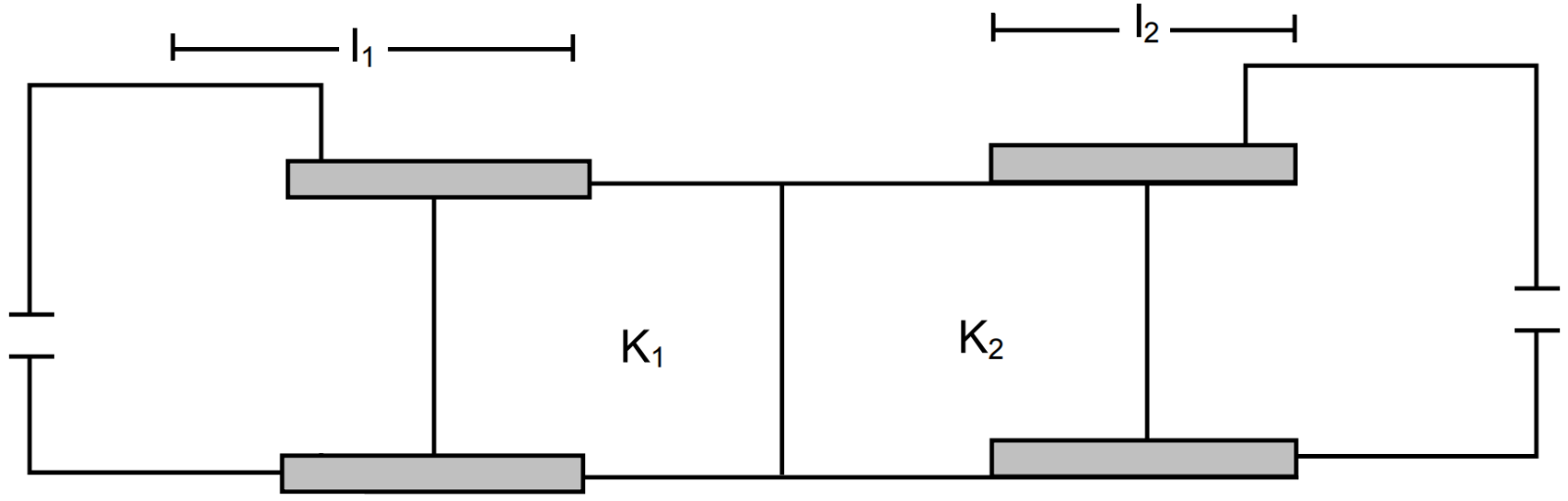
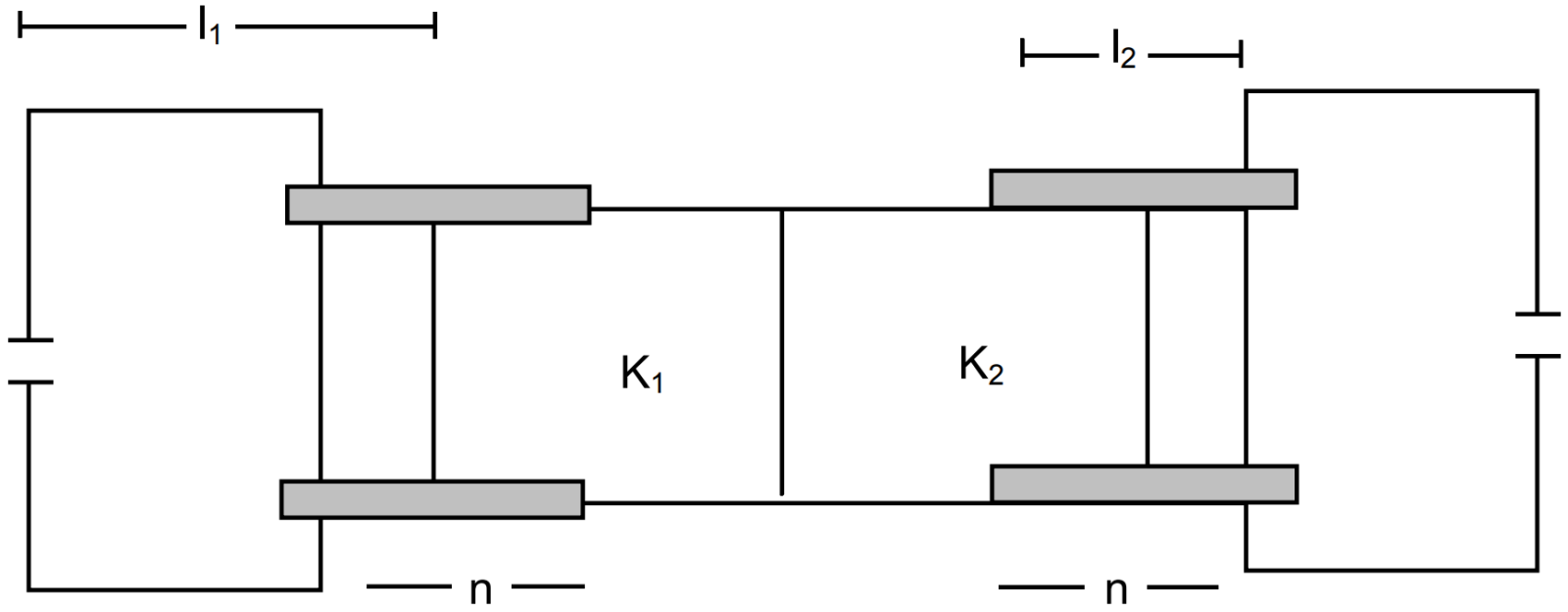
Figure shows two parallel plate capacitors with fixed plates and connected to two batteries. The separation between the plates is the same for the two capacitors. The plates are rectangular in shape with width b and lengths $l_1$ and $l_2$ The left half of the dielectric slab has a dielectric constant $K_1$ and the right half $K_2$. Neglecting any friction, find the ratio of the emf of the left. battery to that of the right battery for which the dielectric slab may remain in equilibrium.
Answer


Consider the left side
The plate area of the part with the dielectric is by its capacitance $\text{C}_1=\frac{\text{K}_1\epsilon_0\text{bx}}{\text{d}}$ and with out dielectric $\text{C}_2=\frac{\epsilon_0\text{b}(\text{L}_1-\text{x})}{\text{d}}$
These are connected in parallel
$\text{C}=\text{C}_1+\text{C}_2$
$=\frac{\epsilon_0\text{b}}{\text{d}}[\text{L}_1+\text{x}(\text{k}_1-1)]$
Let the potential $V_1$
$\text{U}=\Big(\frac{1}{2}\Big)\text{CV}_1^2=\frac{\epsilon_0\text{bv}_1^2}{2\text{d}}[\text{L}_1+\text{x}(\text{k}-1)]\ \dots(1)$
Suppose dielectric slab is attracted by electric field and an external force $F$ consider the part dx which makes inside further, As the potential difference remains constant at $V.$
The charge supply, $dq = (dc)v$ to the capacitor.
The work done by the battery is $dw_b = v.dq = (dc)v^2​​​​​​​$​​​​​​​
The external force $F$ does a work dwe $= (–f.dx)$ during a small displacement.
The total work done in the capacitor is $dw_b + dw_e = (dc)v^2 - fdx$
This should be equal to the increase dv in the stored energy.
Thus $\Big(\frac{1}{2}\Big)(\text{dk})\text{v}^2=(\text{dc})\text{v}^2-\text{fdx}$
$\text{f}=\frac{1}{2}\text{v}^2\frac{\text{dc}}{\text{dx}}$
from equation $(1)$
$\text{F}=\frac{\epsilon_0\text{bv}^2}{2\text{d}}(\text{k}_1-1)$
$\Rightarrow\text{V}_1^2=\frac{\text{F}\times2\text{d}}{\epsilon_0\text{b}(\text{k}_1-1)}$
$\Rightarrow\text{V}_1=\sqrt{\frac{\text{F}\times2\text{d}}{\epsilon_0\text{b}(\text{k}_1-1)}}$
For the right side, $\text{V}_2=\sqrt{\frac{\text{F}\times2\text{d}}{\epsilon_0\text{b}(\text{k}_2-1)}}$
$\frac{\text{V}_1}{\text{V}_2}=\frac{\sqrt{\frac{\text{F}\times2\text{d}}{\epsilon_0\text{b}(\text{k}_1-1)}}}{\sqrt{\frac{\text{F}\times2\text{d}}{\epsilon_0\text{b}(\text{k}_2-1)}}}$
$\frac{\text{V}_1}{\text{V}_2}=\frac{\sqrt{\text{k}_2-1}}{\sqrt{\text{k}_1-1}}$
$\therefore$ The ratio of the emf of the left battery to the right battery $=\frac{\sqrt{\text{k}_2-1}}{\sqrt{\text{k}_1-1}}$

Need a full question paper?

Generate a complete, print-ready paper with questions like this in minutes — across 16+ boards, with answer keys.

Start Generating Free

Similar questions

Figure shows an outline of Lloyd's mirror experiment. $M$ is a plane mirror; $S$ is a narrow slit illuminated by some source of light $($not shown$)$ and $S$' is the image of S in $M. M, S$ and $S\ '$ are in a plane perpendicular to the paper. $O$ is the line of intersection of the mirror and the screen.
$a$. What is the origin of fringes observed on the screen?
Image

$b$. Why is the slit $S$ placed so as to have very oblique angle of incidence of light striking the mirror?
$c.$ The two path lengths $PS$ and $PS\ '$ are equal when $P$ coincides with $O$. Yet the fringe at $O$ is found in the experiment to be dark not bright. What does this observation imply?
A long straight horizontal cable carries a current of $2.5 A$ in the direction $10^\circ$ south of west to $10^\circ$ north of east. The magnetic meridian of the place happens to be $10^\circ$ west of the geographic meridian. The earth’s magnetic field at the location is $0.33 G,$  and the angle of dip is zero. Locate the line of neutral points $($ignore the thickness of the cable$). ($At neutral points, magnetic field due to a current $-$ carrying cable is equal and opposite to the horizontal component of earth’s magnetic field.$)$
A small piece of cesium metal $(\phi = 1 ·9 eV)$ is kept at a distance of $20\ cm$ from a large metal plate having a charge density of $1.0 \times 10^{-9}C/m^2$ on the surface facing the cesium piece. A monochromatic light of wavelength $400\ nm$ is incident on the cesium piece. Find the minimum and the maximum kinetic energy of the photoelectrons reaching the large metal plate. Neglect any change in electric field due to the small piece of cesium present.
Define common potential. Find the expression for redistribution of charges and energy loss when capacitors are connected together.
Calculate potential energy of a point charge -q placed along the axis due to a charge +Q uniformly distributed along a ring of radius R. Sketch P.E. as a function of axial distance z from the centre of the ring. Looking at graph, can you see what would happen if -q is displaced slightly from the centre of the ring (along the axis)?
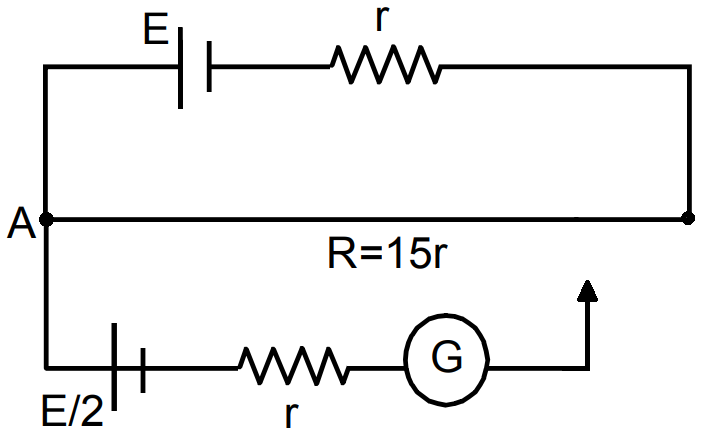
Consider the potentiometer circuit as arranged in the figure. The potentiometer wire is $600\ cm$ long. $(a)$ At what distance from the point A should the jockey touch the wire to get zero deflection in the galvanometer? $(b)$ If the jockey touches the wire at a distance of $560\ cm$ from A, what will be the current in the galvanometer?
Consider a metal ring kept (supported by a cardboard) on top of a fixed solenoid carrying a current I (see Fig). The centre of the ring coincides with the axis of the solenoid. If the current in the solenoid is switched off, what will happen to the ring?
Write the definition of electric capacitance. A parallel plate capacitor is filled with a medium of dielectric constant K between the plates. Find the expression of its capacitance. Draw the necessary diagram.
In an A.C. circuit inductance L, capacitance C and resistance R are connected in series. Find the expression for impedance Z of circuit and phase difference between V and I.### Prove that : $Z=\sqrt{R^{2}+(\omega L-\frac{1}{\omega C})^{2}}$ and $tan \phi=\frac{(\omega L-\frac{1}{\omega C})}{R}$
Answer the following questions:
(a) Are the equations of nuclear reactions (such as those given in Section 13.7) 'balanced' in the sense a chemical equation (e.g., $2 H _2+ O _2 \rightarrow 2 H _2 O$ ) is? If not, in what sense are they balanced on both sides?
(b) If both the number of protons and the number of neutrons are conserved in each nuclear reaction, in what way is mass converted into energy (or vice-versa) in a nuclear reaction?
(c) A general impression exists that mass-energy interconversion takes place only in nuclear reaction and never in chemical reaction. This is strictly speaking, incorrect. Explain.