Question
Figure shows two wave pulses at t = 0 travelling on a string in opposite directions with the same
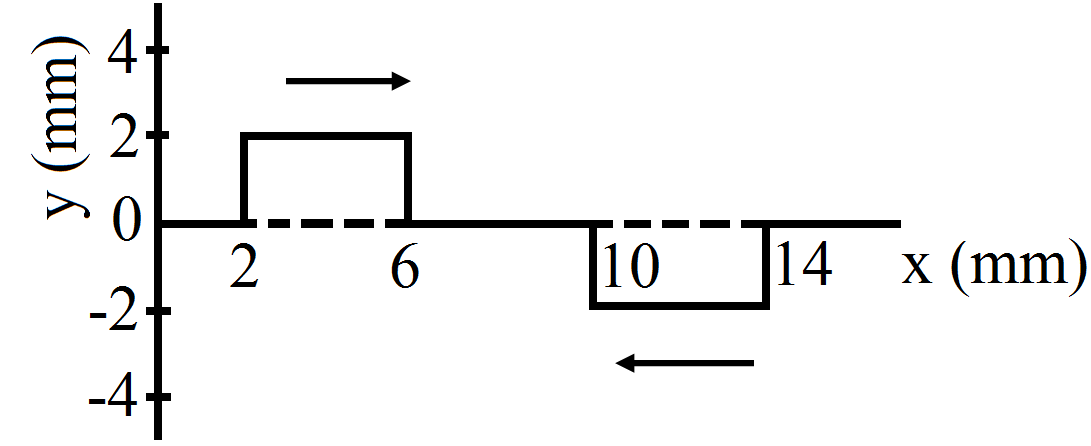
wave speed 50cm/s. Sketch the shape of the string at t = 4ms, 6ms, 8ms, and 12ms.
Answer

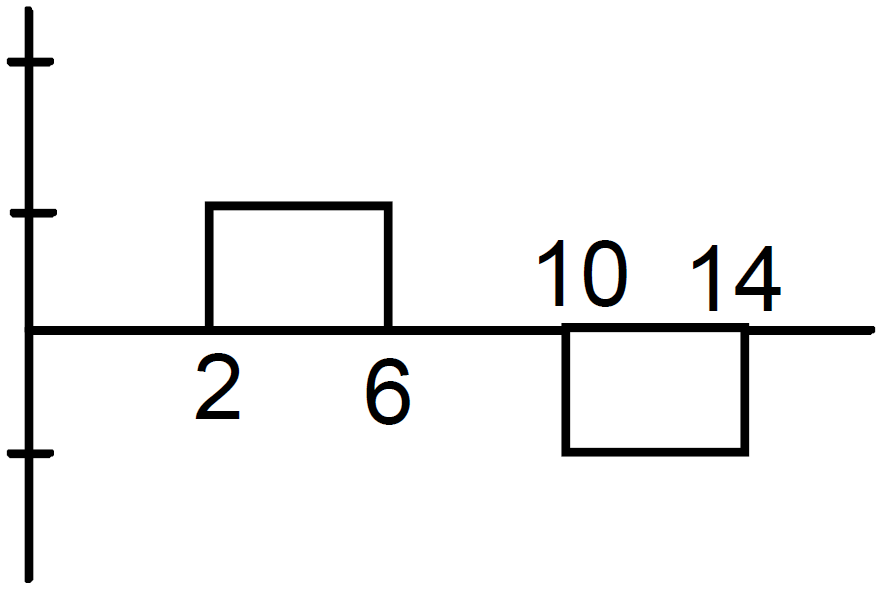
The distance travelled by the pulses are shown below.
$\mathrm{t}=4 \mathrm{~ms}=4 \times 10^{-3} \mathrm{~s}, \mathrm{~s}=\mathrm{vt}=50 \times 10 \times 4 \times 10^{-3}=2 \mathrm{~mm}$
$\mathrm{t}=8 \mathrm{~ms}=8 \times 10^{-3} \mathrm{~s}, \mathrm{~s}=\mathrm{vt}=50 \times 10 \times 8 \times 10^{-3}=4 \mathrm{~mm}$
$\mathrm{t}=6 \mathrm{~ms}=6 \times 10^{-3} \mathrm{~s}, \mathrm{~s}=3 \mathrm{~mm}$
$\mathrm{t}=12 \mathrm{~ms}=12 \times 10^{-3} \mathrm{~s}, \mathrm{~s}=50 \times 10 \times 12 \times 10^{-3}=6 \mathrm{~mm}$
The shape of the string at different times are shown in the figure.

Need a full question paper?

Generate a complete, print-ready paper with questions like this in minutes — across 16+ boards, with answer keys.

Start Generating Free

Similar questions

A charge of 1.0C is placed at the top of your college building and another equal charge at the top of your house. Take the separation between the two charges to be 2.0km. Find the force exerted by the charges on each other. How many times of your weight is this force?
  1. What is meant by Simple Harmonic Motion $\text{(S.H.M)}$?
  2. At what points is the energy entirely kinetic and potential in $\text{S.H.M}$?
  3. What is the total distance travelled by a body executing $\text{S.H.M}$ in a time equal to its time period, if its amplitude is $A$?
Can we find the mass of a photon by the definition p = mv?
Reynold's number $N_R$(a dimensionless quantity) determines the condition of laminar flow of a viscous liquid through a pipe. $N_R$ is a function of the density of the liquid 'r', its average speed is 'y' and the coefficient of viscosity of the liquid is 'h'. If N, is given directly proportional to 'd' (the diameter of the pipe), show from dimensional consideration that $\text{N}_\text{R}\propto \frac{\text{dp}\rho}{\eta}$ the unit of '$\eta$' in SI system is kg $m^{-1}s^{-1}​​​​​​​$?
See Fig. 4.11. A mass of 4 kg rests on a horizontal plane. The plane is gradually inclined until at an angle θ = 15° with the horizontal, the mass just begins to slide. What is the coefficient of static friction between the block and the surface ?
Image
If a number of little droplets of water, each of radius $r$, coalesce to form a single drop of radius $R$, show that the rise in temperature will be given by $\Delta \theta=\frac{3 \sigma}{J}\left(\frac{1}{r}-\frac{1}{R}\right)$ where $\sigma$ is the surface tension of water and J is the mechanical equivalent of heat.
A man of mass $70kg$ stands on a weighing scale in a lift which is moving. Downwards with a uniform acceleration of $5ms^{-2}$.
Find the magnetic field B due to a semicircular wire of radius 10.0cm carrying a current of 5.0A at its centre of curvature.
Check by the method of dimensional analysis whether the following relations are correct. $\text{v}=\sqrt{\frac{\text{P}}{\text{D}}}$ where $v =$ velocity of sound and $P =$ pressure, $D =$ density of medium $\text{n}=\frac{1}{21}\sqrt{\frac{\text{F}}{\text{m}}},$ where $n =$ frequency of vibration $l =$ legnth of the string $F =$ Stretching force $m =$ mass per unit length of the string.
The planet Saturn has a mass $95$ times that of the earth, and its radius is $9.5$ times the earth's radius. Calculate the escape speed of a body from Saturn's surface, if the escape speed from the earth's surface is $11.2kms^{-1}$.