Question
Fill in the blanks:
If $\cos2\theta=0,$ then $\begin{vmatrix}0&\cos\theta&\sin\theta\\\cos\theta&\sin\theta&0\\\sin\theta&0&\cos\theta\end{vmatrix}^2=$ _________.
Answer

If $\cos2\theta=0,$ then $\begin{vmatrix}0&\cos\theta&\sin\theta\\\cos\theta&\sin\theta&0\\\sin\theta&0&\cos\theta\end{vmatrix}^2=\frac{1}{2}.$
Solution:
Since, $\cos2\theta=0$
$\Rightarrow\ \cos2\theta=\cos\frac{\pi}{2}$ $\Rightarrow\ 2\theta=\frac{\pi}{2}$
$\Rightarrow\ \theta=\frac{\pi}{4}$
$\therefore\ \sin\frac{\pi}{4}=\frac{1}{\sqrt{2}}$ and $\cos\frac{\pi}{4}=\frac{1}{\sqrt{2}}$
$\therefore\ \begin{vmatrix}0&\frac{1}{\sqrt{2}}&\frac{1}{\sqrt{2}}\\\frac{1}{\sqrt{2}}&\frac{1}{\sqrt{2}}&0\\\frac{1}{\sqrt{2}}&0&\frac{1}{\sqrt{2}}\end{vmatrix}$
Expanding along $R_1,$
$=\bigg[-\frac{1}{\sqrt{2}}\Big(\frac{1}{2}\Big)+\frac{1}{\sqrt{2}}\Big(-\frac{1}{2}\Big)\bigg]^2$ $=\bigg[\frac{-2}{2\sqrt{2}}\bigg]^2=\bigg(\frac{-1}{\sqrt{2}}\bigg)^2=\frac{1}{2}$

Need a full question paper?

Generate a complete, print-ready paper with questions like this in minutes — across 16+ boards, with answer keys.

Start Generating Free

Similar questions

Fill in the blanks:
$\int\frac{\sin\text{x}}{3+4\cos^2\text{x}}\text{dx}=$ ________.
The value of $\int \sin ^2 x d x$ is ___________
If in any circle radius is increasing at the rate of 0.5 $cm / sec$ then rate of increasing circumference is ________ .
If A has $3 \times 3$ order square matrix and $| A |=2$, then $\left|- AA ^{ T }\right|=$ ________ .
Fill in the blank.
If A and B are symmetric matrices of same order, then AB is symmetric if and only if _________.
If the coordinates of the points $A , B , C$ and D are respectively $(1,2,3),(4,5,7),(-4,3,-6)$ and $(2,9,2)$, then the angle between the lines AB and CD will be an acute angle ____________ .
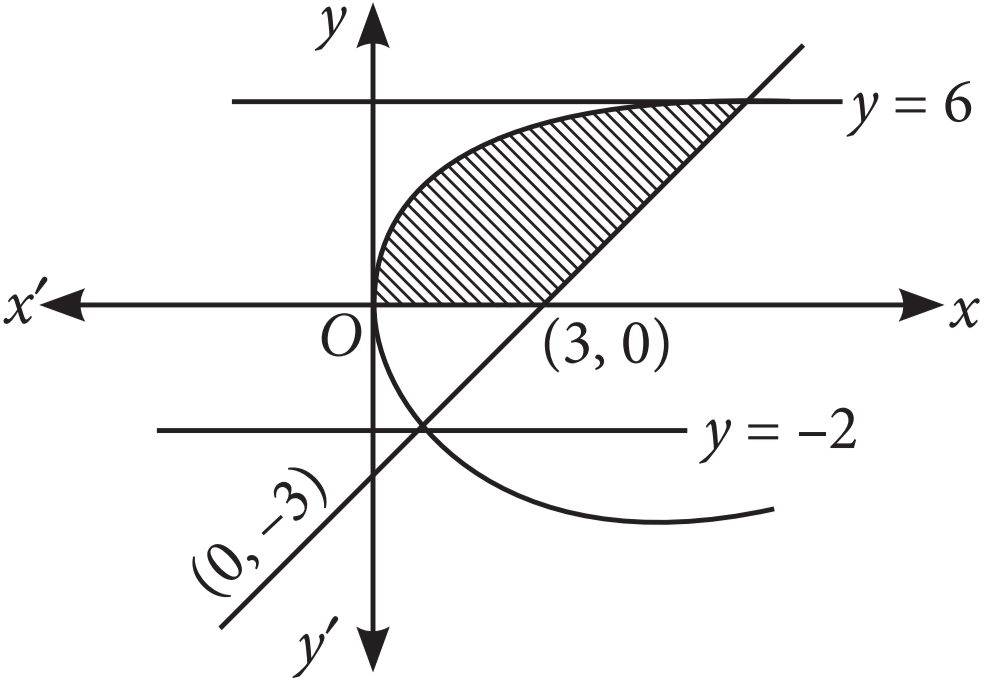
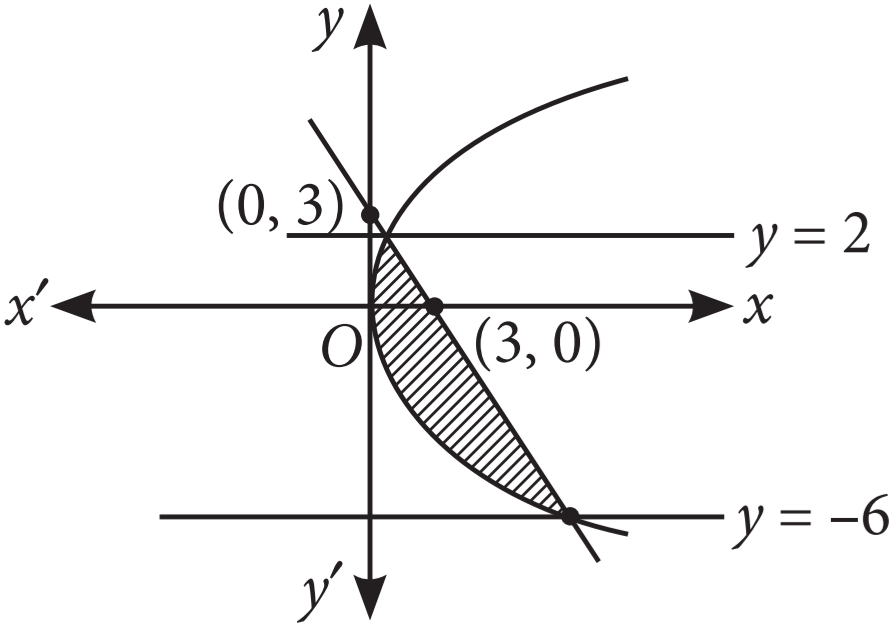
Consider the following equation of curve $y^2= 4x$ and straight line $x + y = 3.$
Based on the above information, answer the following questions.
  1. The line x + y = 3 cuts the x-axis and y-axis respectively at.
  1. $(0, 2), (2, 0)$
  2. $(3, 3), (0, 0)$
  3. $(0, 3), (3, 0)$
  4. $(3, 0), (0, 3)$
  1. Point(s) of intersection of two given curves is (are).
  1. $(1, -2), (-9, 6)$
  2. $(2, 1), (-6, 9)$
  3. $(1, 2), (9, -6)$
  4. None of these.
  1. Which of the following shaded portion re present the area bounded by given curves?
    1. None of these
  1. Value of the integral $\int\limits_{-6}^{2}(3-\text{y})\text{ dy}$ is
  1. $10$
  2. $20$
  3. $30$
  4. $40$
  1. Value of area bounded by given curves is.
  1. $56\text{ sq.units}$
  2. $\frac{63}{5}\text{ sq. units}$
  3. $\frac{64}{3}\text{ sq. units}$
  4. $31\text{ sq.units}$
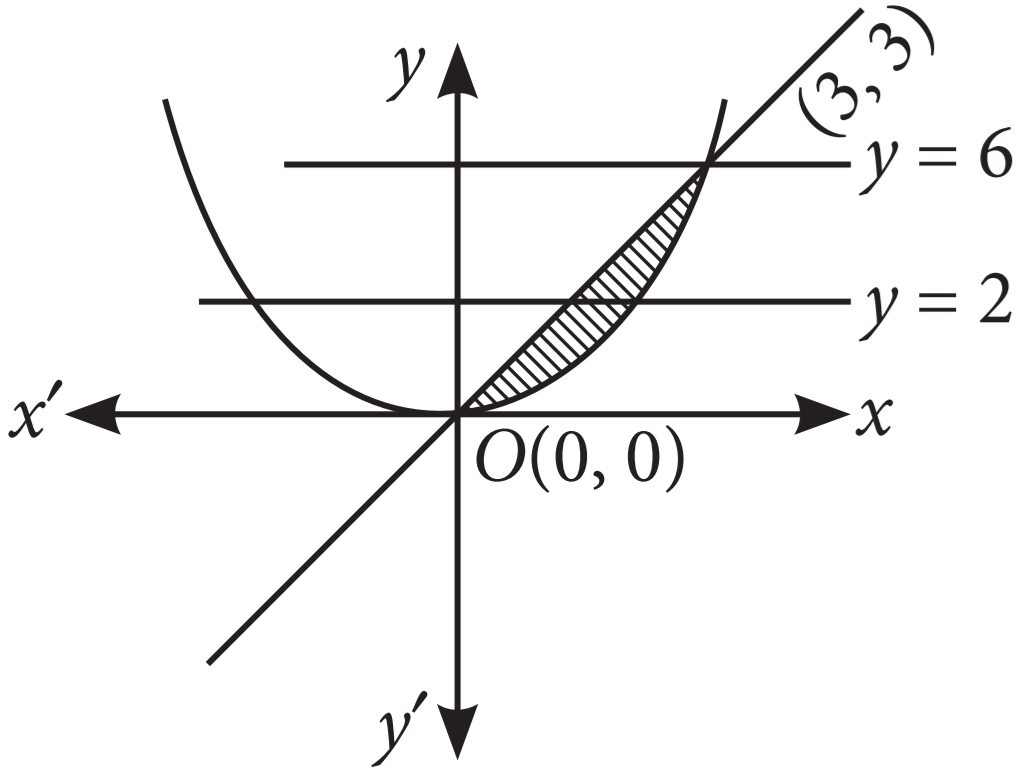
Consider the following equations of curves $x^2= y$ and $y = x.$
On the basis of above information, answer the following questions.
  1. The point(s) of intersection of both the curves is (are).
  1. (0, 0)(2, 2)
  2. (0, 0)(1, 1)
  3. (0, 0)(-1, -1)
  4. (0, 0)(-2, -2)
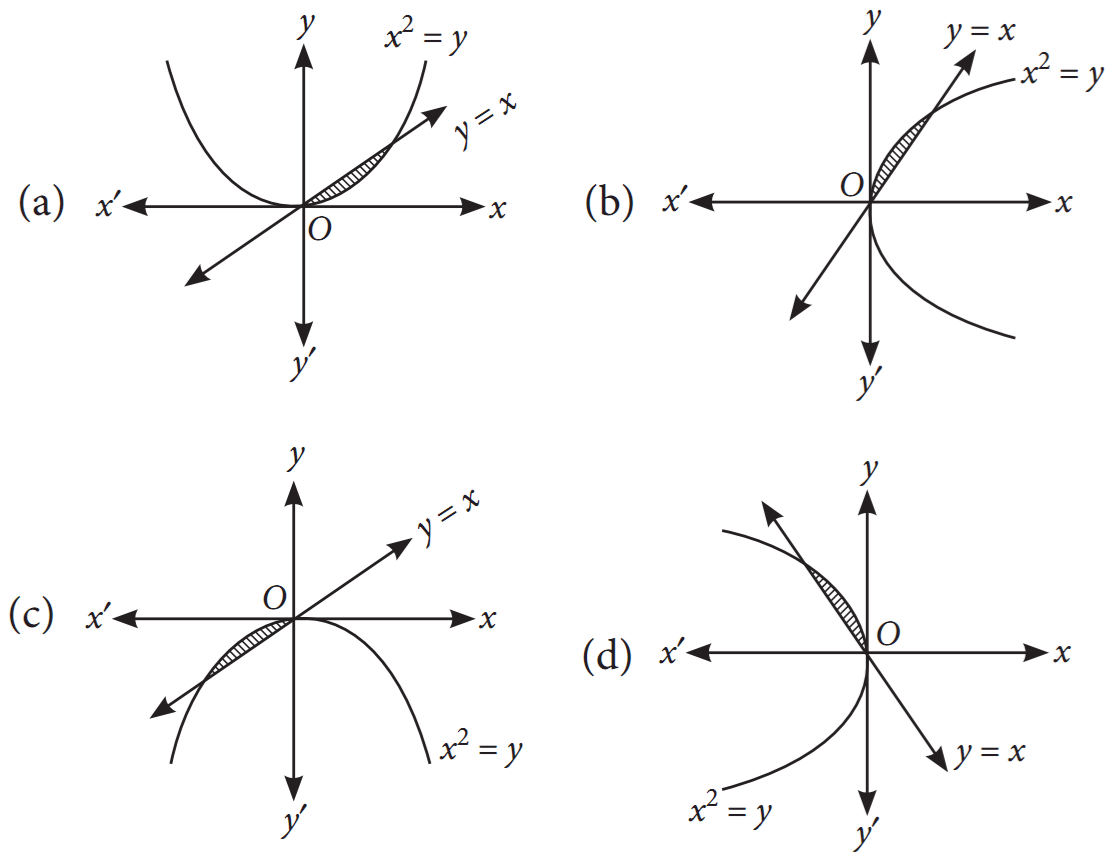
  1. Area bounded by the curves is represented by which of the following graph?
  1. The value of the integral $\int\limits_{1}^{0}\text{x}\ \text{dx}$ is.
  1. $\frac{1}{4}$
  2. $\frac{1}{3}$
  3. $\frac{1}{2}$
  4. $1$
  1. The value of the integral $\int\limits_{0}^{1}\text{x}^2\ \text{dx}$ is.
  1. $\frac{1}{4}$
  2. $\frac{1}{3}$
  3. $\frac{1}{2}$
  4. $1$
  1. The value of area bounded by the curves $x^2= y$ and $x = y$ is.
  1. $\frac{1}{6}\text{ sq}.\text{unit}$
  2. $\frac{1}{3}\text{ sq}.\text{unit}$
  3. $\frac{1}{2}\text{ sq}.\text{unit}$
  4. ${1}\text{ sq}.\text{unit}$
If $\vec{a}=2 \hat{i}+\hat{j}+3 \hat{k}$ and $\vec{b}=3 \hat{i}+5 \hat{j}-2 \hat{k}$, then the value of $|\vec{a} \times \vec{b}|$ will be ___________ .
If $y=\log _a x$ then $\frac{d y}{d x}=$ __________ .