Question
Fill in the blanks: If $\text{f(x)}=\begin{vmatrix}(1+\text{x})^{17}&(1+\text{x})^{19}&(1+\text{x})^{23}\\(1+\text{x})^{23}&(1+\text{x})^{29}&(1+\text{x})^{34}\\(1+\text{x})^{41}&(1+\text{x})^{43}&(1+\text{x})^{47}\end{vmatrix}=\text{A}+\text{Bx}+\text{Cx}^2+\ \dots,$ then A = ________.
Answer

If $\text{f(x)}=\begin{vmatrix}(1+\text{x})^{17}&(1+\text{x})^{19}&(1+\text{x})^{23}\\(1+\text{x})^{23}&(1+\text{x})^{29}&(1+\text{x})^{34}\\(1+\text{x})^{41}&(1+\text{x})^{43}&(1+\text{x})^{47}\end{vmatrix}=\text{A}+\text{Bx}+\text{Cx}^2+\ \dots,$ then A = 0. Solution: We have, $\text{f(x)}=\begin{vmatrix}(1+\text{x})^{17}&(1+\text{x})^{19}&(1+\text{x})^{23}\\(1+\text{x})^{23}&(1+\text{x})^{29}&(1+\text{x})^{34}\\(1+\text{x})^{41}&(1+\text{x})^{43}&(1+\text{x})^{47}\end{vmatrix}$ [Taking $(1+x)^{17},(1+x)^{23},(1+x)^{41}$ common from $R _1, R _2, R _3$ respectively]
$=(1+\text{x})^{17}(1+\text{x})^{23},(1+\text{x})^{41}\begin{vmatrix}1&(1+\text{x})^{2}&(1+\text{x})^{6}\\1&(1+\text{x})^{6}&(1+\text{x})^{11}\\1&(1+\text{x})^{2}&(1+\text{x})^{6}\end{vmatrix}=0$ $\big[\because\ \text{R}_1\text{ and R}_3\text{ are identical}\big]$ $\therefore\ \text{A}=0$

Need a full question paper?

Generate a complete, print-ready paper with questions like this in minutes — across 16+ boards, with answer keys.

Start Generating Free

Similar questions

Fill in the blanks:
If $\text{f(x)}=|\cos\text{x}|,$ then $\text{f}'\Big(\frac{\pi}{4}\Big)=$ _______.
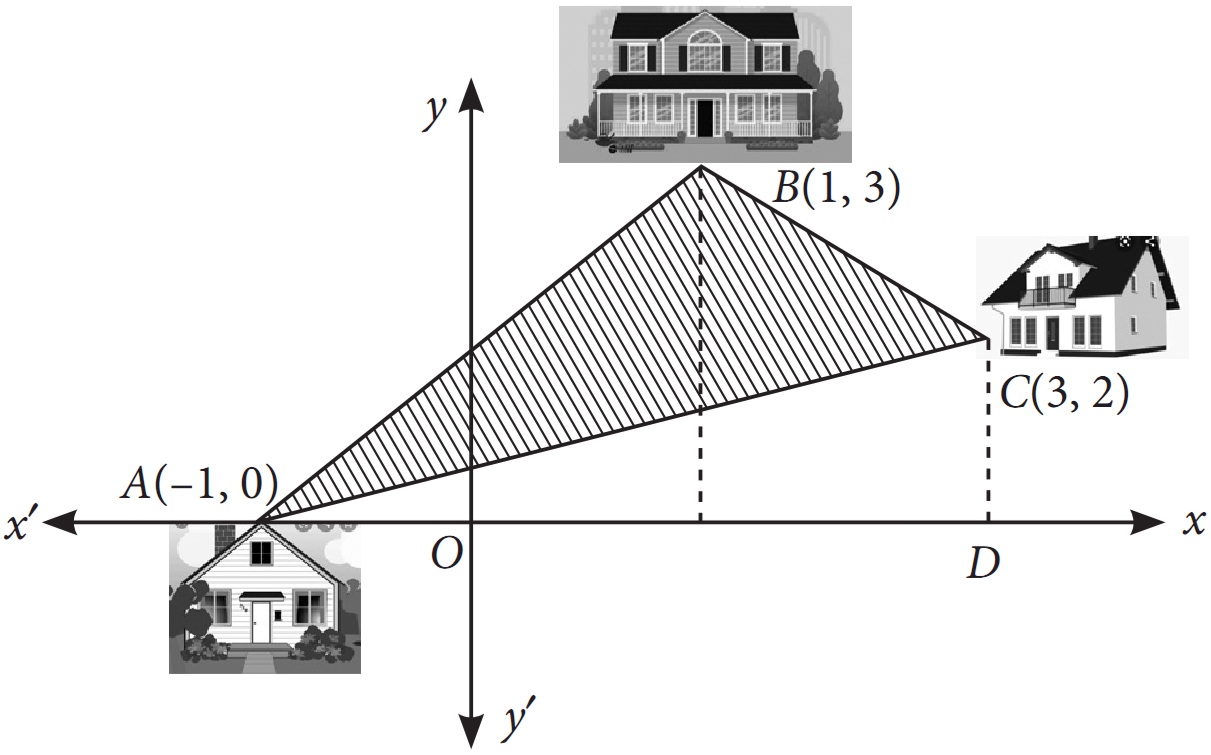
Location of three houses of a society is represented by the points A(-1, 0), B(1, 3) and C(3, 2) as shown in figure.

Based on the above information, answer the following questions
  1. Equation of line AB is.
    1. $\text{y}=\frac{3}{2}(\text{x}+1)$
    2. $\text{y}=\frac{3}{2}(\text{x}-1)$
    3. $\text{y}=\frac{1}{2}(\text{x}+1)$
    4. $\text{y}=\frac{1}{2}(\text{x}-1)$
  2. Equation of line BC is.
    1. $\text{y}=\frac{1}{2}\text{x}-\frac{7}{2}$
    2. $\text{y}=\frac{3}{2}\text{x}-\frac{7}{2}$
    3. $\text{y}=\frac{-1}{2}\text{x}+\frac{7}{2}$
    4. $\text{y}=\frac{3}{2}\text{x}+\frac{7}{2}$
  3. Area of region ABCD is.
  1. 2 sq. units
  2. 4 sq. units
  3. 6 sq. units
  4. 8 sq. units
  1. Area of $\triangle\text{ADC}$ is,
  1. 4 sq. units
  2. 8 sq. units
  3. 16 sq. units
  4. 32 sq. units
  1. Area of $\triangle\text{ABC}$ is.
  1. 3 sq. units
  2. 4 sq. units
  3. 5 sq. units
  4. 6 sq. units
Fill in the blanks.
The solution of $(1+\text{x})^2\frac{\text{dy}}{\text{dx}}+2\text{xy}-4\text{x}^2=0$ is _________.
Fill in the blanks.
The integrating factor of $\frac{\text{dy}}{\text{dx}}+\text{y}=\frac{1+\text{y}}{\text{x}}$ is ________.
The curves $y = 4x^2 + 2x - 8$ and $y = x^3 - x + 13$ touch each other at the point $.......$
Fill in the blanks.
If $|\vec{\text{a}}\times\vec{\text{b}}|^2+|\vec{\text{a}}\cdot\vec{\text{b}}|^2=144$ and $|\vec{\text{a}}|=4,$ then $|\vec{\text{b}}|^2$ is equal to ________.
In the first quadrant the area of the region bounded by the circle $x^2+y^2=(2)^2$ and lines $x=0, x=2$ will be ___________ .
If $\left[\begin{array}{lll}3 & -2 & 0\end{array}\right]\left[\begin{array}{c}2 \\ k \\ -5\end{array}\right]=0$, then value of $k$ is _________
The rate of change of the area of a circle with respect to its radius $r$ at $r=3 cm$ is ________ .
Fill in the blanks:
If A is a matrix of order 3 × 3, then number of minors in determinant of A are ________.