Question
Fill in the blanks.
In a LPP if the objective function Z = ax + by has the same maximum value on two corner points of the feasible region, then every point on the line segment joining these two points give the same _________ value.
Answer

In a LPP if the objective function Z = ax + by has the same maximum value on two corner points of the feasible region, then every point on the line segment joining these two points give the same maximum value.Solution:
In a LPP if the objective function Z = ax + by has the same maximum value on two corner points of the feasible region, then every point on the line segment joining these two points give the same maximum value.

Need a full question paper?

Generate a complete, print-ready paper with questions like this in minutes — across 16+ boards, with answer keys.

Start Generating Free

Similar questions

A coin and a die is thrown. The probability of getting a head on coin and even number on die is ......
If the direction cosines of a line are $l, m, n$, then the equations of the line are _____________ .
Fill in the blanks.
The degree of the differential equation $\frac{\text{d}^2\text{y}}{\text{d}\text{x}^2}+\text{e}^{\frac{\text{dy}}{\text{dx}}}=0$ is _________.
The degree of $\frac{d y}{d x}+\sin \left(\frac{d y}{d x}\right)=0$ _____________ .
In the first quadrant the area of the region bounded by the circle $x^2+y^2=(2)^2$ and lines $x=0, x=2$ will be ___________ .
If a line makes equal angles with direction axes, then the direction cosines of that line will be_______
Fill in the blank.
Sum of two skew symmetric matrices is always _________ matrix.
$f(x)=2 x$, for $f: N \rightarrow N$, is. ________ but not onto.
Fill in the blanks.
The vectors $\vec{\text{a}}=3\hat{\text{i}}-2\hat{\text{j}}+2\hat{\text{k}}$ and $\vec{\text{b}}=-\hat{\text{i}}-2\hat{\text{k}}$ are the adjacent sides of a parallelogram. The angle between its diagonals is _________.
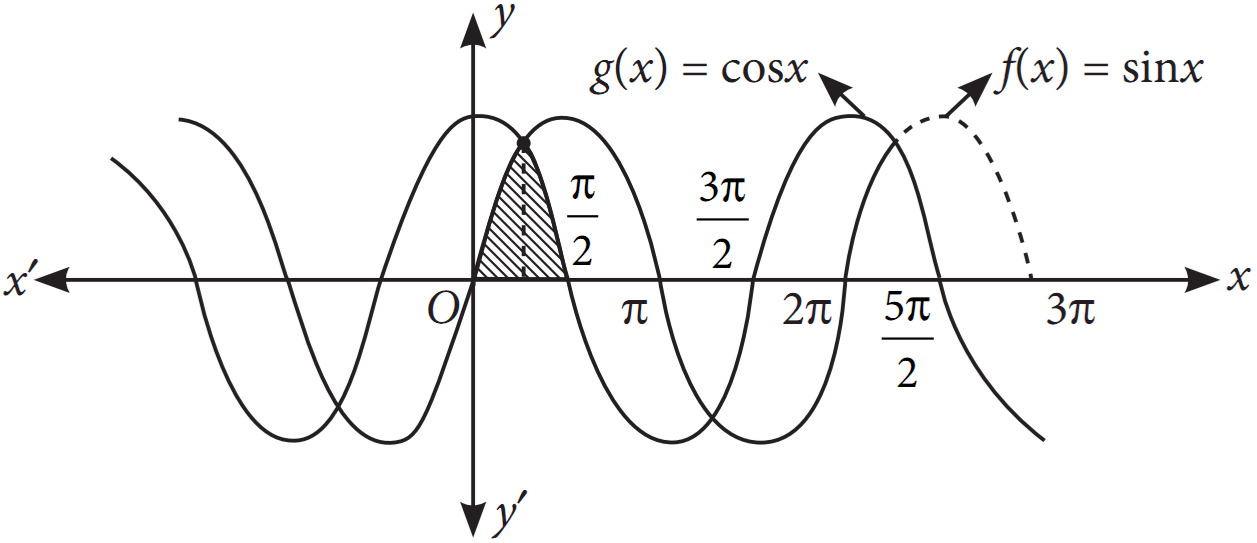
Graphs of two function $\text{f}(\text{x})=\text{sin}\text{ x}$ and $\text{(g)}\text{x}=\text{cos}\text{ x}$ is given below:

Based on the above information, answer the following questions.
  1. In $(0, \pi)$, the curves $\text{f}(\text{x})=\text{sin}\text{ x}$ and $\text{g}\text{ (x)}=\text{cos}\text{ x}$ at $\text{x}=$
    1. $\frac{\pi}{2}$
    2. $\frac{\pi}{3}$
    3. $\frac{\pi}{4}$
    4. ${\pi}$
  2. Value of $\int\limits_{0}^{\frac{\pi}{4}}\text{sin}\text{ x}\text{ dx}$ is.
    1. $1-\frac{1}{\sqrt{2}}$
    2. $1+\frac{1}{\sqrt{2}}$
    3. $2-\frac{1}{\sqrt{2}}$
    4. $2+\frac{1}{\sqrt{2}}$
  1. Value of $\int\limits_\frac{\pi}{4}^{\frac{\pi}{2}}\text{cos}\text{ x}\text{ dx}$ is.
    1. $1+\frac{1}{\sqrt{2}}$
    2. $1-\frac{1}{\sqrt{2}}$
    3. $2-\sqrt{2}$
    4. $2+\sqrt{2}$
  2. Value of $\int\limits_{0}^{\pi}\text{sin}\text{ x}\text{ dx}$ is.
  1. 0
  2. 1
  3. 2
  4. -2
  1. Value of $\int\limits_{0}^\frac{\pi}{2}\text{sin}\text{ x}\text{ dx}$ is.
  1. 0
  2. 1
  3. 3
  4. 4