Question
Fill in the blanks.
In a LPP, the objective function is always ________.

Answer

In a LPP, the objective function is always linear.Solution:
In a LPP, the objective function is always linear.

Need a full question paper?

Generate a complete, print-ready paper with questions like this in minutes — across 16+ boards, with answer keys.
Start Generating Free

Similar questions

Fill in the blanks.
The vector equation of the line through the points (3, 4, -7) and (1, -1, 6) is __________.
Fill in the blanks.
The vector equation of the line $\frac{\text{x}-5}{3}=\frac{\text{y}+4}{7}=\frac{\text{z}-6}{2}$ is _________.
Fill in the blanks.
General solution of the differential equation of the type $\frac{\text{dy}}{\text{dx}}+\text{P}_1\text{x}=\text{Q}_1$ is given by _________.
If $A =\left[\begin{array}{cc}\frac{1}{3} & 2 \\ 0 & 2 x-3\end{array}\right], B =\left[\begin{array}{cc}3 & 6 \\ 0 & -1\end{array}\right]$ and $AB = I$, then $x=$  __________ .
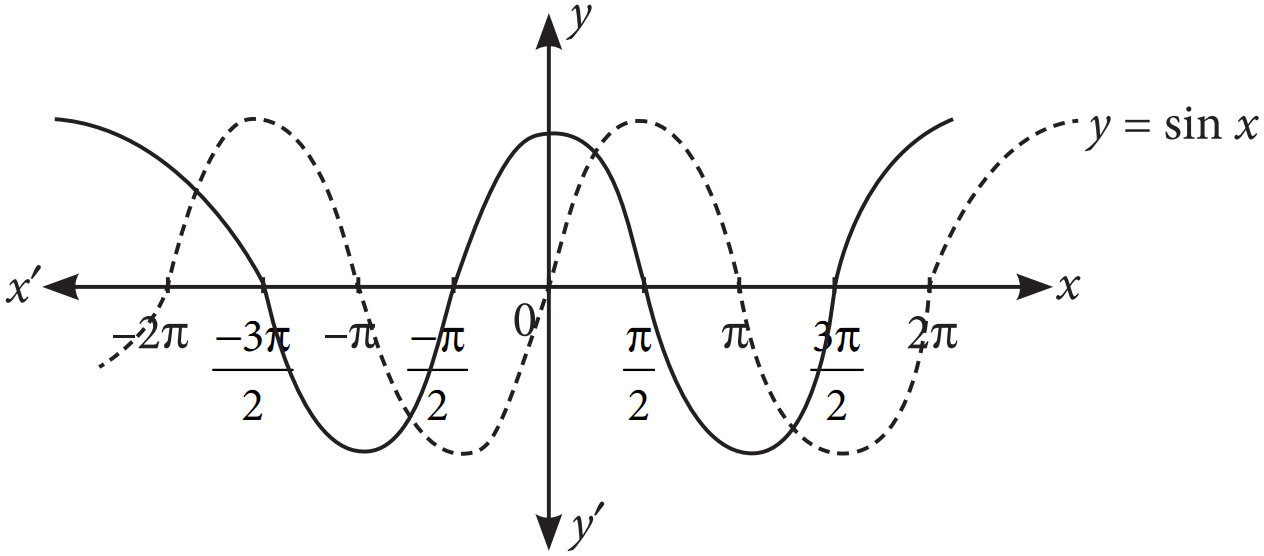
In a classroom, teacher explains the properties of a particular curve by saying that this particular curve has beautiful up and downs. It starts at 1 and heads down until $\pi$ radian, and then heads up again and closely related to sine function and both follow each other, exactly $\frac{\pi}{2}$ radians apart as shown in figure.

Based on the above information, answer the following questions.
  1. Name the curve, about which teacher explained in the classroom.
  1. Cosine
  2. Sine
  3. Tangent
  4. Cotangent
  1. Area of curve explained in the passage from 0 to $\frac{\pi}{2}$ is.
  1. $\frac{1}{3}\text{ sq.unit}$
  2. $\frac{1}{2}\text{ sq.unit}$
  3. ${1}\text{ sq.unit}$
  4. ${2}\text{ sq.units}$
  1. Area of curve discussed in classroom from $\frac{\pi}{2}$ to $\frac{3\pi}{2}$ is.
  1. -2 sq. units
  2. 2 sq. units
  3. 3 sq. units
  4. -3 sq. units
  1. Area of curve discussed in classroom from $\frac{3\pi}{2}$ to $2\pi$ is.
  1. 1 sq. unit
  2. 2 sq. units
  3. 3 sq. units
  4. 4 sq. units
  1. Area of explained curve from 0 to $2\pi$ is.
  1. 1 sq. unit
  2. 2 sq. units
  3. 3 sq. units
  4. 4 sq. units
If $A =\left[\begin{array}{lll}3 & 0 & 0 \\ 0 & 3 & 0 \\ 0 & 0 & 3\end{array}\right]$, then $A ^4=$ _________ .
The value of $\tan ^2\left(\sec ^{-1} 3\right)+\cot ^2\left(\operatorname{cosec}^{-1} 4\right)$ is. _______
Any point of the feasible region which given the optimal value (maximum or minimum value) of the objective function is called __________ .
Fill in the blanks: If $A$ is invertible matrix of order $3 \times 3,$ then $|A^{-1}| ..........$
Two vectors $\vec{a}$ and $\vec{b}$ are called equal vectors if their ___________ .