Question
Fill in the blanks:
$\int\limits^{\frac{\pi}{2}}_0\cos\text{x e}^{\sin\text{x}}\text{dx}$ is equal to_________.

Answer

$\int\limits^{\frac{\pi}{2}}_0\cos\text{x e}^{\sin\text{x}}\text{dx}$ is equal to, $\text{e}-1$
​​​​​Solution:
Let $\text{I}=​​​​\int\limits^{\frac{\pi}{2}}_0\cos\text{x e}^{\sin\text{x}}\text{dx}$
Put $\sin\text{x}=\text{t}\Rightarrow\cos\text{x dx}=\text{dt}$
As $\text{x}\rightarrow0,$ then $\text{t}\rightarrow0$
and $\text{x}\rightarrow\frac{\pi}{2},$ then $\text{t}\rightarrow1$
$\therefore\ \text{I}=\int\limits^1_0\text{e}^\text{t}\text{dt}=\big[\text{e}^\text{t}\big]^1_0$
$=\text{e}^1-\text{e}^0=\text{e}-1$

Need a full question paper?

Generate a complete, print-ready paper with questions like this in minutes — across 16+ boards, with answer keys.
Start Generating Free

Similar questions

Fill in the blanks:
The value of $\int\limits^\pi_{-\pi}\sin^3\text{x}\cos^2\text{x dx}$ is _______.
Fill in the blanks: If $\text{f(x)}=\begin{vmatrix}(1+\text{x})^{17}&(1+\text{x})^{19}&(1+\text{x})^{23}\$1+\text{x})^{23}&(1+\text{x})^{29}&(1+\text{x})^{34}\$1+\text{x})^{41}&(1+\text{x})^{43}&(1+\text{x})^{47}\end{vmatrix}=\text{A}+\text{Bx}+\text{Cx}^2+\ \dots,$ then $A =.........$
Fill in the blanks:
If $\text{f(x)}=|\cos\text{x}-\sin\text{x}|,$ then $\text{f}'\Big(\frac{\pi}{3}\Big)=$ _______.
$f(x)=2 x$, for $f: N \rightarrow N$, is. ________ but not onto.
Any point of the feasible region which given the optimal value (maximum or minimum value) of the objective function is called __________ .
Fill in the blank.
The result $\tan^{-1}\text{x}-\tan^{-1}\text{y}=\tan^{-1}\Big(\frac{\text{x}-\text{y}}{1+\text{xy}}\Big)$ is true when value of xy is _____.
Fill in the blanks:
If $A$ is a matrix of order $3 \times 3,$ then $(A^2)^{-1} =$ ________.
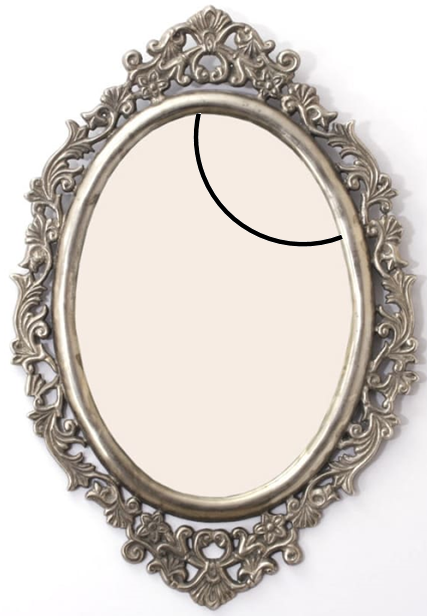
A mirror in the shape of an ellipse represented by $\frac{\text{x}^2}{9}+-\frac{\text{y}^2}{4}=1$ was hanging on the wall. Arun and his sister were playing with ball inside the house, even their mother refused to do so. All of sudden, ball hit the mirror and got a scratch in the shape of line represented by $\frac{\text{x}}{3}+\frac{\text{y}}{2}=1$ Based on the above information, answer the following questions.
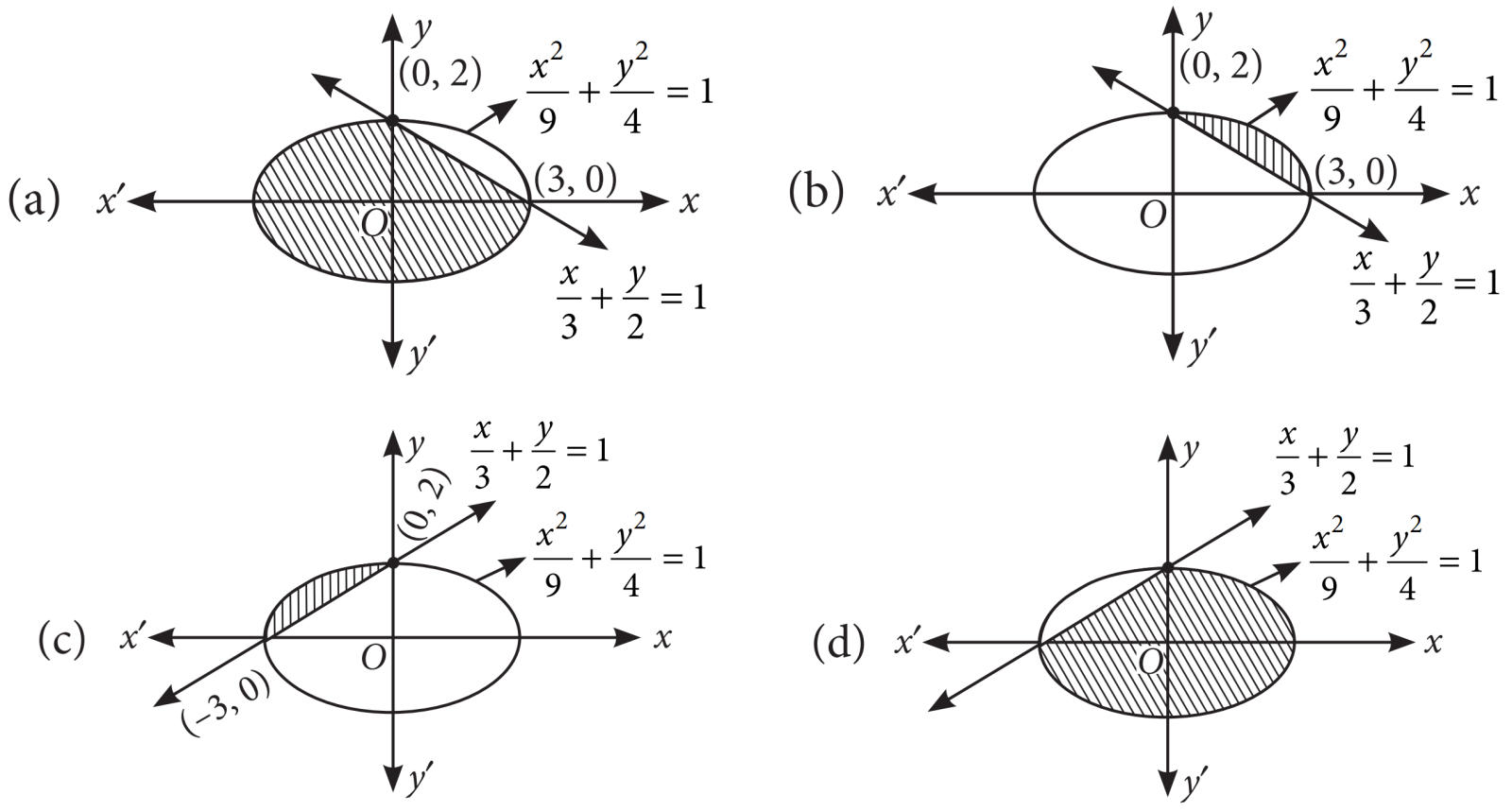
  1. Point(s) of intersection of ellipse and scratch (straight line) is (are).
  1. (0, 2), (3, 0)
  2. (2, 0), (3, 0)
  3. (2, 3), (0, 0)
  4. (0, 3), (3, 0)
  1. Area of smaller region bounded by the ellipse and line is represented by.
  1. The value of $\frac{2}{3}\int\limits_{0}^{3}\sqrt{9-\text{x}^2}\text{dx}$ is.
    1. $\frac{\pi}{2}$
    2. $\pi$
    3. $\frac{3\pi}{2}$
    4. $\frac{\pi}{4}$
  1. The value of  $2\int\limits_{0}^{3}\bigg(1-\frac{\text{x}}{3}\bigg)\text{dx}$ is.
    1. 0
    2. 1
    3. 2
    4. 3
  1. Area of the smaller region bounded by the mirror and scratch is.
  1. $3\Big(\frac{\pi}{2}+1\Big)\text{ sq.units}$
  2. $\Big(\frac{\pi}{2}+1\Big)\text{ sq.units}$
  3. $\Big(\frac{\pi}{2}-1\Big)\text{ sq.units}$
  4. $3\Big(\frac{\pi}{2}-1\Big)\text{ sq.units}$
If direction ratios of a line are $1,1,-1$ then its direction cosines will be………
If $y=x+e^x$ then $\frac{d^2 y}{d x^2}=$ _________ .