Question
Fill in the blanks.
The vector $\vec{\text{a}}+\vec{\text{b}}$ bisects the angle between the non-collinear vectors $\vec{\text{a}}$ and $\vec{\text{b}}$ if _________.
Answer

The vector $\vec{\text{a}}+\vec{\text{b}}$ bisects the angle between the non-collinear vectors $\vec{\text{a}}$ and $\vec{\text{b}}$ if $\vec{\text{a}}=\vec{\text{b}}.$Solution:
If vector $\vec{\text{a}}=\vec{\text{b}}$ bisects the angle between the non-collinear vectors, then $\vec{\text{a}}\cdot(\vec{\text{a}}+\vec{\text{b}})=|\vec{\text{a}}|\cdot|\vec{\text{a}}+\vec{\text{b}}|\cos\theta$ $\vec{\text{b}}\cdot(\vec{\text{a}}+\vec{\text{b}})=\text{b}\sqrt{\text{a}^2+\text{b}^2}\cos\theta$ $\Rightarrow\cos\theta=\frac{\vec{\text{a}}\cdot(\vec{\text{a}}+\vec{b})}{\text{a}\sqrt{\text{a}^2+\text{b}^2}}\ ....(\text{i})$ And $\vec{\text{b}}\cdot({\vec{\text{a}}}+\vec{\text{b}})=|\vec{\text{b}}|\cdot|\vec{\text{a}}+\vec{\text{b}}|\cos\theta$ [since, $\theta$ should be same] $\Rightarrow\cos\theta=\frac{\vec{\text{b}}\cdot(\vec{\text{c}}+\vec{b})}{\text{b}\sqrt{\text{a}^2+\text{b}^2}}\ ....(\text{ii})$ From equations (i) and (ii), we get: $\Rightarrow\frac{\vec{\text{a}}\cdot(\vec{\text{a}}+\vec{b})}{\text{a}\sqrt{\text{a}^2+\text{b}^2}}=\frac{\vec{\text{b}}\cdot(\vec{\text{c}}+\vec{b})}{\text{b}\sqrt{\text{a}^2+\text{b}^2}}$ $\Rightarrow\frac{\vec{\text{a}}}{|\vec{\text{a}}|}=\frac{\vec{\text{b}}}{|\vec{\text{b}}|}$ $\therefore\vec{\text{a}}=\vec{\text{b}}$ Thus, the vector $\vec{\text{a}}+\vec{\text{b}}$ bisects the angle between the non-collinear vector $\vec{\text{a}}$ and $\vec{\text{b}},$ if $\vec{\text{a}}$ and $\vec{\text{b}}$ are equal vectors.

Need a full question paper?

Generate a complete, print-ready paper with questions like this in minutes — across 16+ boards, with answer keys.

Start Generating Free

Similar questions

Fill in the blanks.
$\frac{\text{dy}}{\text{dx}}+\frac{\text{y}}{\text{x}\log\text{x}}=\frac{1}{\text{x}}$ is an equation of the type _________.
Fill in the blanks.
Let X be a random variable taking values $x_1, x_2, ......, x_n$ with probabilities $p_1, p_2, ..., p_n,$ respectively. Then var (X) = ________.
Fill in the blanks:
$\int\limits^{\frac{\pi}{2}}_0\cos\text{x e}^{\sin\text{x}}\text{dx}$ is equal to_________.
If A has a symmetric matrix then $B ^{ T } AB$ has ________ matrix.
Fill in the blank.
The set of values of $\sec^{-1}\Big(\frac{1}{2}\Big)$ is __________.
Fill in the blanks.
If $\vec{\text{a}}$ is any non-zero vector, then $(\vec{\text{a}}\cdot\vec{\text{i}})\vec{\text{i}}+(\vec{\text{a}}\cdot\vec{\text{j}})\vec{\text{j}}+(\vec{\text{a}}\cdot\vec{\text{k}})\vec{\text{k}}$ equal ________.
For set A , relation R is known as _________ if every $a_1$, $a_2, a_3 \in A,\left(a_1, a_2\right) \in R$ and $\left(a_2, a_3\right) \in R$ then also $\left(a_1, a_3\right) \in R$.
Fill in the blanks:
$\int\limits^{\frac{\pi}{2}}_0\cos\text{x e}^{\sin\text{x}}\text{dx}$ is equal to_________.
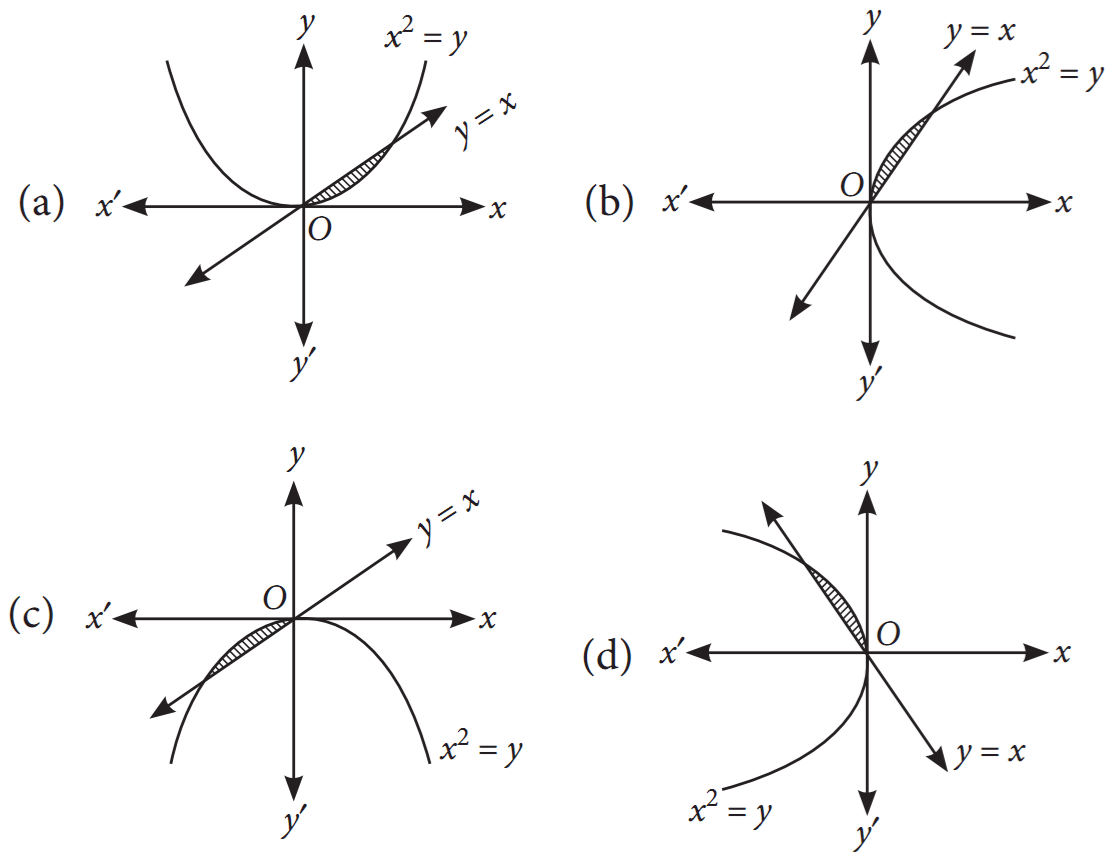
Consider the following equations of curves $x^2= y$ and $y = x.$
On the basis of above information, answer the following questions.
  1. The point(s) of intersection of both the curves is (are).
  1. (0, 0)(2, 2)
  2. (0, 0)(1, 1)
  3. (0, 0)(-1, -1)
  4. (0, 0)(-2, -2)
  1. Area bounded by the curves is represented by which of the following graph?
  1. The value of the integral $\int\limits_{1}^{0}\text{x}\ \text{dx}$ is.
  1. $\frac{1}{4}$
  2. $\frac{1}{3}$
  3. $\frac{1}{2}$
  4. $1$
  1. The value of the integral $\int\limits_{0}^{1}\text{x}^2\ \text{dx}$ is.
  1. $\frac{1}{4}$
  2. $\frac{1}{3}$
  3. $\frac{1}{2}$
  4. $1$
  1. The value of area bounded by the curves $x^2= y$ and $x = y$ is.
  1. $\frac{1}{6}\text{ sq}.\text{unit}$
  2. $\frac{1}{3}\text{ sq}.\text{unit}$
  3. $\frac{1}{2}\text{ sq}.\text{unit}$
  4. ${1}\text{ sq}.\text{unit}$
If matrix $A=\left[a_{i j}\right]_{1 \times 3}$ and $\mathrm{a}_{\mathrm{ij}}=\frac{i+j}{2}$, then $\mathrm{A}=$……..