Question
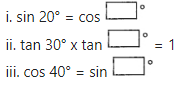
Fill in the blanks.
Image

Answer

i. sin 20° = cos (90° – 20°) …..[∵ sin θ = cos (90 – θ)]
= cos 70°

ii. tan θ x tan (90 – θ) = 1
Substituting θ = 30°,
tan 30° x tan (90 – 30)° = 1
∴ tan 30° x tan 60° = 1

iii. cos 40° = sin (90° – 40°) …[∵ COS θ = sin (90 – θ)]
= sin 50°

Need a full question paper?

Generate a complete, print-ready paper with questions like this in minutes — across 16+ boards, with answer keys.
Start Generating Free

Similar questions

In a competitive exam 50 students passed in English, 60 students passed in Mathematics and 40 students passed in both the subjects. None of them failed in both the subjects. Find the number of students who passed at least in one of the subjects ?
Total income of Ramesh, Suresh and Preeti is ₹ 8,07,000. The percentages of their expenses are 75%, 80% and 90% respectively. If the ratio of their savings is 16 : 17 : 12, then find the annual saving of each of them.
PQRS is a trapezium having PS and QR as parallel sides. A is any point on PQ and B is a point on SR such that AB || QR. If area of $\triangle\text{PBQ}$ is $17cm^2$,
find the area of $\triangle\text{ASR}.$
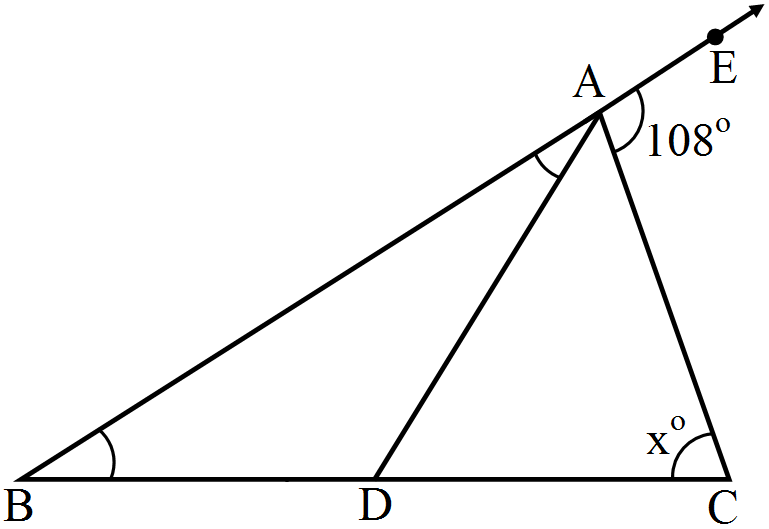
In the given figure, AD divides $\angle\text{BAC}$ in the ratio 1 : 3 and AB = DB. Determine the value of x.
In a competitive examination, there were 60 questions. The correct answer would carry 2 marks, and for incorrect answer 1 mark would be subtracted. Yashwant had attempted all the questions and he got total 90 marks. Then how many questions he got wrong?
In figure, ABCD is a rectangle in which CD = 6cm, AD = 8cm. Find the area of parallelogram CDEF.
In the given figure, ABC is an equilateral triangle; PQ || AC and AC is produced to R such that CR = BP. Prove that QR bisects PC.
Show that the quadrilateral formed by joining the midpoints of the pairs of adjacent sides of a rhombus is a rectangle.
Show that the quadrilateral formed by joining the midpoints of the pairs of adjacent sides of a rectangle is a rhombus.
Use table lito carry out the following activity.
Mr. Pandit is 75 years old. Last year his annual income was ₹ 13,25,000. How much is his taxable income? How much tax does he have to pay? (Textbook pg. no. 103)