Question
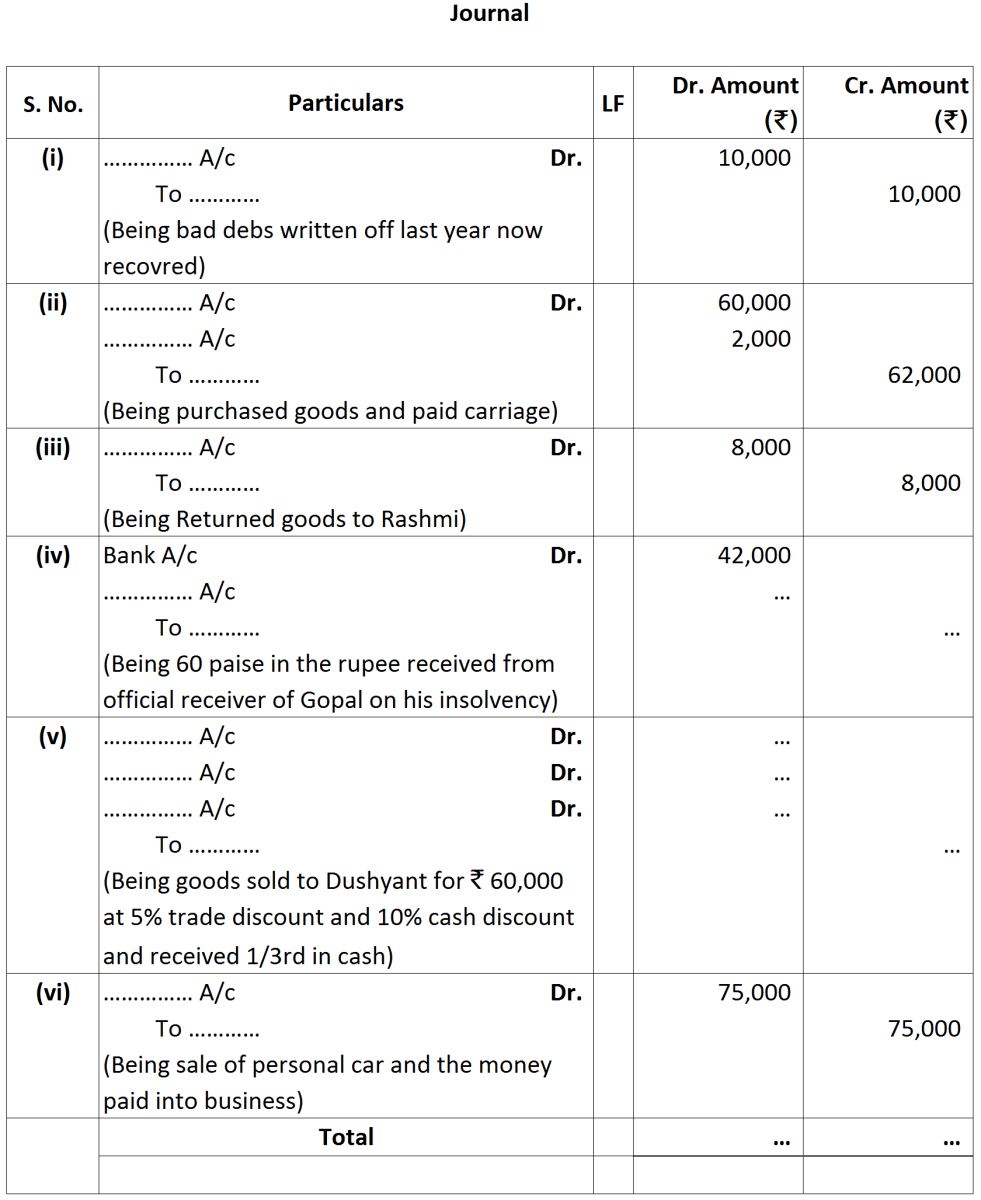
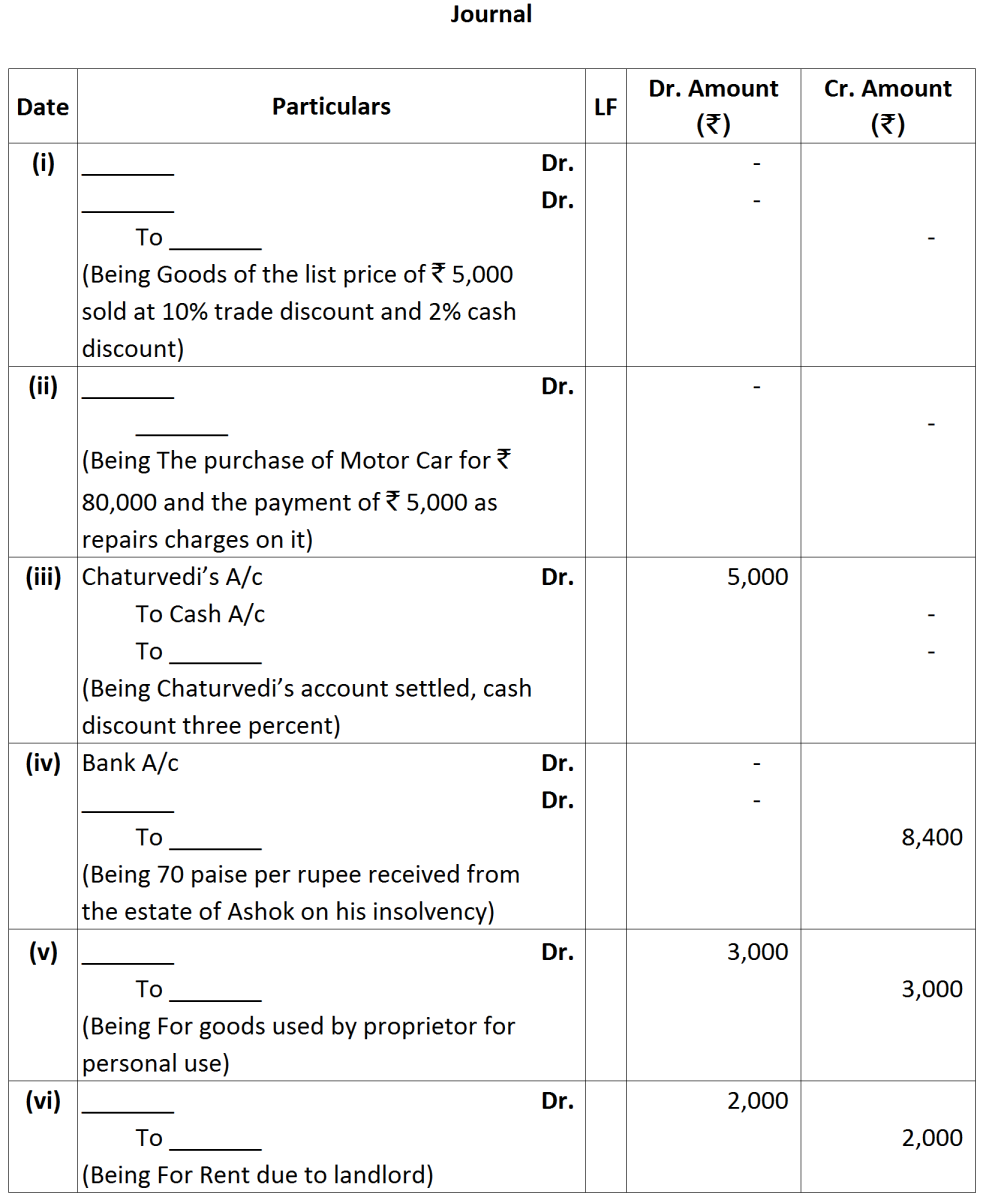
Fill in the missing information in the following journal entries:
Answer

Get the step-by-step solution for this question inside the Vidyadip app.

Get the answer in the app

Need a full question paper?

Generate a complete, print-ready paper with questions like this in minutes — across 16+ boards, with answer keys.
Start Generating Free

Similar questions

Rectify the following errors by means of Journal entries:
  1. A cheque of ₹ 5,000 received from Ashish was dishonoured and was debited to Discount Account.
  2. Purchase of ₹ 540 from Ramneek was written in Sales day book, but was correctly posted to correct side of Ramneek’s Account.
  3. Salary paid to Miss Yugakshi ₹ 1,000 was debited to her personal account as ₹ 900.
  4. Furniture costing ₹ 500, purchased from Jyoti, was wrongly entered in Purchase book as ₹ 450.
What are the different types of errors that are usually committed in recording business transaction.
Explain the meaning of any three of the following terms:
Consistency.
Give the journal entries corresponding to the narration given below:
Record the following transactions of Keshav Bros. in the proper books:
2017
 
Jan. 1
 
Assets: Cash in hand ₹ 8,500; Cash at Bank ₹ 1,40,000; Stock of goods ₹ 2,20,000; Due from Manohar Lal ₹ 30,000 and Deep Chand ₹ 24,000; Furniture and Equipment ₹ 3,00,000.
Liabilities: Due to Sunil ₹ 15,000.
Jan. 2
Withdrawn from bank ₹ 20,000.
Jan. 4
Paid salaries ₹ 22,000.
Jan. 6


Sold goods to Surya Narain:
60 metres silk @ ₹ 150 per metre
100 metres cotton @ ₹ 70 per metre
Less: Trade Discount @ $12\frac{1}{2}\%$
Jan. 8
Surya Narain returned 40 metres Cotton.
Jan. 9
Received full payment from Manohar Lal by cheque, sent it to bank, Discount allowed 3%.
Jan. 10


Purchased from Ganga Parshad:
300 metres cotton @ ₹ 60 per metre
500 metres silk @ ₹ 120 per metre
Less: Trade Discount 10%.
Jan. 12
Sold goods to Vinita for cash ₹ 16,000.
Jan. 13
Accepted a bill for ₹ 25,000 for 30 days drawn by Ganga Parshad.
Jan. 15
Gave cheque to Ganga Parshad for ₹ 45,000, discount allowed by him ₹ 200.
Jan. 18
Paid to Sunil ₹ 14,850 after receiving discount of 1%.
Jan. 20
Mr. Keshav Chand took away 5 metres silk costing ₹ 100 per metre for his personal use.
Jan. 24
Paid rent by cheque ₹ 2,000.
Jan. 25
Received from Surya Narain ₹ 11,000 in full settlement of his account.
Jan. 27
Old newspapers sold for cash ₹ 400.
Jan. 27
Paid for stationery and postage ₹ 500.
Jan. 28
Sold 400 metres silk @ ₹ 160 per metre to Sh. Ganesh Chand.
Jan. 31
Received cash ₹ 40,000 from Sh. Ganesh Chand and also received a B/R from him for the balance amount due from him for 2 months.
Record journal entries for the following transactions in the books of Anudeep of Delhi:
  1. Bought goods ₹ 2,00,000 from Kanta of Delhi (CGST @ 9%, SGST @ 9%)
  2. Bought goods ₹ 1,00,000 for cash from Rajasthan (IGST @ 12%)
  3. Sold goods ₹ 1,50,000 to Sudhir of Punjab (IGST @ 18%)
  4. Paid for Railway Transport ₹ 10,000 (CGST @ 5%, SGST @ 5%)
  5. Sold goods ₹ 1,20,000 to Sidhu of Delhi (CGST @ 9%, SGST @ 9%)
  6. Bought Air-Condition for office use ₹ 60,000 (CGST @ 9%, SGST @ 9%)
  7. Sold goods ₹ 1,50,000 for cash to Sunil to Uttar Pradesh (IGST 18%)
  8. Bought Motor Cycle for business use ₹ 50,000 (CGST 14%, SGST @ 14%)
  9. Paid for Broadband services ₹ 4,000 (CGST @ 9%, SGST @ 0%)
  10. Bought goods ₹ 50,000 from Rajesh, Delhi (CGST @ 9%, SGST @ 9%)
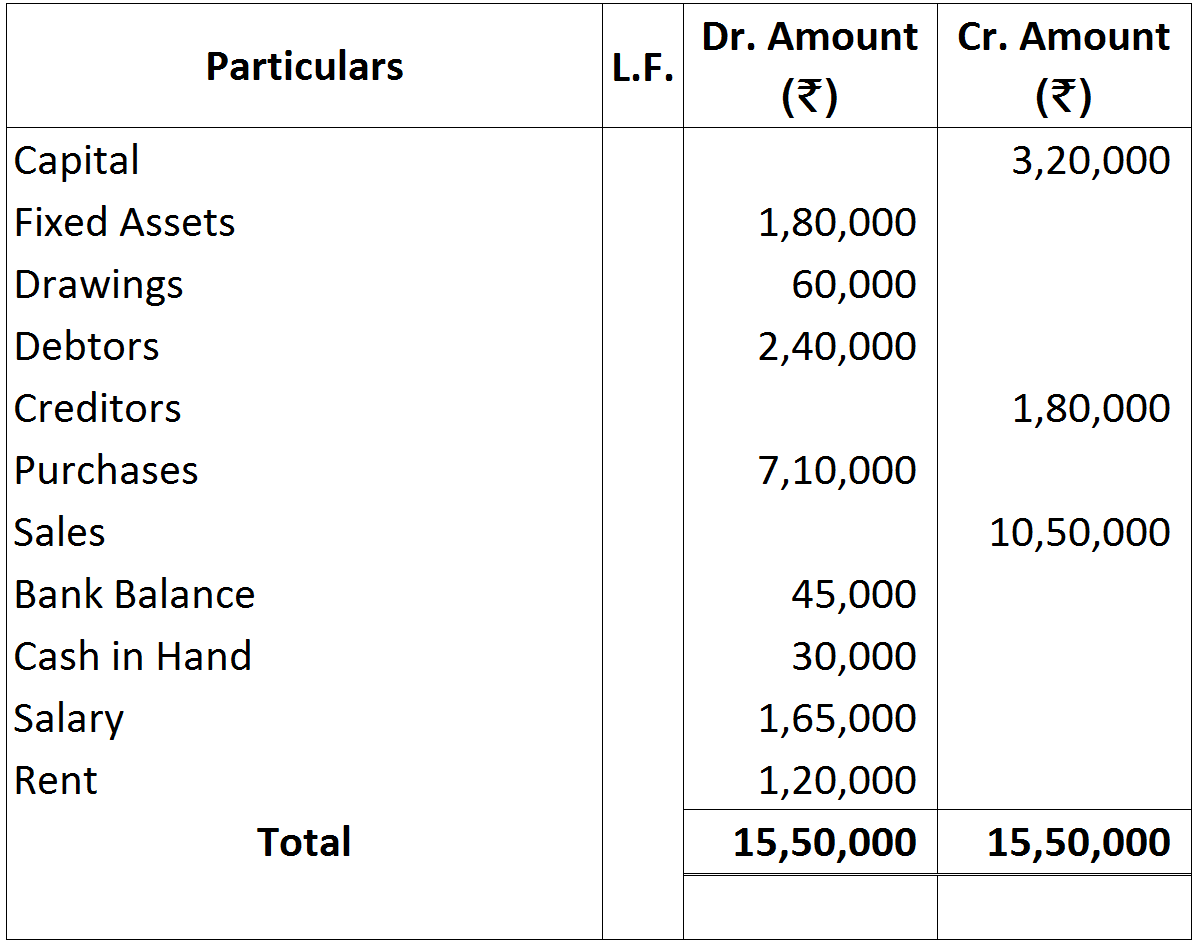
Following is the Trial Balance as at 31st March, 2015: Having prepared the Trial Balance, it was discovered that following transactions remained unrecorded:
  1. Goods were sold on credit amounting to ₹ 40,000.
  2. Paid to creditors ₹ 22,000 by cheque.
  3. Goods worth ₹ 7,000 were returned to a supplier.
  4. Paid salary ₹ 15,000 by cheque.
Required:
  1. Pass Journal entries for the above mentioned transactions and post them into Ledger.
  2. Redraft the Trial Balance.
From the following particulars of a trader, prepare a Bank Reconcilation Statement as on 31st March, 2019.
  1. Bank overdraft as per Cash Book ₹ 52,100.
  2. During the month, the total amount of cheques for ₹ 94,400 were deposited into the bank but of these, one cheque for ₹ 11,160 has been entered into the Pass Book on 5th April.
  3. During the month, cheques for ₹ 89,580 were drawn in favour of creditors. Of them, one creditor for ₹ 38,580 encashed his cheque on 7th April whereas another for ₹ 4,320 have not yet been encashed.
  4. As per instructions the bank on 28th March paid out ₹ 10,500 to a creditor but by mistake, the same has not been entered in the Cash Book.
  5. According to agreement, on 25th March, a debtor deposited directly into the bank ₹ 9,000 but the same has not been recorded in the Cash Book.
  6. In the month of March, the bank without any intimation, debited his account for ₹ 120 as bank charges and credited the same for ₹ 180 as interest.
  7. Cash deposit of ₹ 5,780 in bank was recorded as ₹ 7,580. The error was rectified by the Bank before 31st March, 2019.
Enter the following transactions in the Two Column Cash Book of Mr. Mohan:
2018
 
Jan. 1
Cash in Hand
2,200
Cash at Bank
50,000
Jan. 3
Purchased goods for ₹ 75,000; Trade Discount 20%; CGST 6%, SGST 6%; Payment made by Cheque
 
Jan. 4
Sold goods for ₹ 40,000; Trade Discount 15%; IGST 12%; Payment received by Cheque
 
Jan. 5
Received a cheque from Naresh
1,000
Jan. 8
Cheque received from Naresh endorsed to Suresh in full settlement of his account of ₹ 1,050
 
Jan. 10
Paid Life Insurance premium of Mr. Mohan
100
Jan. 13
Received a cheque from Pawan in full settlement of his account of ₹ 750
700
Jan. 16
Pawan's cheque returned dishonoured by bank
 
Jan. 20
Deposited into Bank, balance of Cash in excess of ₹ 250
 
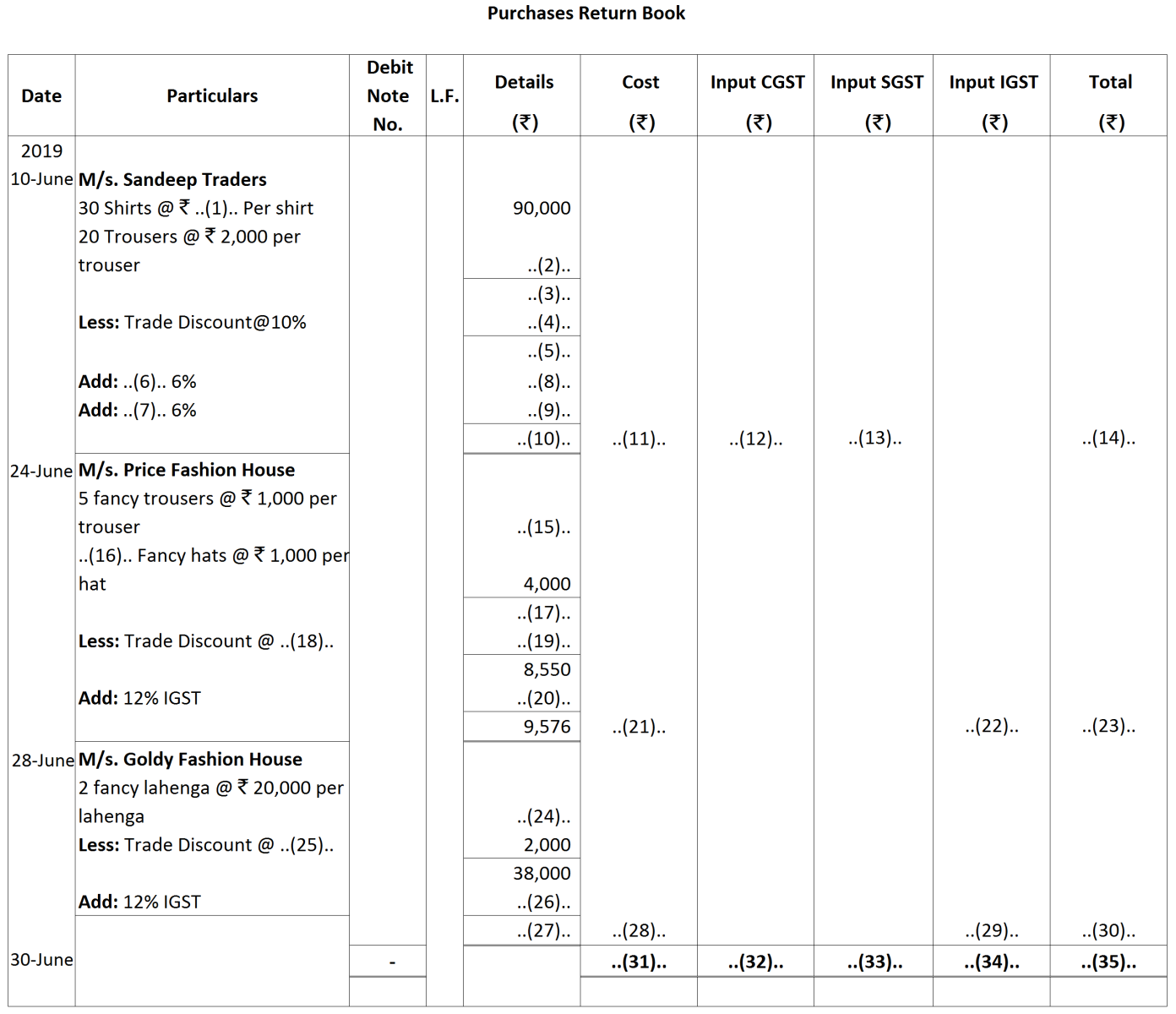
In the following Purchases Return Book, determine the missing information: