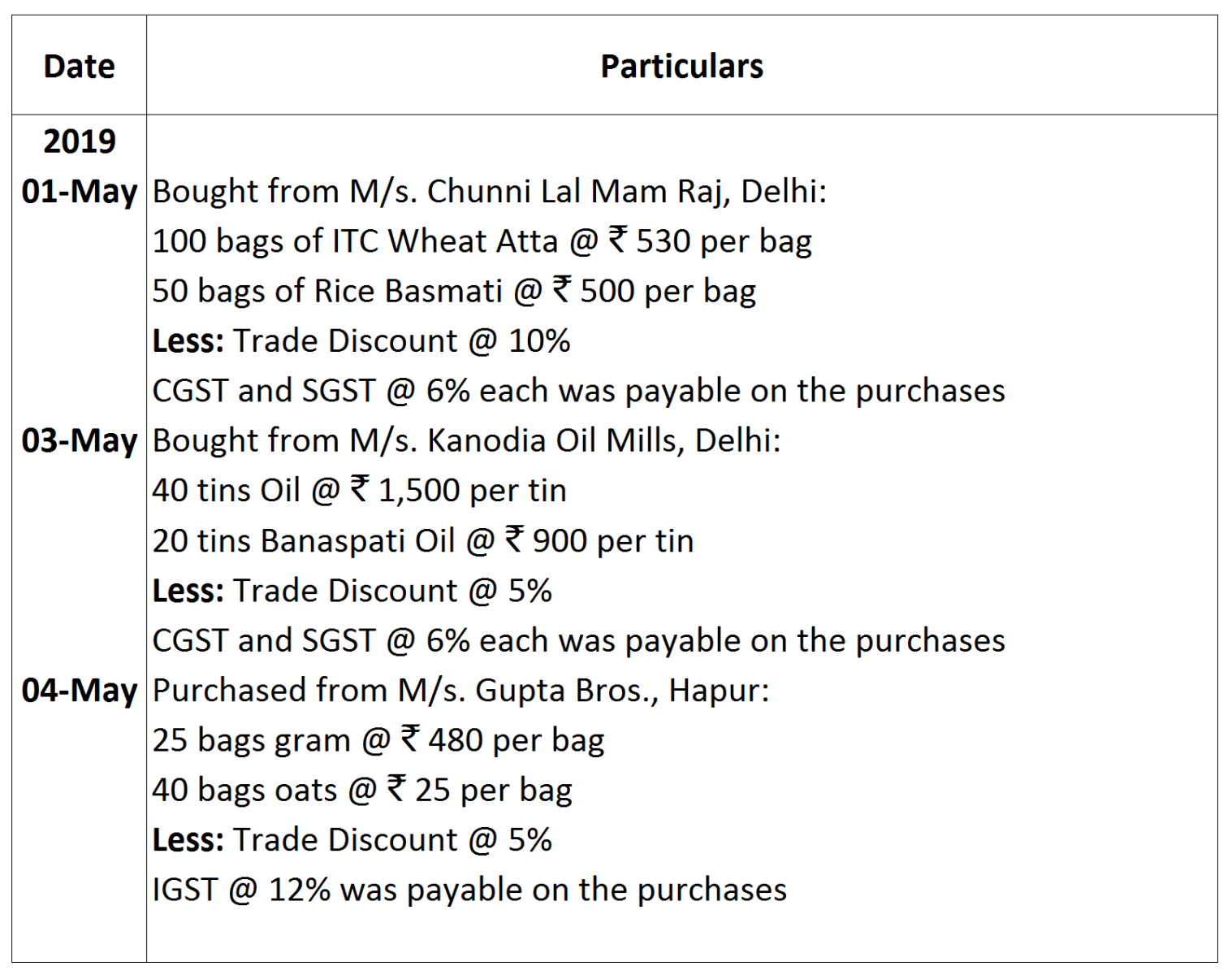
Question
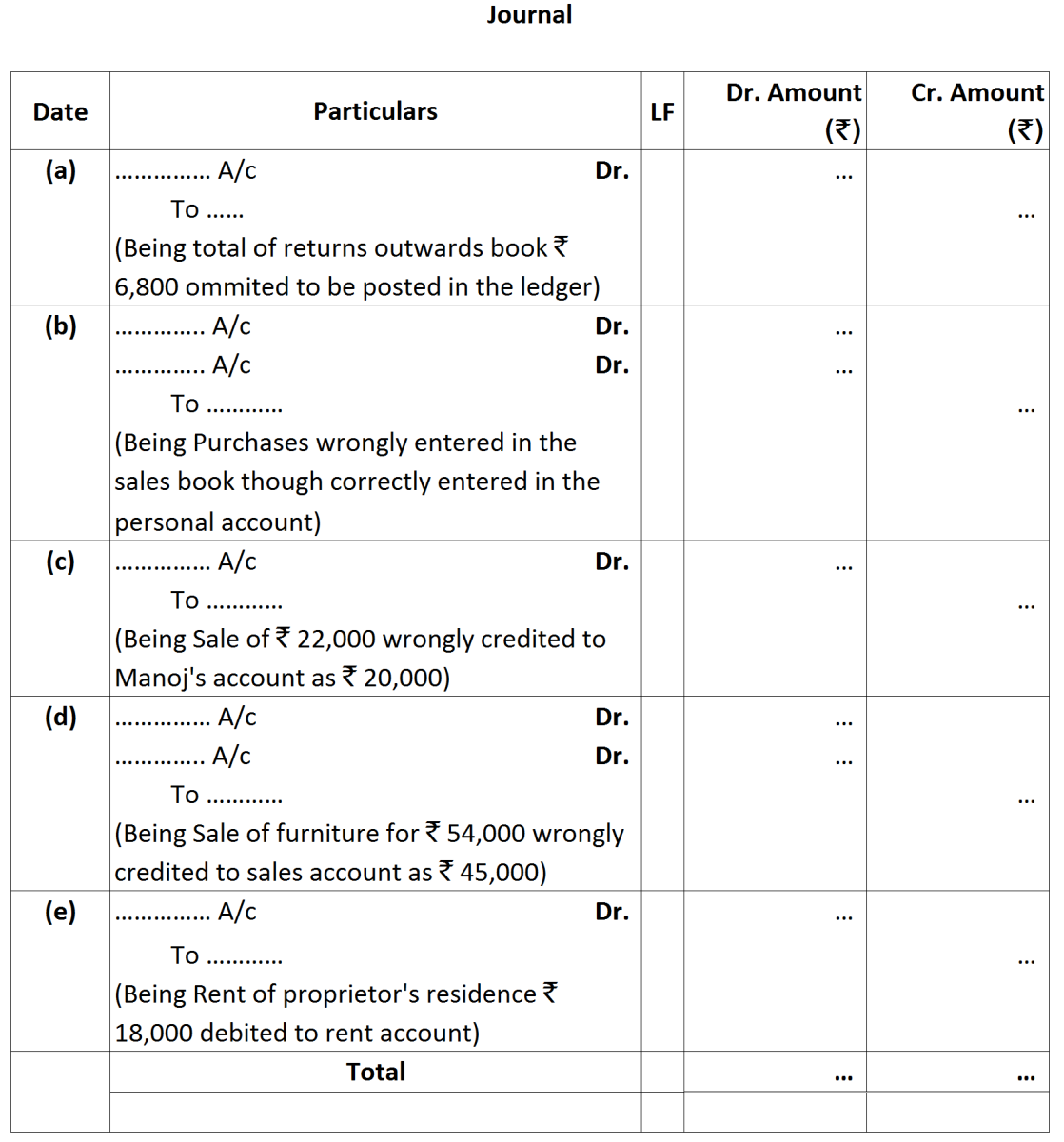
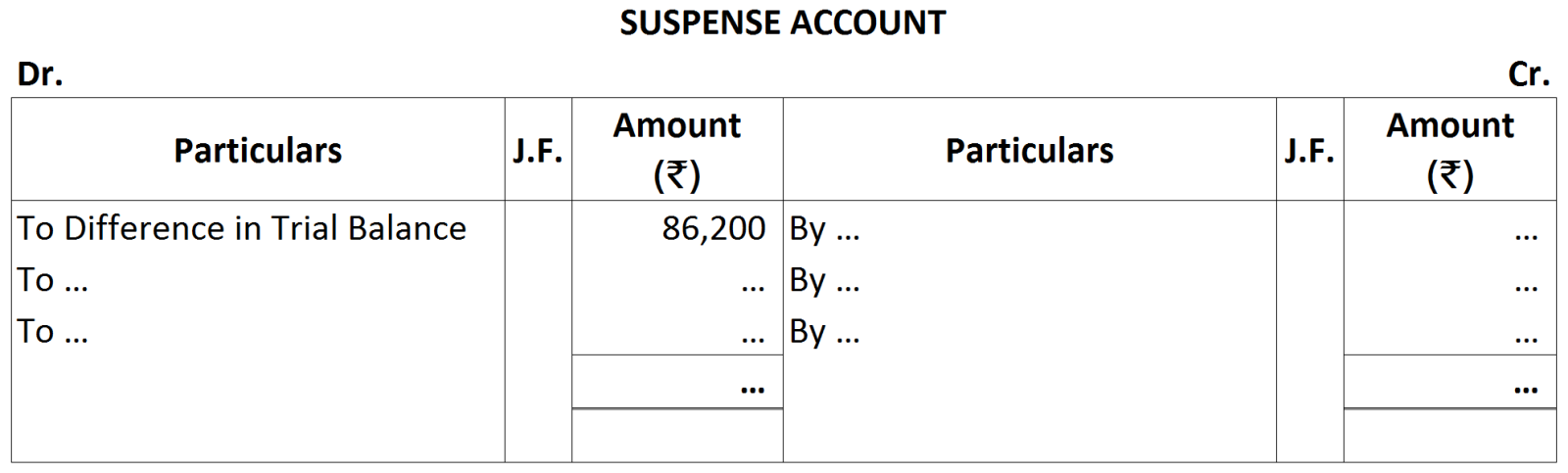
Fill up the missing information in the following rectifying entries:
Answer

Get the step-by-step solution for this question inside the Vidyadip app.

Get the answer in the app

Need a full question paper?

Generate a complete, print-ready paper with questions like this in minutes — across 16+ boards, with answer keys.

Start Generating Free

Similar questions

Following was the position of debtor and creditor of Gautam as on 1.1.2017.
 
Debtors (₹)
Creditors (₹)
Babu
5,000
-
Chanderkala
8,000
-
Kiran
13,500
-
Anita
14,000
-
Anju
-
5,000
Sheiba
-
12,000
Manju
-
6,000
 
 
The following transactions took place in the month of Jan 2017:
Jan 2
Drew on Babu at two months after date at full settlement for ₹ 4,800. Babu accepted the bill and returned it on 5.1.2017 .
Jan. 04
Babu’s bill discounted for ₹ 4,750.
Jan. 08
Chanderkala sent a promissory note for ₹ 8,000 payable three months after date.
Jan. 10
Promissory note received from Chanderkala discounted for ₹ 7,900.
Jan. 12
Accepted Sheiba draft for the amount due payable two months after date.
Jan. 22
Anita sent his promissory note payable after two months.
Jan. 23
Anita’s promissory note endorsed in favour of Manju.
Jan. 25
Accepted Anju’s draft payable after three months.
Jan. 29
Kiran sent ₹ 2,000 in cash and a promissory note for the balance payable after three months. Record the above transactions in the proper subsidiary books.
Prepare Accounting Equation from the following and also prepare a Balance Sheet:
  1. Raghu started business with Cash ₹ 1,50,000.
  2. Bought goods for cash ₹ 80,000 and on credit for ₹ 40,000.
  3. Goods costing ₹ 75,000 sold at a profit of $33\frac{1}{3}\%.$ Half the payment received in cash.
  4. Goods costing ₹ 10,000 sold for ₹ 12,000 on credit.
  5. Paid for Rent ₹ 2,000 and for salaries ₹ 4,000.
  6. Goods costing ₹ 20,000 sold for ₹ 18,500 for Cash.
The accountant of X prepared the Trial Balance at the end of the year on 31st March, 2015. But there was a difference and the accountant put the difference in a Suspense Account. Rectify the following errors found and prepare the Suspense Account:
  1. The total of the returns outward book ₹ 420 has not been posted in the ledger.
  2. A purchase of ₹ 350 from Y has been entered in the sales book. However Y's Account has been correctly entered.
  3. A sale of ₹ 390 to Z has been credited to his account ₹ 290.
  4. Old furniture sold for ₹ 5,400 had been posted as ₹ 4,500 in Sales Account.
  5. Goods taken by the proprietor ₹ 500 have not been entered in the books at all.
On 1st January, 2019 for goods sold, Ramesh drew a Bill of Exchange on Mahesh for ₹ 4,000, for a period of 3 months. Mahesh accepts it and returns to Ramesh. Ramesh then endorses it to Mukesh who in turn endorses it to Suresh on 1st February, 2019. The bill is then discounted by Suresh on the same date with his bank at 5% p.a. On the due date the bill is dishonoured.
Pass the necessary Journal entries in the books of all the four parties.
Record the following transactions in the Purchases Book of Subhash General Stores, Delhi:
Classify the following into Assets, Liabilities, Capital, Expenses and Revenue:
i Land ii Investments
iii Building iv Interest Received
v Salary vi Bank Overdraft
vii Debtors viii Creditors
ix Bad Debts x Capital
xi Depreciation xii Motor Vehicles
xiii Freight xiv Wages
xv Goodwill xvi Repairs.
On 1st February 2018, A sold goods to B for ₹ 40,000 Charging CGST and SGST @ 9% each. B pays ₹ 17,200 in cash and accepted a three months bill for the balance. On the due date, B expressed his inability to meet the bill and offered ₹ 12,000 in cash and to accept a new bill for one month for the balance plus interest at 18% p.a. A agrees to the proposal. On the due date the bill was duly honoured by B. Pass entries in the books of A and B.
Enter the following transactions in proper Subsidiary Books and post them into Ledger:
2017
 
March 2
Purchased from Navrang Traders for ₹ 8,300
March 3
Sold goods to Rohan for ₹ 3,200
March 5
Bought of Ruchi Traders for ₹ 12,100
March 8
Rohan returns the goods for ₹ 600
March 10 Purchased goods from Jaipur Stores of the list price of ₹ 15,400 less 5% Trade Discount
March 12 Sold goods to Arun Traders for ₹ 18,000 less 15% Trade Discount
March 12 Bought of Amit Traders for ₹ 10,000
March 16 Purchased Machinery from Kirloskar Ltd. ₹ 20,000
March 18 Returned goods to Jaipur Stores for ₹ 800 less 5% Trade Discount
March 19 Arun Traders returned goods for ₹ 3,000, less 15% Trade Discount
March 20 Sales to Kalpna & Co. for ₹ 14,700
March 22 Purchased goods from Navrang Traders ₹ 25,000
March 25 Returns outward to Navrang Traders for ₹ 1,200
March 26 Sales to Rupa Traders for ₹ 10,000 less 10% Trade Discount
March 29 Returns inward from Kalpana & Co. for ₹ 2,000
Prepare Two Column Cash Book from the following transactions and balance the book on 31st Jan., 2014:
2014  
Jan. 1 Cash in hand ₹ 50,000; Bank overdraft ₹ 1,90,000.
Jan. 2 Purchased goods from Rajesh Kumar of the list price of ₹ 50,000 at 5% trade discount and payment made by cheque.
Jan. 6 Goods sold for ₹ 80,000 and payment received by cheque. Cheque deposited into Bank on same day.
Jan. 10 Goods purchased for cash ₹ 19,800.
Jan. 15 Furniture sold for ₹ 1,77,000 and payment received by cheque & cheque deposited into Bank on same day.
Jan. 18 Salaries paid ₹ 4,500.
Jan. 21 Settled the amount due to Ram ₹ 2,000 by paying cash ₹ 1,910.
Jan. 22 Cash received from Jai ₹ 14,780 in full settlement of his account of ₹ 15,000.
Jan. 23 Paid Life Insurance premium ₹ 1,500.
Jan. 31 Deposited with bank the entire balance after retaining ₹ 7,000 cash in hand.
Explain the meaning of any three of the following terms:
Conservatism.